Pharmaceutical R&D is at an inflection point.
Consider that small molecules accounted for 65% of FDA novel drug approvals in 2025. That is a jump from 56% in both 2023 and 2024. The note that even as biologic sales are growing three times faster than their chemical counterparts and are projected to overtake them by 2027. That paradox captures the central tension reshaping pharmaceutical R&D: the old binary was is it a small and large molecule? But now the reality is giving way to a more complex, hybrid-driven landscape.
Adobe
The global pharma market was estimated at $828 billion in 2018, with 69% of sales from small molecules and 31% from biologics. By 2023, the market had grown to $1344 billion, with 58% small molecules and 42% biologics. Biologics sales are growing three times faster than small molecules, with some analysts predicting that they will outstrip small molecule sales by 2027.
Drug discovery is shifting from broad-spectrum to precision medicine. Advances in genomics, target biology and AI are enabling researchers to identify and attack diseases with far greater specificity.
“It’s no longer trying to shotgun blast a whole bunch of things, but instead trying to sniper and be really tight in what we’re attacking,” said Andreas Matern, vice president of professional services at Elsevier.
Pharmaceutical companies are using more biological intelligence before committing to a modality, aiming to understand the target, genomics and patient population before pursuing development.
Meanwhile, AI is compressing timelines, generating hypotheses and informing modality selection. AlphaFold, generative chemistry and large language models are being layered on top of proprietary and public datasets to unlock new insights.
“Most programs fail in the clinic because of the early stages of the decision-making process. The focus of the next few years needs to be on increasing the success rate (the yield), rather than just efficiency. AI must help us select the right therapeutic hypotheses and the right patient populations from the start,” said Daphne Koller, CEO and founder of Insitro, at the Danaher Summit.
Defining the modalities
Small molecules are chemically synthesized compounds, typically with molecular weights below 900 Daltons. These molecules are small enough to cross cell membranes, enabling intracellular target access.
These medicines are generally orally bioavailable, stable at room temperature and manufacturable at scale. They also have well-established regulatory and manufacturing pathways and a lower cost of goods. Small molecules have historically been the dominant paradigm in pharma.
Large molecules are derived from living organisms, including cells, proteins and nucleic acids. These are far more structurally complex than small molecules, weighing more than 1,000 Daltons. These medicines cannot cross cell membranes easily and generally require injection or infusion. Examples of large molecules include monoclonal antibodies, antibody-drug conjugates, mRNA therapies, CAR-T cell therapies and engineered peptides like GLP-1 agonists. Large molecules are highly specific to their targets, lowering off-target toxicity, but are more complex to manufacture and store, typically requiring cold storage.

CAR-T cell therapy. Adobe.
The choice between modalities is driven by target biology. Key considerations include specificity, patient population and whether the target is intracellular or extracellular. Data platforms are increasingly central to answering these questions, aggregating published research, clinical data and pipeline intelligence to inform decisions.
“The choice of modality — whether I use a small molecule or any number of the large molecules — really comes down to understanding your target, understanding the biology,” said Matern.
Historically, small molecules could only target a subset of disease-relevant proteins, those with well-defined binding pockets. An estimated 80% of the human proteome is considered undruggable by traditional small molecules. This limitation has been a key driver of biologic development. Antibodies and other large molecules can engage targets that small molecules cannot.
The binary of small versus large molecules is increasingly a false dichotomy. A growing class of hybrid and intermediate modalities, including ADCs, PROTACs and RNA-small molecule conjugates, deliberately combine properties of both.
Market Landscape and R&D Investment
The global small molecule drug discovery market was valued at $61.9 billion in 2025 and is projected to reach $103 billion by 2031. Despite predictions of biologic dominance, small molecules accounted for 62% of FDA novel drug approvals in 2024 and 72% in early 2025. This has been driven by AI-accelerated hit identification and lead optimization, as well as oral delivery innovation. This trend is reflected in IQVIA’s 2024 data, where Murray Aitken notes that while biologics drive market value, small molecules are seeing a ‘technological upgrade’ through induced proximity and oral delivery breakthroughs.
The global biologics market reached $349 billion in 2023 and is projected to reach $1.077 trillion by 2035. Biosimilar competition is intensifying as blockbuster biologics lose patent protection. Still, innovation pipelines remain robust. Biologic growth has been driven by the expansion of ADC approvals, mRNA platform technology, CAR-T and cell/gene therapy scaling and RNA-based therapies gaining regulatory traction.
How companies approach modality investment is heavily shaped by their size, infrastructure and strategic goals. Large pharma companies have diversified portfolios spanning small molecules, biologics and emerging modalities. They can absorb risk across therapeutic areas and have manufacturing infrastructure to scale modalities. Biotech companies are typically platform-driven, built around a specific modality or technology. This has higher risk concentration but faster, more focused innovation.
“Large pharma has the privilege of running diversified portfolios across molecules, biologics — maybe they can try newer modalities so they can balance some of that risk across different therapeutic areas. Whereas smaller biotechs are often built around a specific platform… a lot of biotechs are built around, ‘we have a really clever way of doing this modality — so what can we point this modality at?” explained Matern.
This dynamic is fueling a robust deal-making environment where large pharma acquires or licenses biotech platforms to access novel modalities without building from scratch.
Small molecule R&D: a renaissance underway
For years, the narrative in pharma was that biologics would gradually displace small molecules as the dominant drug modality. Now, that narrative is being challenged. A combination of AI-driven discovery, novel chemical approaches and delivery innovation is opening up previously inaccessible target classes.
Small molecules endure due to several key advantages: oral bioavailability, manufacturing scalability, stability, intracellular access and lower cost of goods. “Small molecules will remain at the foundation because they’re scalable, they’re orally delivered, they’re stable,” Matern predicts. Small molecules will likely remain the default modality for many indications, particularly in metabolic and infectious diseases.
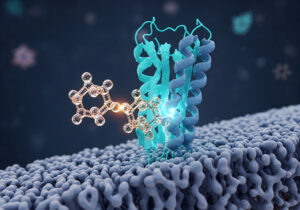
One of the most significant developments in small molecule R&D is the emergence of targeted protein degradation (TPD). Rather than inhibiting a protein’s function, degraders like proteolysis-targeting chimeras (PROTACs) and molecular glues hijack the cell’s own protein disposal machinery to eliminate the target. This approach dramatically expands the druggable target space; proteins that lack a conventional binding pocket, or that are too large or flexible for traditional inhibitors, become accessible.
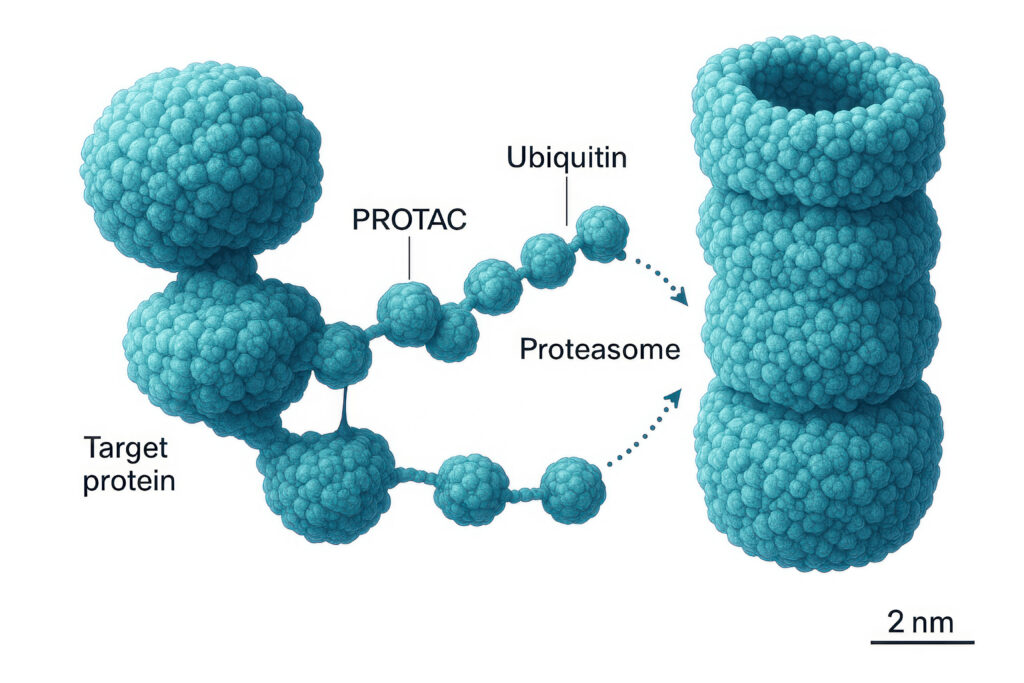
Targeted protein degradation. Adobe.
“Targeted protein degradation allows us to reach broader patient populations compared to injectable biologics. We are developing oral drugs with biologics-like activity, reaching critical signaling nodes that have been historically ‘undruggable’ with traditional inhibitors,” Nello Mainolfi, CEO of Kymera Therapeutics said in a statement.
RNA-targeting molecules mark an emerging frontier: small molecules designed to bind and modulate RNA rather than proteins. Historically, RNA was considered undruggable by small molecules, but advances in structural biology and AI are changing that. These molecules have the potential to address targets upstream of protein expression, including transcription factors and splice sites, that are inaccessible to both traditional small molecules and most biologics.
Last year, Merck Group made a $2 billion partnership with Skyhawk Therapeutics specifically for RNA-targeting small molecules, a strong commercial validation of the approach.
One of the most commercially significant trends in small molecule R&D is the push to make complex molecules orally available, including peptides and other structures that historically required injection. The GLP-1 story is the highest-profile example of this. Semaglutide began as an injectable peptide and is now available as an oral formulation with next-generation oral small molecule GLP-1 agonists in development.
“If you can make complex biological drugs orally available, you expand access, you make them stable, you can deliver them to remote corners of the world without worrying about a cold chain,” Matern said.
Oral peptide technologies could unlock a new generation of drugs that combine the targeting precision of biologics with the convenience and scalability of small molecules.
Large molecule R&D: expanding the frontier
Biologics are in the middle of a full-scale expansion. The biologic pipeline is broader, more diverse and more technically ambitious than at any point in the history of the industry. What began with monoclonal antibodies in the 1980s has evolved into an entire ecosystem of modalities, each with distinct mechanisms, target classes and patient populations.
Monoclonal antibodies. Adobe.
Biologics, particularly monoclonal antibodies, can be engineered to bind a single target with extraordinary precision, minimizing off-target effects. Proteins, receptors and ligands on the cell surface or in circulation are highly accessible to large molecules. Many biologics offer long-lasting effects, some requiring only monthly or even less frequent dosing. From blocking a receptor to delivering a cytotoxic payload to editing a gene, biologics offer a range of mechanisms unavailable to small molecules.
Monoclonal antibodies (mAbs) are still the backbone of the biologic pipeline. They are increasingly engineered for improved half-life, reduced immunogenicity and bispecific targeting. Meanwhile, bispecific antibodies are engineered to engage two targets simultaneously, enabling novel mechanisms like redirecting T cells to kill tumor cells. Another key large molecule is antibody-drug conjugates (ADCs), which combine the targeting precision of an antibody with the cytotoxic potency of a small molecule payload.
mRNA therapies have been emerging since the pandemic, being rapidly diversified into oncology vaccines, rare disease treatments and infectious disease vaccines beyond COVID. Also in the RNA space, siRNA and antisense oligonucleotides (ASOs) are RNA interference approaches that silence disease-causing genes at the mRNA level, gaining approvals in rare disease and cardiovascular indications.
CAR-T cell therapies use patient-derived T cells engineered to recognize and destroy cancer cells. These have been transformative in hematologic malignancies, with solid tumor applications in development. CRISPR and gene editing are also advancing, with the first approved CRISPR therapy to reach patients after being approved in 2023.
Oncology is the single largest driver of biologic R&D investment, and the therapeutic area where the most ambitious large molecule science is being deployed. ADCs in particular have seen a wave of approvals and late-stage pipeline activity, with more than 100 ADCs currently in clinical development globally. Immuno-oncology, including checkpoint inhibitors, CAR-T and bispecifics, continues to expand, moving from hematologic cancers into solid tumors.
The GLP-1 story: a case study in biologic validation at scale
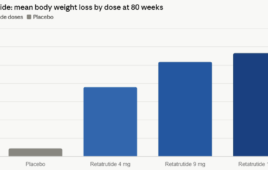
The GLP-1 receptor agonist story illustrates the commercial and scientific power of large molecule R&D. Semaglutide and tirzepatide have become among the best-selling drugs in pharmaceutical history, validating peptide engineering at a scale the industry has never seen.
The GLP-1 story is also about lifecycle innovation, how biologic validation drives small molecule follow-on.
“GLP-1 is really showing how that balance is evolving. They are a peptide-based modality — technically in the large molecule category — but the commercial success is now driving innovation across small molecules: oral delivery and combination therapy,” Matern said. “I think we’ll see that pattern repeat. Historically, many therapies start as injectables because it’s technically simpler to deliver a complicated molecule that way. But once you get the validation of the biology and the commercial demand becomes clear, there’s a really strong investment incentive to invest in more convenient formats.”
The GLP-1 arc from injectable peptide to oral small molecule agonist is likely to become a template for future modality evolution across multiple therapeutic areas.
What this means for stakeholders
For large pharma, the imperative is portfolio diversification across modalities, investment in data infrastructure and strategic acquisition of platform biotechs before valuations reflect clinical validation.
For biotechs, platform focus remains a strength, but the most fundable and partnerable story is one that combines a novel modality with a validated target and a clear path to oral or convenient delivery.
Investors should follow delivery technology and pay attention to the companies solving the last-mile problem of getting complex molecules to their targets safely and conveniently.
For researchers and R&D teams, the data foundation is the new lab bench. Investing in ELNs, ontologies and structured data capture from day one is no longer optional.
Conclusion
The binary between small and large molecules is not a competition. As the gray area between the modalities continues to expand, the modality question becomes more of a spectrum than a binary choice.
“I don’t see small and large molecules competing for dominance. I think there’s going to be a continued balance… small molecules will remain at the foundation because they’re scalable, they’re orally delivered, they’re stable. And biologics will probably be where we continue to expand, where things like precision and durability matter,” Matern said.
The shift from trial and error to data-driven prediction is the most consequential change in drug discovery in a generation. Organizations are increasingly investing in data quality, governance and integration for AI-powered drug discovery.

Adobe
Scientific insight alone is not enough: getting the right drug to the right target in the right patient remains the driving challenge of drug discovery. Lipid nanoparticles, oral peptide technologies, ADC linker chemistry and next-generation formulation science mark the next generation of breakthroughs.
The expansion of the modality toolkit is good news for patients, science and the industry. More tools means more targets, more addressable diseases and more patients reached.
Ultimately, competition is not between modalities, it is between organizations that embrace this complexity and those that do not.
Filed Under: Biologics, Biotech, Precision Medicine