Novo Nordisk has agreed to acquire Akero Therapeutics, a clinical-stage company that develops treatments for metabolic diseases, the company announced last week.

The Novo Nordisk research centre is located on the 3rd floor of the innovation building at Old Road Campus, University of Oxford. Credit: Novo Nordisk
Akero’s EFX pipeline
Akero Therapeutics’ treatment for metabolic-dysfunction-associated steatohepatitis (MASH) “is closely linked with Novo Nordisk’s expertise in diabetes and obesity,” the press release stated. More than 40% of patients with MASH, formerly known as nonalcoholic steatohepatitis (NASH), also have type 2 diabetes, and over 80% of MASH patients are overweight, aligning Akero’s pipeline with Novo Nordisk’s focus in diabetes and obesity. The treatment, a fibroblast growth factor 21 analog efruxifermin (EFX), is currently in phase 3 development for the treatment of moderate to advanced liver fibrosis and cirrhosis.
Akero Therapeutics’ pipeline is built on EFX, which was designed to treat MASH but has the potential to treat other serious metabolic diseases. EFX is engineered to mimic the activity of fibroblast growth factor 21 (FGF21), an endocrine regulator of metabolism. FGF21 acts to reduce production of glucose, fat and low-density lipoproteins. In fat tissue, FGF21 enhances the uptake of glucose from the bloodstream into the fat cells.
“If approved, we believe it (EFX) could become a cornerstone therapy, alone or together with Wegovy,” said Mike Doustdar, President and CEO of Novo Nordisk.
Under the agreement, Novo Nordisk will acquire all outstanding shares of Akero’s common stock at $54 per share in cash, an aggregated value of $4.7 billion. If the FDA approves EFX, the potential contingent value payment brings the equity value to approximately $5.2 billion. The transaction is expected to close by the end of the year.
Keeping up with Eli Lilly
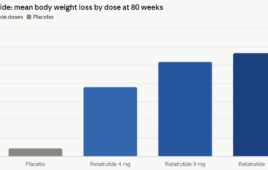
This is the first major deal by Novo’s new CEO, Maziar Mike Doustdar, the first non-Dane to occupy the corner office. Last month, Novo announced a plan to cut 9,000 jobs, and this week laid off dozens of employees at a plant in North Carolina. The company is competing with Eli Lilly’s multi-agonist incretin mimeticss, and they are falling behind. They reported disappointing sales for the first half of 2025. Meanwhile, Lilly is developing one of the frist triple–hormone-receptor agonists, retatrutide. Its blockbusters Zepbound and Mounjaro are both dual-agonist incretins [both based on tirzepatide, targeting GLP-1 and GIP ((glucose-dependent insulinotropic polypeptide)] while Novo’s semaglutide is a pure GLP-1 agonist.
Eli Lilly stock is up 7.08% YTD, while Novo lags behind at -34.81%. Eli Lilly’s two GLP-1 drugs, Mounjaro and Zepbound, generated a combined $14.734 million in sales YTD as of Aug. 7. Comparatively, Novo Nordisk’s GLP-1s generated $7,831.22 million in the first six months of 2025. Studies have shown that tirzepatide could be more effective than semaglutide for weight loss, which could be a factor in Lilly stock’s resilience.
Filed Under: Biologics, Metabolic disease/endicrinology