The Pharma 50 has a new company sitting at the top: Eli Lilly, which last year was in the ninth slot. The next question is how long it can stay there, because pharma sector leadership is, historically, something of a revolving door.
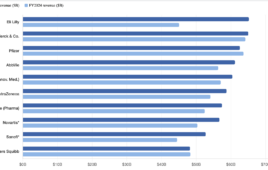
Right now, Lilly’s lead is razor thin. Just $170 million separated Eli Lilly’s revenue ($65.18 billion) from Merck & Co.’s ($65.01 billion) in FY2025 pharmaceutical revenue. And the two CEOs sitting on either side of that margin have chosen to describe their positions in ways that show different theories about what pharma leadership means.
Dave Ricks, Lilly’s chairman and CEO, said in Q4 2025 that there is little precedent for what Lilly has become by convincing so many patients to shell out cash for its incretin therapies. “I am hard pressed to think of an analog where you have this many people paying out of pocket for prescription medication,” he said on the earnings call. “I don’t think there’s a good analog in our industry.” He then laid out the strategic implications: first-party data, subscription pricing models, a consumer platform built to reduce friction.
How Lilly got here, and what could threaten its new lead
As of 2023, Novo Nordisk’s core strategy was to tap semaglutide to transition from treating diabetes alone to capturing the much larger market for metabolic health. Ozempic approved for diabetes in 2017, Wegovy for obesity in 2021. By the time Lilly’s Zepbound won its obesity approval in late 2023, Novo had a two-year head start, the cultural momentum of the “Ozempic era,” and a semaglutide franchise already generating tens of billions in revenue.
How did Lilly catch up? The answer turned on three things, none of which Novo could easily counter. First, the molecule. Tirzepatide is a dual GIP/GLP-1 receptor agonist, meaning it activates two hormonal pathways where semaglutide activates one. In SURMOUNT-5, the first head-to-head obesity trial between the two drugs, tirzepatide beat semaglutide outright: 20.2% mean weight loss versus 13.7% at 72 weeks. Prescribers noticed. By mid-2025, Lilly’s tirzepatide drugs accounted for two-thirds of all patients on obesity medications in the U.S.
In the beginning of 2026, Lilly’s stock is tending downward
Second, supply. Novo spent most of 2023 and 2024 unable to meet demand, with semaglutide on the FDA’s drug shortage list and compounding pharmacies rushing in to fill the gap. Lilly had supply constraints of its own, but invested earlier and more aggressively in manufacturing capacity. By mid-2025, CEO Dave Ricks reported Lilly had “produced more than 1.6 times the amount of salable incretin doses during the first half of 2025 compared to the first half of 2024.” The company is now building additional manufacturing sites and has committed $55 billion in domestic investment, announced at J.P. Morgan in January, partly as a tariff hedge and partly to ensure it never has to cede market share to compounders again.
Third, the consumer pivot. Lilly built LillyDirect into a scaled direct-to-consumer platform that lets patients find, start, and stay on treatment without navigating the traditional pharmacy and insurance maze. On the Q4 call, Ilya Jungerman, Lilly’s chief commercial officer, described it as an effort to “reduce consumer friction.” That’s language borrowed from tech. The out-of-pocket market now represents a significant and growing share of incretin prescriptions, and Lilly has structured its pricing and distribution to capture that channel in a way no pharma company has done before.
Novo’s rise ran out of steam
While Lilly was executing on manufacturing, distribution, and consumer access, Novo was unraveling on multiple fronts. At the time of writing, its stock is trading at $35.29 per share, almost 50% lower than a year ago. The stock is a reflection of a cascade that started roughly in December 2024 when CagriSema, the next-generation obesity drug Novo had positioned as its answer to Zepbound, missed its own 25% weight-loss target in the Phase III REDEFINE 1 trial, coming in at 22.7%. The stock cratered roughly 20% in a single day, wiping out about €90 billion in market value. A second pivotal CagriSema trial in March 2025 fell even further short, showing just 15.7% weight loss in patients with Type 2 diabetes. Then in February 2026, the head-to-head REDEFINE 4 trial delivered the worst blow: CagriSema achieved 23% weight loss at 84 weeks versus 25.5% for tirzepatide, failing to demonstrate noninferiority to Zepbound.
The boardroom turmoil that followed was significant even by pharma standards. CEO Lars Fruergaard Jørgensen was ousted in May 2025. His replacement, Mike Doustdar, was named in late July and took over August 7. Barely a month into the job, Doustdar announced 9,000 layoffs: 11% of Novo’s workforce, including 5,000 in Denmark, one of the largest corporate layoffs in the country’s history. At its mid-2024 peak, Novo’s market capitalization of $570 billion had exceeded the entire GDP of Denmark; its ecosystem accounted for roughly 40% of the country’s exports and nearly half its GDP growth. Then the board itself blew up. In October 2025, Chairman Helge Lund and more than half the board stepped down after a dispute with the Novo Nordisk Foundation over the pace of change. The Foundation’s chair, Lars Rebien Sørensen, who had led Novo as CEO from 2000 to 2016, was installed as the new board chair, completing what amounted to a Foundation takeover. More than $450 billion in market value had been erased in roughly 18 months.
The sum result of Lilly’s execution can be seen in its FY2025 revenue of $65.18 billion, a 45% increase driven almost entirely by volume, the company actually absorbed a 6% price headwind globally. Tirzepatide generated a combined $36.5 billion across Mounjaro and Zepbound, making it the highest-grossing drug franchise in the industry. In Q3 alone, the franchise topped $10 billion, officially surpassing Merck’s Keytruda as the world’s best-selling drug. The contrast with Novo is stark: Novo’s FY2025 revenue came in at approximately $46.8 billion with 10% growth at constant exchange rates, respectable, but dwarfed by Lilly’s 45% surge. Novo then guided for 2026 sales to decline 5% to 13%, its first projected revenue decline in nearly a decade. Lilly, meanwhile, projected revenue growth of 23% to 27%.
But the growth rate is decelerating, and the market has noticed. The U.S. incretin analogs market grew 33% in Q4, down from the exponential rates of 2023 and early 2024. Lilly’s U.S. share hit 60.5% versus Novo’s 39.1%, but the total market’s expansion rate is slowing as supply catches up with demand. The price headwind is worsening, too. CFO Lucas Montarce told analysts that the net price erosion in 2026 would accelerate to “low to mid teens” percent, a sharp increase from the 6% absorbed in 2025, driven by the Most-Favored-Nation pricing deal with the Trump administration and expanded direct-to-consumer discounting.
That deceleration shows up in the stock. Lilly is down roughly 8% year to date, while Merck and Pfizer have been trading near their 52-week highs. The market crowned Lilly No. 1 in revenue and then immediately started pricing in GLP-1 deceleration risk. The tension, revenue leadership on one side, investor skepticism about its durability on the other, is the central question of this year’s Pharma 50.
| Rank | Company | Headquarters | FY2025 Revenue (USD) |
|---|---|---|---|
| 1 | Eli Lilly | USA | $65.18B |
| 2 | Merck & Co. | USA | $65.01B |
| 3 | Pfizer Inc. | USA | $62.58B |
| 4 | AbbVie | USA | $61.16B |
| 5 | Johnson & Johnson | USA | $60.40B |
| 6 | AstraZeneca plc | UK | $58.74B |
| 7 | Roche Group | Switzerland | $57.40B |
| 8 | Novartis AG | Switzerland | $56.67B |
| 9 | Sanofi S.A. | France | $52.73B |
| 10 | Bristol Myers Squibb | USA | $48.20B |
| 11 | Novo Nordisk | Denmark | $46.71B |
| 12 | GSK plc | UK | $43.04B |
| 13 | Amgen | USA | $36.75B |
| 14 | Boehringer Ingelheim | Germany | $31.38B |
| 15 | Takeda Pharmaceutical | Japan | $30.62B |
| 16 | Gilead Sciences | USA | $29.44B |
| 17 | Bayer | Germany | $20.12B |
| 18 | Teva Pharmaceutical | Israel | $17.26B |
| 19 | CSL Limited | Australia | $15.56B |
| 20 | Regeneron | USA | $14.34B |
| 21 | Viatris | USA | $14.30B |
| 22 | Astellas Pharma | Japan | $12.78B |
| 23 | Daiichi Sankyo | Japan | $12.61B |
| 24 | Vertex Pharmaceuticals | USA | $12.00B |
| 25 | Sandoz Group | Switzerland | $11.16B |
| 26 | Otsuka Holdings | Japan | $10.89B |
| 27 | Bausch Health | Canada | $10.27B |
| 28 | Biogen | USA | $9.89B |
| 29 | Merck KGaA | Germany | $9.71B |
| 30 | UCB | Belgium | $8.74B |
| 31 | Grifols | Spain | $8.49B |
| 32 | Chugai Pharmaceutical | Japan | $8.41B |
| 33 | Servier | France | $7.74B |
| 34 | Organon | USA | $6.22B |
| 35 | Sun Pharmaceutical | India | $5.97B |
| 36 | Abbott Laboratories | USA | $5.54B |
| 37 | Menarini | Italy | $5.52B |
| 38 | Eisai | Japan | $5.28B |
| 39 | Incyte | USA | $5.14B |
| 40 | STADA Arzneimittel | Germany | $4.85B |
| 41 | Sino Biopharmaceutical | China | $4.46B |
| 42 | Jiangsu Hengrui | China | $4.44B |
| 43 | Ipsen | France | $4.43B |
| 44 | Jazz Pharmaceuticals | Ireland | $4.27B |
| 45 | Perrigo | Ireland | $4.25B |
| 46 | Chiesi Farmaceutici* | Italy | $3.85B* |
| 47 | Dr. Reddy’s | India | $3.74B |
| 48 | H. Lundbeck | Denmark | $3.72B |
| 49 | Shanghai Pharmaceutical* | China | $3.50B* |
| 50 | Kyowa Kirin | Japan | $3.32B |
*Estimate. FY2025 results not yet reported; figure based on most recent available data.
Revenue reflects pharmaceutical divisions only where applicable. All non-USD figures converted at IRS annual average exchange rates.
Note on methodology: The Pharma 50 ranks companies by pharmaceutical revenue, excluding non-pharma divisions. Johnson & Johnson, for example, reported $94.2 billion in total 2025 sales across its broader business, but only its Innovative Medicine division ($60.40 billion) is counted here. This is consistent with Nature/Evaluate’s approach, which separately ranked Lilly No. 1 by 2025 prescription-drug sales.
Filed Under: Pharma 50