Eli Lilly’s retatrutide, a triple hormone receptor agonist, has demonstrated an average weight loss of 28.3% over 80 weeks on the highest dose in Phase 3 trials. While this is more than the average weight loss of other GLP-1 drugs, the medicine comes with increased severity of side effects. Common side effects include nausea and vomiting, a burning or pins and needles sensation and loss of muscle mass.
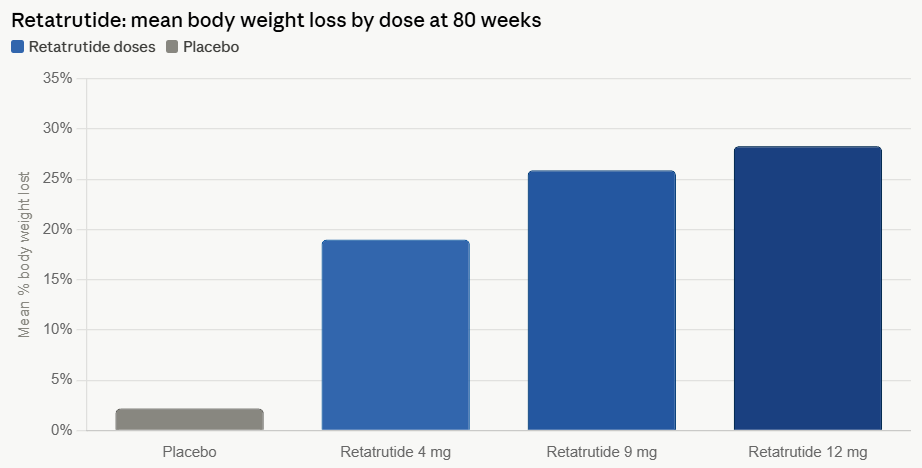
“TRIUMPH-1 highlights the importance of options and the potential for retatrutide to help people across various stages of their obesity journey,” said Kenneth Custer, executive vice president and president, Lilly Cardiometabolic Health. “From the 4 mg dose, reaching nearly 20% weight loss with one escalation step, to the 12 mg dose that delivered a level of weight loss long associated with bariatric surgery, retatrutide offers the potential for a patient-centric approach to obesity. Together with Zepbound and Foundayo, retatrutide could build on Lilly’s commitment to match treatments to the needs and preferences of patients.”
“The clean safety profile, combined with best-in-class efficacy across all doses, makes this a clean win for [Lilly],” RBC Capital Markets analyst Trung Huynh said in a note to clients.
However, according to William Blair analysts, retatrutide’s tolerability profile could confine the drug to use in patients at the higher end of the BMI spectrum, while tirzepatide will “continue to serve as the go-to medication, due to its balanced efficacy and tolerability profile.”
At the highest dose of retatrutide, 11.3% of participants discontinued treatment due to adverse effects. This is higher than other GLP-1s, which had discontinuation rates of 6.1% (tirzepatide), 8.0% (semaglutide) and 10.3% (orforglipron).
The closest performing GLP-1 medicine in terms of average weight loss is Novo Nordisk’s CagriSema, an Amylin/GLP-1 dual agonist, which had an average weight loss of 22.7% after 68 weeks in Phase 3 trials. However, CagriSema failed to show non-inferiority to tirzepatide after 84 weeks of treatment in a Phase 3 trial comparing the two medicines.
The dysesthesia side effect
Approximately 12.5% of participants on the highest dose of retatrutide experienced dysesthesia, or abnormal skin sensations, including a burning, tingling or pins and needles sensation. These events were generally mild to moderate and most resolved during treatment. Comparatively, orforglipron, Lilly’s oral nonpeptide GLP-1, reported dysesthesia in only 1.2% of participants at the highest dose. High doses of semaglutide (7.2 mg) caused the side effect in 22.9% of participants in experimental trials. Other GLP-1s have not listed dysesthesia as an adverse effect.
The exact mechanism of the dysesthesia side effect is not known, but researchers hypothesize it may be due to the activation of the glucagon or GLP-1 receptors, as these receptors are expressed on central and peripheral nerves. Another cause could be transient shifts in B vitamins and electrolytes, which are vital for nerve health, caused by rapid weight loss and reduced food intake.
GLP-1 weight loss is up to 35% muscle mass loss
GLP-1 weight loss can be 20% to 35% loss of lean tissue instead of fat. Trials for the orforglipron showed that an average of 26.9% of the total weight loss was due to a loss in lean mass. For CagriSema, there was a 14.4% reduction in lean soft-tissue mass.
For retatrutide, which had an average weight loss of 70.3 lbs, this could translate to approximately 14 to 24.6 lbs of muscle mass loss. Direct body composition data for retatrutide has not been published, but additional results from the Phase 3 trial are expected later this year.
Loss of muscle mass is a key driver of bone density decline, as it reduces the dynamic strain on the skeleton, thereby accelerating disuse signaling. This has led to a focus on developing next-generation weight loss candidates like XW020 by SciWind Bio, a long-acting injectable peptide designed to induce body weight reduction while preserving muscle mass.
The effect of retatrutide on bone density is also yet to be seen, although other GLP-1s have been shown to cause a decrease in bone density proportional to weight loss.
Activation of GIP could protect bone density
Rapid, substantial weight loss reduces the static and dynamic loads on the skeleton, causing the body to increase bone resorption and decrease bone formation, leading to a decline in bone mineral density (BMD). According to a 2025 review published in Nature Bone Research, rapid weight loss is associated with approximately 1% to 3% BMD loss for every 10% of body weight lost.
In one study, non-diabetic GLP-1 users who maintained stable weights had a 22% higher osteoporosis risk compared to those on other weight loss medications. The risk increased as weight loss intensified.
Five-year follow-up data presented at the AAOS 2026 meeting indicated that GLP-1 users had a significantly higher risk of osteoporosis than matched controls (4.1% to 3.2%).
A study that studied GIP infusions found that the hormone may provide a protective effect that counteracts some of the bone loss associated with weight reduction. This may be because GIP receptors are present on osteoblasts and osteoclasts. In animal models, GIP agonists were shown to have beneficial effects on tissue-level bone material properties.
A 2025 mechanistic review published in The Journal of Clinical Endocrinology and Metabolism showed that tirzepatide, which activates the GIP receptor, showed less BMD loss than expected for the weight loss achieved.
Filed Under: Biologics, Endocrinology