[Adobe Stock]
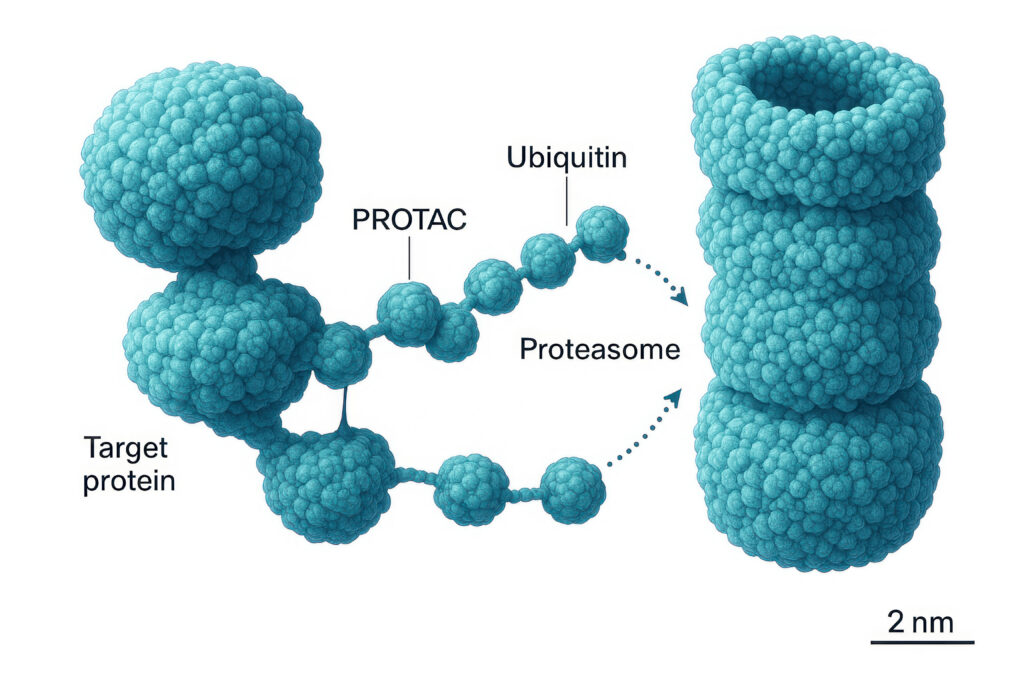
While PROTACs offer strong therapeutic promise for diseases with high unmet need, they also create significant formulation challenges. PROTACs are typically beyond Lipinski’s Rule of 5 (bRo5) molecules with high molecular weight, high hydrophobicity, and complex bifunctional architecture, which makes them difficult to dissolve and formulate for oral delivery. Poor aqueous solubility can reduce dissolution in the gastrointestinal (GI) tract, increase precipitation risk and lead to low or variable bioavailability.
For teams advancing PROTAC programs, these are not just technical concerns. They can directly affect dose selection, exposure, safety, and the ability to progress a drug molecule toward the clinic.
Three key formulation pain points in PROTAC development
One of the most common pain points is poor solubility. PROTACs may show limited solubility not only in water, but also in biorelevant media and commonly used excipients. This makes it difficult to create a stable and reproducible dosage form. If the drug does not remain solubilized after administration, it may precipitate in the GI tract, reducing absorption and causing inconsistent exposure. For a molecule with a narrow therapeutic index, such variability can increase the risk of suboptimal efficacy or toxicity.
A second challenge is poor permeability. Because PROTACs are large and complex, they may not easily cross biological membranes. Even if a formulation improves dissolution, the molecule still needs to permeate effectively to reach systemic circulation. This means formulation development must look at the full absorption journey encompassing solubility, dissolution, supersaturation, precipitation risk, permeability, and bioavailability.
The third challenge is safety control. When the therapeutic index is limited, formulation decisions become critical. The goal is not simply to increase exposure, but to achieve predictable and controlled exposure. A poorly designed formulation can lead to precipitation, variable absorption, unexpected exposure, or dose-limiting toxicity. Therefore, PROTAC formulation requires a careful, molecule-specific strategy from the earliest development stage.
How to address these formulation challenges
These challenges can be addressed through an integrated formulation development approach. The process begins with developability and pre-formulation studies, including assessment of solubility, permeability, stability, hygroscopicity, pKa, Log P, solid-form behavior, and excipient compatibility. These studies help identify risks early and guide the right formulation strategy.
For poorly soluble and complex molecules, enabling formulation technologies include amorphous solid dispersions, nanosuspensions, nanoemulsions, lipid-based systems, salt and co-crystal approaches, polymorph screening, micronization and particle engineering. These approaches are designed to improve solubility, maintain the molecule in an absorbable form, reduce precipitation risk and support better bioavailability and safety. Some, such as lipid-based systems, can also improve permeation.
What makes this especially important for PROTAC programs is the need for cross-functional decision-making. Formulation teams need to work closely with analytical development, particle science, DMPK, toxicology, medicinal chemistry, and process chemistry teams to design scalable, patient-appropriate dosage forms. This integrated model helps teams move from a challenging molecule to a formulation strategy that is scientifically justified, clinically relevant, and development ready.
PROTAC formulation is not a downstream activity. It is a key enabler of therapeutic success. Addressing solubility, permeability, precipitation, and safety risks early helps turn complex degraders into more reliable, patient-ready therapies.
Matt Ling is senior director of CMC drug product at Sai Life Sciences, a contract research, development and manufacturing organization (CRDMO) headquartered in Hyderabad, India. He is based in Cheshire, England, and studied at the University of Nottingham.
Filed Under: Drug Delivery, Drug Discovery and Development