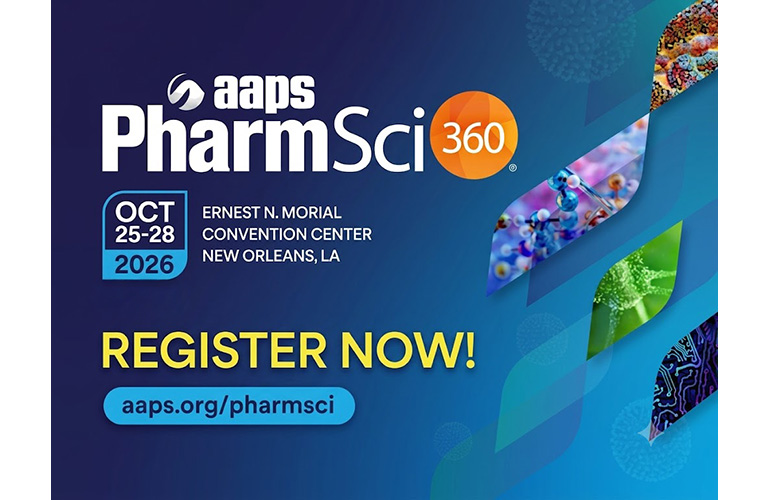
 The Arlington, Virginia–based nonprofit American Association of Pharmaceutical Scientists (AAPS) will launch two Innovator-Curated tracks at its 2026 PharmSci 360 conference, scheduled for October 25–28, 2026, at the Ernest N. Morial Convention Center in New Orleans, Louisiana.
The organization announced that the tracks will explore the current state of scientific research integrity in an AI era alongside emerging drug development technologies.
The first track, scheduled for Monday, October 26, will focus on credibility, reproducibility, and open-science policy. Brian Nosek, co-founder and executive director of the Center for Open Science, will curate and anchor the program with a keynote on promoting openness, integrity, and trustworthiness in research findings. Sessions will examine methods for identifying problematic papers, verifying citations, and establishing ethical practices for using generative AI in research.
A morning symposium will examine organizations that enable scientific fraud, publishers’ ability to catch problematic manuscripts, lessons from large-scale replication of preclinical cancer experiments, and NIH efforts to build a more reliable evidence ecosystem. Center for Open Science researcher Maryam Zaringhalam will moderate the symposium as well as a concluding session on open-science policies intended to accelerate research translation.
Two days later, Johns Hopkins professor Thomas Hartung will lead a curated full-day track on new approach methodologies (NAMs), including human-derived laboratory systems, AI applications, organ-on-a-chip models, neural organoids, and computational models designed to reduce or replace animal testing. The program arrives as federal agencies transition toward validation standards, targeted funding, and specific regulatory applications.
FDA issued draft guidance in March outlining four principles for NAM evidence submitted during drug development. NIH, meanwhile, has committed $150 million over five years to develop and standardize human-based research technologies through its Complement-ARIE program.
A morning symposium will cover neural microphysiological systems, regulatory data packages for organ chips, AI-assisted chemical read-across, and organoid intelligence. NIH Deputy Director Nicole Kleinstreuer will deliver an afternoon keynote on building trust in non-animal safety science, followed by a session examining how startups, model developers, and regulators are approaching post-animal drug development.
The organoid discussion connects directly to recent Johns Hopkins work; Hartung and colleague Lena Smirnova coauthored a 2025 study reporting synaptic plasticity and other building blocks associated with learning and memory in human neural organoids.
Filed Under: Drug Discovery and Development, PharmSci360