Eli Lilly, Novo Nordisk, AstraZeneca and more announced recent GLP-1 clinical and preclinical data at the American Diabetes Association’s (ADA’s) national conference this week.
The conference was eventful, with several experts being escorted out by police after handing out copies of an editorial criticizing the Trump administration’s science policies. The editorial was published in the ADA’s flagship journal, Diabetes Care, and detailed the effects of funding cuts and other actions on diabetes research. Shortly before Jay Bhattacharya, director of the National Institutes of Health (NIH), was scheduled to speak, some experts began handing out the copies.
Security staff asked the researchers to step outside and tried to take the papers, Aaron Kelly, a professor of pediatrics at the University of Minnesota, who was among the researchers escorted out, told The New York Times.
The researchers attempted to reenter the convention at another entrance, but were met by event security and police officers, who told them they would be trespassing and would be arrested if they set foot on the premises again, Justin Ryder, another researcher, told the New York Times.
Organizers told five of the researchers, some of whom were scheduled to present, that they could no longer participate in the conference.
Retatrutide shows promise for osteoarthritis pain and sleep apnea
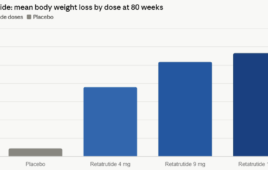
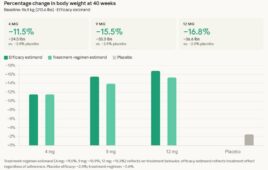
Lilly presented Phase 3 results for its triple agonist, retatrutide, which showed 28.3% body weight loss over 80 weeks on the highest dose. The drug also reduced knee osteoarthritis pain by up to 73.1% and moderate-to-severe obstructive sleep apnea severity by 60.6%, both of which are associated with obesity.
“These findings demonstrate what may be possible when we treat obesity and impact overall health, and what this could mean for people living with obesity and its related complications,” said Ania Jastreboff, lead investigator.
Retatrutide also reduced A1C by up to 2% for patients with type 2 diabetes. Up to 90% of participants achieved an A1C below 7%, the ADA’s general target for type 2 diabetes. Retatrutide reduced triglycerides by up to 41%, non-HDL cholesterol by 24.2% and systolic blood pressure by 12.3 mmHg.
The tolerability was generally consistent with other GLP-1s, Lilly said. Most common adverse effects included nausea, diarrhea, constipation and vomiting. Approximately 14.2% of participants on the highest dose experienced upper respiratory tract infections. Some also experienced dysesthesia, which has been seen to a limited extent with related drugs.
After failing to best Zepbound, CagriSema shows ‘significant’ blood sugar benefits in phase 3
CagriSema, a combination amylin analog and GLP-1 receptor agonist, achieved significant reductions in HbA1c and bodyweight versus comparators in phase 3 trials, Novo Nordisk announced.
“With these findings, CagriSema has the potential to be the first amylin and GLP-1 combination therapy that addresses blood glucose control with reductions in bodyweight for people living with type 2 diabetes,” Martin Holst Lange, executive vice president, chief scientific officer and head of Research and Development at Novo Nordisk, said in a press release.
When compared with semaglutide (Ozempic), CagriSema achieved a greater reduction in HbA1c and body weight. The highest dose of CagriSema showed a 14.2% reduction in body weight, while the same dose of semaglutide showed a 10.2% reduction after 68 weeks.
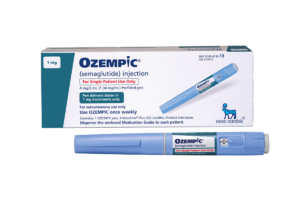
Ozempic (semaglutide). Credit: Novo Nordisk
Earlier this year, another phase 3 trial found that CagriSema was inferior to Eli Lilly’s Zepbound (tirzepatide). In that trial, CagriSema achieved 23% weight loss after 84 weeks of treatment, compared to 25.5% with tirzepatide.
In a call with investors after the results were announced, Martin Lange, executive vice president of R&D, chief scientific officer and member of the Management Board for Novo Nordisk, explained that Zepbound “performed unusually well on efficacy compared to what has typically been reported in most previous trials of a similar nature.”
In a phase 3 trial in adults with pre-diabetes and obesity, participants had an average weight reduction of 22.9% on the highest dose of tirzepatide, 2.1% less weight loss than was seen in the CagriSema comparator trial.
Oral GLP-1s continue to show less weight loss than injections
AstraZeneca presented results for its oral GLP-1, elecoglipron, which achieved an 11.8% weight reduction at 36 weeks. It lowered HbA1c by 1.9% at 26 weeks, with 90% of patients reaching an HbA1c below 7%. The drug will advance to phase 3 trials in obesity and type 2 diabetes, where it will be evaluated for cardiovascular and kidney outcomes. 2
Ascletis’s ASC30 showed weight loss of up to 7.7% at week 13 in phase 2 trials. The drug had approximately one-half the rate of vomiting observed with orforglipron titrated weekly. Additionally, the company’s oral amylin receptor agonist showed selectivity for the human amylin type 1 receptor comparable to that of eloralintide in preclinical studies.
Pfizer’s monthly GLP-1
Berobenatide, a once-monthly GLP-1 receptor agonist, achieved a 15.9% weight loss at 32 weeks. It also showed a 2.2% reduction in HbA1c at 18 weeks.
“These data highlight the potential for berobenatide to be the first approved monthly GLP-1 RA peptide and support our extensive Phase 3 program that includes 10 studies for chronic weight management and obesity-related comorbidities,” Jim List, chief internal medicine officer at Pfizer, said in a press release.
The VESPER-6 Phase 3 study investigating monthly maintenance dosing for berobenatide in adults with obesity or overweight is open for enrollment, as well as the SOLIS-1 Phase 2b study investigating weekly and monthly maintenance dosing of an ultra-long-acting amylin analog (PF’3945) as a monotherapy and in combination with berobenatide.
Filed Under: Endocrinology, Gastroenterology, Metabolic disease/endicrinology