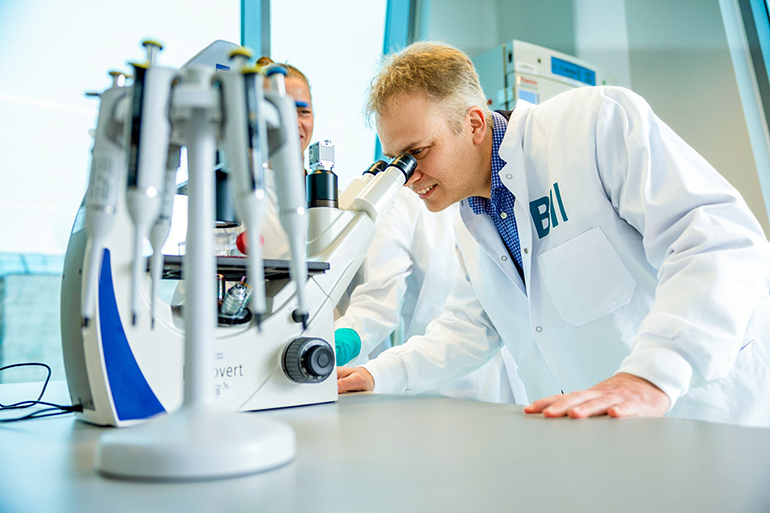
Micha Breakstone, Ph.D., peers into a microscope. [Cellular Intelligence]
The deal comes as cell and gene therapy venture funding thaws after falling from its 2021 peak. Under the agreement, Cellular Intelligence secured global rights to STEM-PD, an allogeneic stem cell-derived therapy designed to replace the dopamine-producing neurons that Parkinson’s patients lose. Novo Nordisk took an equity stake in the company and retained milestone and royalty rights. “Our mission is to transform cell biology from trial and error into an engineering discipline,” said Micha Breakstone, Ph.D., the company’s co-founder and CEO, in an interview. The deal with Novo fulfills something of a longstanding mission of Breakstone’s. “I told my wife that [the day he learned of the partnership] is probably the very best day in my career,” Breakstone said, “because for the first time it felt that I was much, much closer to the ultimate goal, which is reducing suffering and touching patients’ lives.”
The Novo connection grew out of the broader network Cellular Intelligence has assembled, spanning tech-bio investors, academic biology and large-pharma relationships. “We’ve engaged with Novo for the last five months, give or take,” Breakstone said. Breakstone had known Jacob Petersen, a longtime Novo Nordisk executive. “I had reached out about a year prior, or maybe a little less, to learn about the great industry leaders, and he had immediately captivated me with his vision and his deep understanding of the field,” he said.
Unmet medical need in Parkinson’s remains significant

From left: Nuno Mendonça, Cellular Intelligence’s chief medical officer; Malin Parmar, professor of cellular neuroscience at Lund University; Agnete Kirkeby, who led preclinical development of STEM-PD; and Micha Breakstone, Cellular Intelligence’s co-founder and CEO. (Photo courtesy of Cellular Intelligence)
STEM-PD is a Fast Track-designated asset with IND clearance that targets a significant unmet need. While Parkinson’s disease has been medically recognizable for more than two centuries, since James Parkinson described “shaking palsy” in 1817, its therapeutic story has moved slowly. Levodopa, introduced for Parkinson’s in 1970, remains the benchmark treatment for motor symptoms.
“There are a lot of symptomatic treatments,” said Nuno Mendonça, M.D., a board-certified neurologist who recently joined Cellular Intelligence as chief medical officer. “You take them and you improve some of your motor symptoms, but the underlying process goes on. Most of the investigation is devoted to disease modification, and most of it fails.” Cell therapy, he said, works on a different principle entirely: “You’re basically substituting what the patients are missing.”
More than 20 treatments have been approved since 2015, many involving new formulations, infusion systems or device refinements such as adaptive deep brain stimulation. The Michael J. Fox Foundation is tracking 151 treatments in clinical testing and has funded $3 billion in research. The economic burden of Parkinson’s disease and atypical parkinsonism in the U.S. reached more than $82 billion in 2024, surpassing the $79 billion previously projected for 2037. Yet no approved therapy slows or stops the underlying neurodegeneration. One of the field’s most closely watched strategies, targeting alpha-synuclein with monoclonal antibodies, has produced mixed and often disappointing mid-stage results.
STEM-PD: From Lund to the clinic
The program Cellular Intelligence is acquiring grew out of more than a decade of research led from Lund University in Sweden, where neuroscientist Malin Parmar, a professor of cellular neuroscience, has developed methods to turn embryonic stem cells into the dopaminergic neurons that Parkinson’s patients progressively lose. The STEM-PD trial is a broader academic and clinical collaboration involving Lund University, Skåne University Hospital, University of Cambridge, Cambridge University Hospitals NHS Foundation Trust, Imperial College London and Novo Nordisk. Dopamine-producing neurons, concentrated in a brain region called the substantia nigra, produce dopamine, the neurotransmitter essential for coordinating movement.
The therapy entered a first-in-human trial in Sweden in February 2023, with development funded by national and European agencies as well as Novo Nordisk. Nature Medicine named it one of 11 clinical trials expected to shape medicine in 2024.
Mendonça arrived through the deal itself. Breakstone said he was initially brought in as a diligence consultant. Mendonça had previously led late-stage EMEA clinical development of Zolgensma, a gene therapy for spinal muscular atrophy, at Novartis Gene Therapies.
Six hours versus ten
Cell replacement enables the replacement of the dopamine-producing cells Parkinson’s destroys. Manufacturing provides the translation layer. The same cell type has to be produced reproducibly, at clinical quality and in a form surgical teams can administer. That is one area where Cellular Intelligence’s AI platform can help.
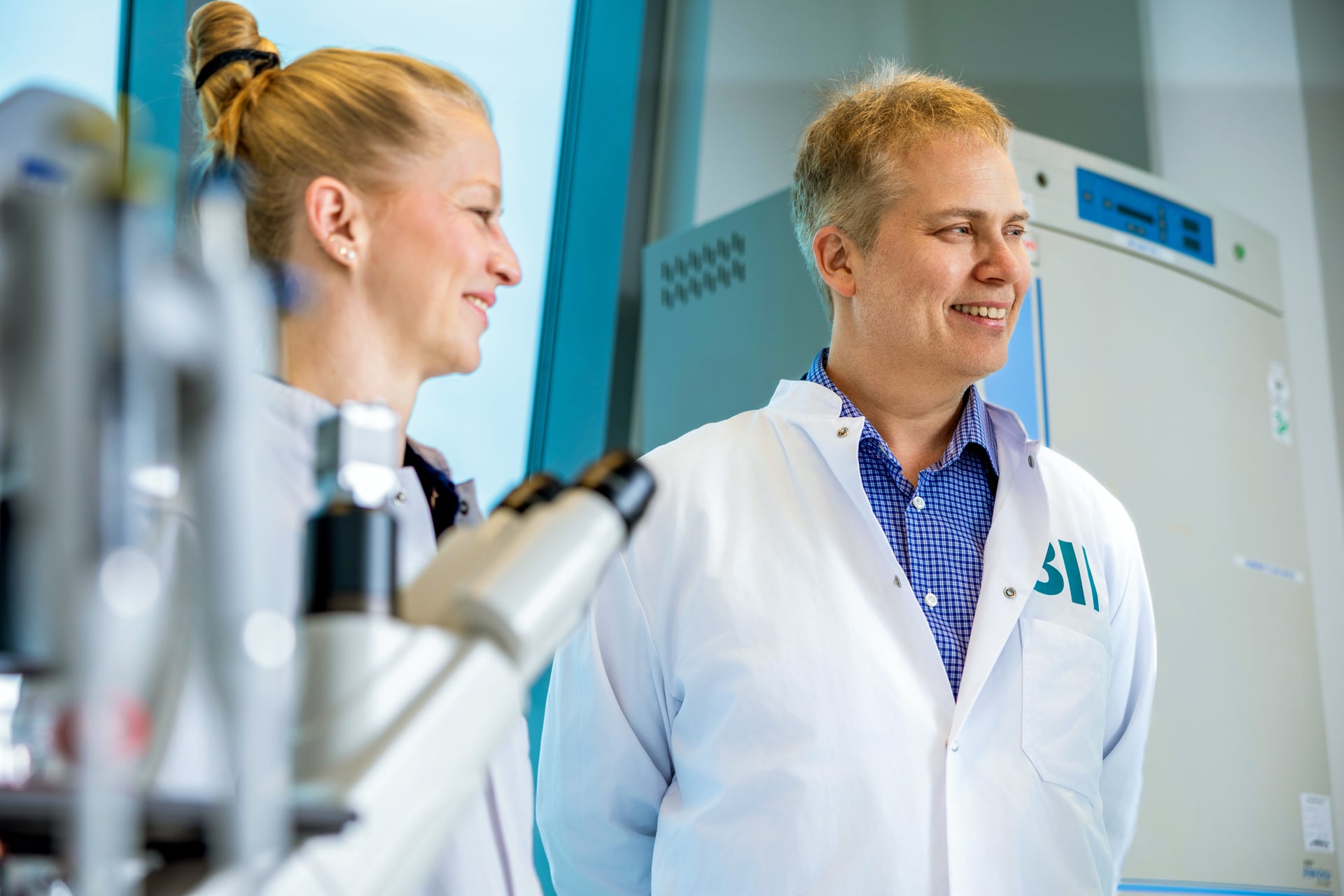
Johanne Press Wegeberg, Ph.D., a Novo Nordisk cell therapy scientist who worked on the STEM-PD program, with Micha Breakstone, Ph.D., co-founder and CEO of Cellular Intelligence. (Photo courtesy of Cellular Intelligence)
Stem cell-derived therapies depend on differentiation protocols, or “recipes,” that guide pluripotent cells through timed exposures to growth factors and other signals until they acquire the desired identity. Research in human pluripotent stem cell models has shown that signaling history, including duration, can help shape cell fate. That makes protocol design a natural target for Cellular Intelligence’s predictive platform.
“The protocols that are used for differentiation of cells from pluripotency into any cell fate are extremely sensitive to very minor changes and tweaks,” Breakstone said. “Very slight tweaks can end up in outsized deltas in terms of the profile of the cell. You can imagine that an exposure of six hours versus 10 hours to a certain biological growth factor might produce a very different viability window.”
Cellular Intelligence claims its platform can track those shifts in a way conventional approaches cannot. “Unlike any other company, we’re able to track cells over time,” Breakstone said. “Our data is temporally resolved. It has context. We know what happens to the cells over time, and we’re able to show that those contexts actually deeply matter.” He compared the approach to the trajectory of large language models: “This move from static perturbations to temporally resolved inputs and outputs seems to follow the same scaling laws that have brought about this latest revolution in AI with large language models.”
In Breakstone’s example, a 10% increase in viability window would give operators 10% more time between extracting cells from reactors and filling vials, meaning more filled vials or roughly 9% lower cost of goods. Longer viability could also make the injection procedure easier to administer, he said. “Learning about how to ever-so-slightly change the recipe, the protocol of cell differentiation, has a very large impact on attributes of the cells, such as purity, viability, their potentially engrafting properties, and other topics,” Breakstone said.
“We’re placing cells in patients’ brains, and you want those cells to be of the best quality,” Mendonça said. “You want to be able to manufacture them as well as you can, with as streamlined a process as you can, as off-the-shelf as you can, so that you can then launch it into the unmet clinical need that is PD.”
Filed Under: Neurological Disease