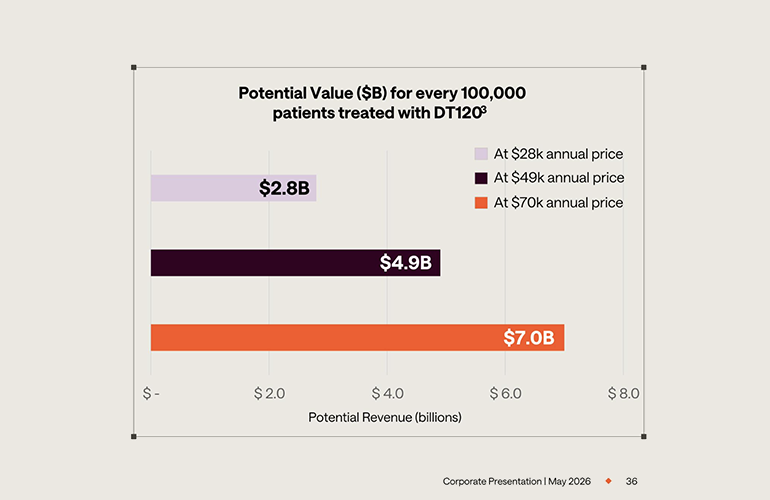
Definium framed DT120’s potential value at $2.8 billion to $7 billion for every 100,000 patients treated, based on assumed annual prices of $28,000 to $70,000. The company notes that “the price of DT120 has not been established.” Source: Definium Therapeutics, May 2026 corporate presentation.
New York City–based Definium recently announced positive data from its Phase 3 Voyage trial of DT120, an orally disintegrating 100 µg dose of LSD in adults with generalized anxiety disorder (GAD). The company announced positive Phase 3 results for the same compound for major depressive disorder (MDD) in June.
Now the company needs to convince regulators, clinicians, payers and patients that a treatment whose results its CEO called “unprecedented” is worth what it costs to deliver. Oral LSD at comparable doses has historically produced effects lasting about eight to twelve hours. Definium’s pivotal protocol requires patients to remain onsite for a minimum of eight hours, supported by two staff members in a room they occupy for the day. Voyage participants met the checklist criteria used to assess readiness to leave in an average of 6.4 hours, and the company’s dosing paradigm anticipates patients resuming normal activities, including driving, the next day. In a corporate presentation filed with the SEC in January, Definium modeled revenue at annual prices ranging from $28,000 to $70,000 per patient, using Spravato, Johnson & Johnson’s blockbuster esketamine, as its pricing surrogate. Definium has not publicly stated what it expects DT120 to cost.
In Definium’s Phase 2b trial, published in JAMA in 2025, every participant remained onsite for 12 hours regardless of when they met the end-of-session criteria. The first assessment came at hour eight, when 45% of the 100 µg group met the criteria, rising to 87.5% by hour 10 and 97.5% by hour 12. The Phase 3 program used a different formulation and a different end-of-session instrument, limiting a direct comparison with Voyage.
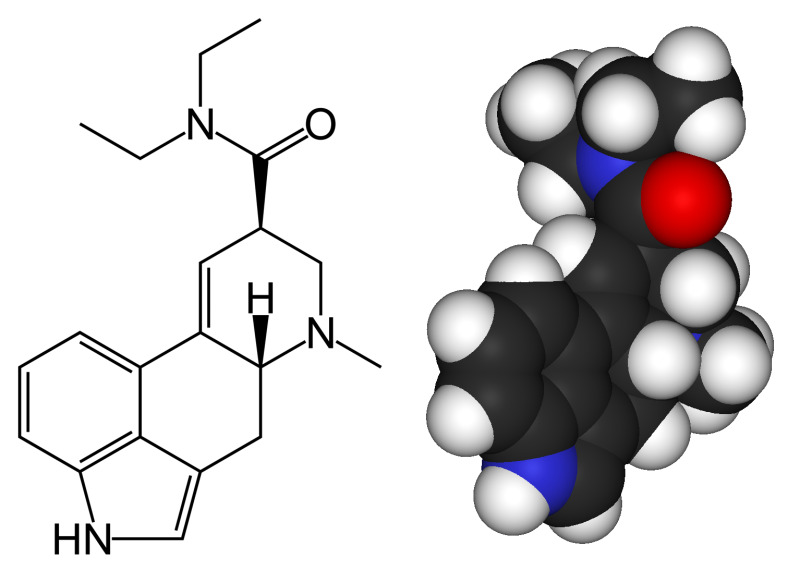
The chemical structure of LSD (lysergic acid diethylamide), shown as a 2D structural formula and a 3D space-filling model. Credit: Wikimedia Commons.
On its August 12 Voyage results call, Chief Medical Officer Dan Karlin called the eight-hour minimum a feature of the trial design. “We have no reason to think that an 8-hour minimum persists in the real world because that’s a trial artifact,” he said. Definium expects the End of Session Checklist to determine when individual patients are ready to leave in clinical practice.
In a 2024 interview, after Definium, known then as MindMed, reported positive Phase 2b results for MM120 in GAD, CEO Robert Barrow said the company had long anticipated the need for patient monitoring. “We envision something similar to Spravato,” he said, referring to its Risk Evaluation and Mitigation Strategy (REMS), the mandatory FDA safety program. But Barrow anticipated “less monitoring burden.” “We don’t see the physiological risks that Spravato has. With Spravato, you need cardiorespiratory monitoring, but we haven’t seen those risks with MM-120 in our development program,” he said.
While Spravato may be the clearest commercial comparison, the magic mushroom compound psilocybin offers a closer pharmacological one. Both are classic serotonergic psychedelics acting at the 5-HT2A receptor. Both likely will require a relatively lengthy supervised dosing session although LSD has much longer-lived psychoaffective effects. While an active Spravato session is in the ball park of a couple of hours, for psilocybin it is roughly three to four times longer. The Phase 3 COMP360 trial administration session lasted “approximately six to eight hours and at least one healthcare professional is present throughout the session to monitor and safeguard participants in our clinical trials,” Compass Pathways wrote in an SEC document with most treatment-emergent adverse events resolving within 24. For its Phase 3 program, Definium wrote that the “required monitoring period for all participants in pivotal studies is 8 hours,” as it noted in an SEC filing. The same presentation sketches a potentially shorter commercial model, describing “5-8 Hour Monitoring via EOSC,” referring to the “End of Session Checklist.”
Compass Pathways is further along than Definium on the path toward commercialization. Its synthetic psilocybin formulation, COMP360, met the primary endpoint in the first of two Phase 3 trials in treatment-resistant depression in June 2025 and in the second in February. In July, Compass reported 26-week durability data from that second trial, as its rolling FDA submission proceeds, with completion expected in the fourth quarter.
Compass’ Phase 3 data, along with Definium’s, also highlight something of a compression effect in pivotal trials. Both programs shrank between Phase 2 and Phase 3. Definium’s placebo-adjusted difference fell from 7.7 points to 5.4, but the standardized effect size held at 0.81. As MindMed’s Dec. 16, 2024 Phase 3 launch announcement, filed with the SEC as an 8-K exhibit, notes, Voyage used central raters blinded to both treatment assignment and visit number.
On its Voyage Phase 3 call, Definium CEO Barrow said those retreatment data would help inform “commercial and market access and pricing” decisions. So far, he said, the emerging profile ranges from “a single dose or a few doses” producing benefits over a “long multi-month period.”
Barrow said that the time of treatment is a non-issue for the clinical trial patients the company has spoken with. “We have yet to meet or talk to one of these anxiety patients who says, you know, ‘I’ve been living with anxiety for 20-plus years. It’s severe. I can’t handle this, but I’m unwilling to stay in the clinic for an extra 30 minutes or so.’” he said. “I mean, the efficacy we’re seeing is to a degree where someone with a probably lifelong, certainly multi-decade [condition] can be in a room for a day and walk out the door having a reasonable expectation of profound effect. That may take some time, but that time is very well worth it.”
Filed Under: Neurological Disease