 After kickstarting the GLP-1 wave that transformed the pharma landscape and briefly sending its market value above Denmark’s annual economic output, Novo Nordisk now trades about 5% below where its shares stood five years ago. After its shares hit an all-time closing high of $137.40 on June 25, 2024, the stock slid about 66% to $47.26 as of August 7, 2026.
Now, Novo is building on a data-and-AI foundation it started before its recent loss of momentum, announcing a strategic partnership with AWS intended to accelerate early drug research and clinical development. The agreement names AWS as Novo’s preferred cloud provider and strategic AI partner. Novo did not disclose the financial terms.
At the center of the announcement is an AI co-innovation hub in the United Kingdom, where engineers, AI specialists and applied scientists from AWS’s Forward Deployed Engineering team and AWS Professional Services will work alongside Novo’s R&D teams to, in the companies’ language, compress the path from drug target to first human dose.
The hub sits inside space Novo already occupies. Mike Doustdar’s statement places it “within our existing facility in London,” and AWS’s own post identifies the site as Novo’s King’s Cross facility. Novo announced that facility in early 2024 as a digital innovation hub in the King’s Cross Knowledge Quarter, near the Alan Turing Institute, the Francis Crick Institute and the Wellcome Trust, initially staffed with roughly 40 employees drawn from its R&D and IT divisions.
The expanded Novo-AWS partnership follows a partnership with OpenAI on April 14.
Big Pharma is making big AI bets
The news comes as Big Pharma companies have announced a string of notable AI and supercomputing announcements. Also on April 14, AWS launched Amazon Bio Discovery. A week later, Merck announced a $1 billion AI-focused partnership with Google. A month later, Google announced continued progress with its Co-Scientist AI platform, which Nature published. Also this year, Lilly, Roche and BMS have all announced supercomputer programs.
Novo, too, has announced a string of AI-related projects over the years. The Copenhagen-headquartered company, for instance, already has a genAI-focused relationship with AWS with more than 2,500 use cases based on Amazon Bedrock, the managed service for building generative AI apps. Another prominent example is a Novo project with Anthropic and MongoDB that cut the task of creating clinical study reports from 12 weeks to 10 minutes. The Novo Nordisk Foundation also partnered with the Export and Investment Fund of Denmark (EIFO) to manage Gefion, a supercomputer based on the NVIDIA DGX SuperPOD, an AI data center infrastructure platform. Novo has also announced technology relationships with Microsoft, dating to a 2022 drug discovery collaboration, as well as Google and Hugging Face.
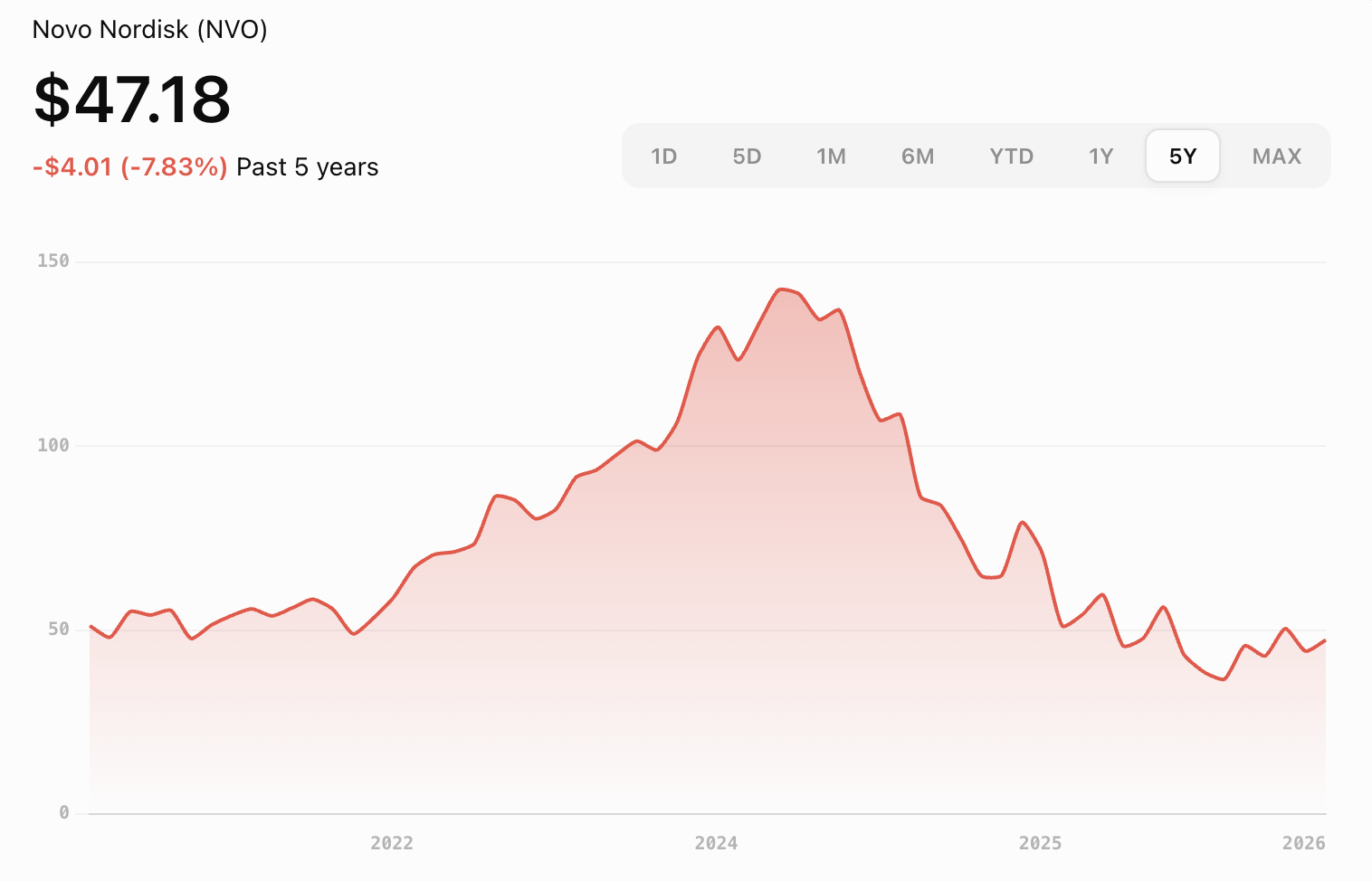
Novo shares have lost the lift they had following the FDA approval of Wegovy (injection) for obesity on June 4, 2021 .
In a statement, Doustdar, president and CEO of Novo Nordisk, notes that the expanded partnership with AWS centers around “making AI a driver of innovation” for the company. The goal is “accelerating discovery and developing responsible AI solutions that will create real progress for people living with serious chronic diseases,” he continued.
The proof point both companies cite is a Bedrock-based generative AI tool that Novo says has reached more than 25,000 employees. AWS describes those employees as building chatbots, retrieving information, drafting documents and using the tool as a virtual colleague for nonregulated processes. Thilde Hummel Bøgebjerg, Novo’s executive vice president for enterprise IT and quality, said in the AWS post that meaningful impact requires pairing the technology with scientific expertise.
Doustdar has also said that Novo would accelerate its pipeline and accelerate research amidst disappointing clinical trial developments for CagriSema. A fixed-dose combination of the amylin analogue cagrilintide with semaglutide, CagriSema has seen three primary disappointments. While it produced 22.7% weight loss in REDEFINE 1 in December 2024, that was below the roughly 25% investors had been led to expect. In February 2026 it failed a head-to-head non-inferiority test against tirzepatide in REDEFINE 4, 23.0% versus 25.5% at 84 weeks in 809 patients. Novo shares closed down about 16% that day. Most recently, in the REIMAGINE 4 head-to-head reported this month, CagriSema established non-inferiority to tirzepatide for weight reduction but failed to establish non-inferiority for HbA1c reduction in patients with type 2 diabetes.
CagriSema is not the only pipeline setback. On July 31, the phase 3 ZEUS trial of the IL-6 antibody ziltivekimab missed its primary endpoint of reducing major adverse cardiovascular events, with a hazard ratio of 0.99. Novo also discontinued monlunabant and booked a DKK 6.3 billion non-cash impairment in the second quarter.
The goal of having ‘more shots at goal’
Speaking of the CagriSema news, Doustdar said Novo needs to “have more shots at goal,” according to Reuters. “We need to be faster and we need to learn from the failures and reinvent ourselves again.”
Competitor Eli Lilly is threatening Novo’s market share with its Zepbound pulling ahead of Novo’s injectable Wegovy in both efficacy and U.S. prescriptions. In addition, Lilly’s oral orforglipron launched as Foundayo on April 9, opening a second front against the Wegovy pill Novo brought to market at the beginning of the year.
Novo remains upbeat about the prospects of CagriSema to be a lifeline. R&D chief Martin Holst Lange said CagriSema still has the potential to be the first GLP-1/amylin combination to reach market, and CFO Karsten Munk Knudsen told Fierce he remains optimistic ahead of an FDA decision expected late this year.
In the announcement regarding its expanded alliance with AWS, Novo said that the partnership will center on services such as Amazon Bio Discovery and Amazon Bedrock to help identify drug targets, design therapies and connect genomic, imaging and clinical data. It will also use Amazon Bedrock AgentCore, AWS’s infrastructure for building and operating AI agents, across other parts of the business.
Matt Garman, CEO, AWS, says that the strategic alliance aims to “fundamentally change how medicines are discovered and developed.”
Amazon Bio Discovery itself is aimed primarily at antibody discovery. AWS launched the service in April with access to more than 40 biological foundation models. Dan Sheeran, vice president and general manager of healthcare and life sciences at AWS, said the companies are building agentic AI applications spanning research, clinical development, manufacturing and IT operations.
Part of a larger relationship
The AWS agreement sits inside a wider Amazon relationship, and the parts of it with a track record involve selling drugs rather than discovering them. AWS notes that Novo already works with Amazon Pharmacy, Amazon Ads and Amazon One Medical to change how therapies are marketed and delivered. Andy Jassy, Amazon’s CEO, posted about the AWS deal and described the companies’ partnership as spanning AWS, Amazon Pharmacy and One Medical.
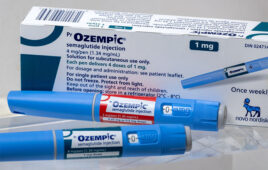
That commercial channel has been building through 2026. Amazon Pharmacy began carrying the Wegovy pill on January 9 at $25 a month for commercially insured customers and $149 for cash-pay, with plans to stock it in prescription vending kiosks at select One Medical clinics. In May, oral Ozempic and Wegovy were added to same-day delivery, with Doustdar appearing on Fox Business to discuss it.
The timing matters because self-pay has become central to Novo’s U.S. business. On the August 5 earnings call, Knudsen said self-pay now accounts for roughly 35% of U.S. injectable Wegovy, up from the 10% to 15% range a year earlier, and U.S. operations chief Jamey Millar said the majority of Wegovy pill prescriptions are self-pay. Amazon Pharmacy is a self-pay channel. It is also a channel for Novo’s competitor: Amazon Pharmacy distributes Eli Lilly’s Zepbound purchased through Lilly’s direct-to-consumer site, and lists Foundayo alongside the Wegovy pill.
The partnership also gives Novo access to a deployment model that has rapidly become fashionable across enterprise AI: forward deployed engineers. The data integration and analytics software firm Palantir helped popularize the concept in which engineers embed with customer teams and build production systems around the customer’s own data, workflows, security requirements and governance. AWS created a dedicated Forward Deployed Engineering organization in June, committing $1 billion and saying it plans to embed thousands of engineers with customers. Novo is among the first pharma companies to draw on it.
AWS’s healthcare and life sciences page says 19 of the top 20 Big Pharma companies already use AWS for generative AI and machine learning.
What investors are asking about is a different set of subjects. On Novo’s August 5 earnings call, nine sell-side analysts asked roughly 17 questions across an hour. The bulk concerned commercial performance: U.S. pricing and gross-to-net rebate adjustments, the injectable Wegovy decline, self-pay channel mix, Medicare Bridge uptake, the Wegovy pill launch trajectory in the U.K. and Germany, and whether Novo can return to revenue growth in 2027. Two questions dealt with manufacturing supply and business development.
The questions that did address research clustered on assets already in late-stage development, most of them built on semaglutide or amylin: CagriSema’s positioning in type 2 diabetes after REIMAGINE 4, whether Novo would file the 50 mg dose of oral semaglutide, amycretin titration, and what the ZEUS failure implies for IL-6 and NLRP3 as cardiovascular targets. In prepared remarks, Novo flagged a phase 2 start for a GLP-1/GIP/amylin triple agonist, a phase 2 for UBT251 in type 2 diabetes, and upcoming regulatory action on etavopivat and denecimig. None of those drew a question.
No analyst asked about discovery-stage research, which is the part of the pipeline the AWS partnership is built to accelerate.
Filed Under: Uncategorized