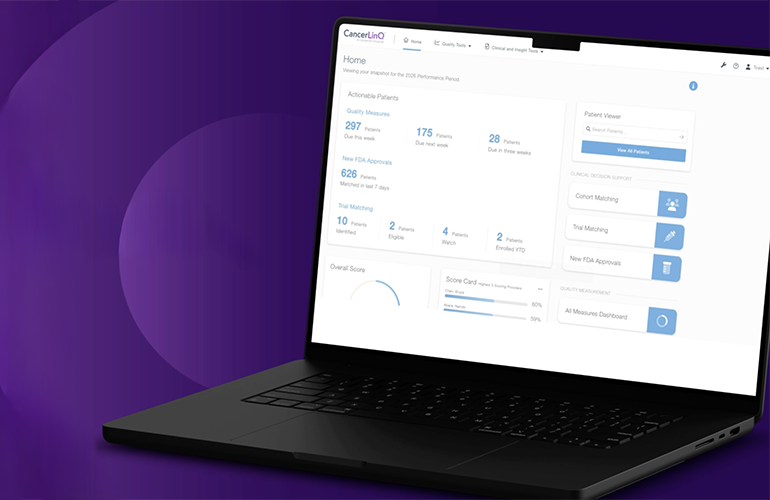
 More than a decade ago, the American Society of Clinical Oncology (ASCO) launched CancerLinQ, a platform designed to pool electronic health record data from oncology practices, turning routine patient encounters into a learning system.
The platform has since become central to ConcertAI, an oncology-focused AI and real-world data company, which acquired it from ASCO in December 2023.
Before the acquisition, CancerLinQ’s most widely used function was automated reporting. “Before we bought it, CancerLinQ largely just delivered software that automated the measurement of ASCO certification quality measures, in order to get your ASCO certification,” said Eron Kelly, ConcertAI’s chief executive.
Closing the care-research gap

Eron Kelly
Since the acquisition, ConcertAI has transformed the platform into an AI-powered system that moves well beyond quality-measure automation. The company has added trial-matching, research datasets and clinical decision support. Recent work has focused on pushing those insights into physicians’ live workflows. “We use a chain of AI models and agents to parse all that information, understand really challenging concepts like progression, or timelines within a diagnosis journey, and summarize that into a structured data model that can be queried from our SaaS software stack,” Kelly said.
Shaalan Beg, MD, ConcertAI’s chief medical officer, oncology, said CancerLinQ is intended to help close the gap between routine clinical care and clinical research. In diseases where new therapies are rapidly redefining standards, he noted, the most current treatment options are sometimes only accessible through trials. As a recent example, he cited ASCO data presented days earlier showing a new agent nearly doubling median survival in previously treated metastatic pancreatic cancer, from roughly six months to 12 months. “If you’re a pancreatic cancer patient right now and you want the best standard of care,” Beg said, “the only way you’re going to get it is through clinical trials.”
In recent years, healthcare data companies including ConcertAI as well as other players like Flatiron Health, Tempus and Komodo Health have gradually increased their focus on transforming the clinical data they aggregate into AI models and eventually agentic AI tools.
Lane assist for oncology
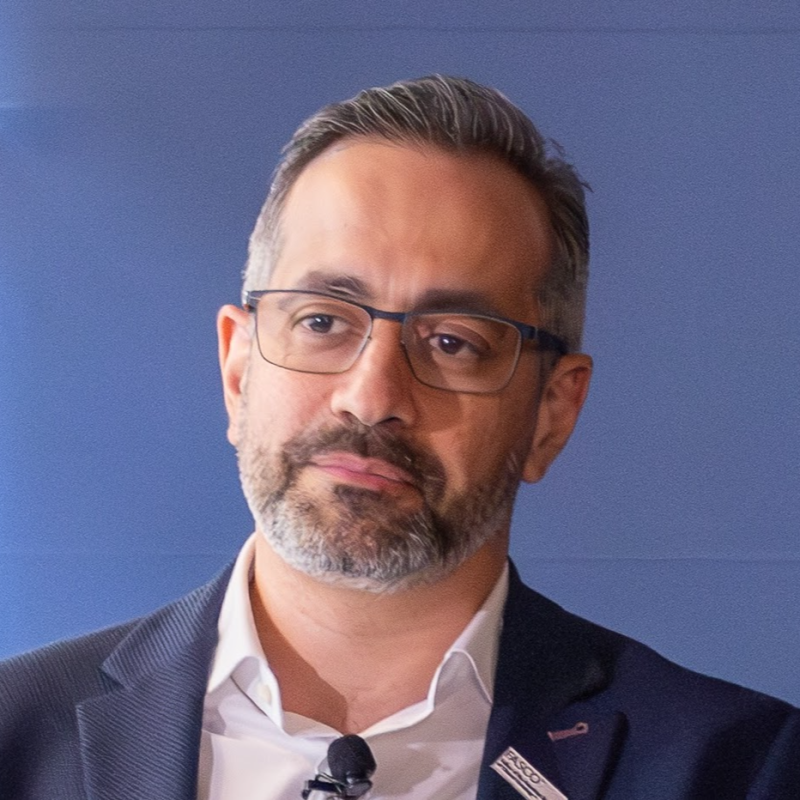
Shaalan Beg, MD
In the interim, physician-based use of AI has surged. In 2023, 38% of physicians were incorporating AI in one or more cases. In 2026, 72% were doing so, according to a survey from the American Medical Association. At the same time, physician awareness of AI in 2026 increased to 81%, up from 66% a year earlier.
Beg frames ConcertAI as the only platform agnostic to all EHR vendors and all genomic/molecular labs, collecting longitudinal, prospective data for both care and research. Point-of-care synthesis of prospective data, he says, is what drew him to the program.
In terms of workflows, Beg invokes a self-driving analogy. “For most of the clinical care doctors are asking for right now, it’s more like lane assist, keeping the car in its lane and giving nudges along the way.” The nudges look like “here’s a care gap, you’re missing molecular data on this colon-cancer patient” or “here’s a trial, have you considered it?”
The American Medical Association’s research points in a similar direction, noting that physician use and enthusiasm cluster on documentation and summarization. Summaries of research and standards of care are now the single most common use case at nearly 40%, up 26 points since 2024, with the documentation tools close behind on enthusiasm.
“We’re not working under the assumption that these tools will autonomously care for patients,” he said. The pressure the tools are built to relieve is one of capacity. Oncology has outgrown the reach of any single clinician. “The era of one physician taking care of all your needs is decades over,” Beg noted.
A cancer patient’s care now routinely spans an oncologist, nurse practitioner, geneticist, dietitian and physical therapist, and coordinating across those roles is a challenge in itself. The staff to carry it is rarely in place. “I don’t know of any academic program or clinical trials office that says it’s fully staffed,” Beg said. Against that backdrop, the tools work as an efficiency layer, giving oncologists back a couple of minutes per patient and letting one physician oversee more of them.
Beg says trial-matching can compress screening time to less than a third of manual screening, because the coordinator’s entire workflow is built in: once someone is flagged a probable match, the system walks 20 to 30 criteria, states its eligibility determination for each, and links back to the source in the record, so coordinators aren’t scouring charts in a separate window. This also reaches patients at satellite sites in hub-and-spoke setups.
Underpinning these point-of-care capabilities and rapid trial matches is ConcertAI’s data engine, which ingests both structured EHR fields and unstructured clinical content directly from sites across the CancerLinQ network, spanning physician notes, pathology reports, and genomic/NGS laboratory reports among them. The pipeline refreshes the resulting structured dataset weekly.
On chaining AI models together
“We use a chain of AI models and agents to parse all that information, understand really challenging concepts like progression, or timelines within a diagnosis journey, and summarize that into a structured data model that can be queried from our SaaS software stack,” Kelly said. “We’re seeing 0.9 and higher in precision and recall.”
The question under all of it is trust: does the AI pull what a human abstractor would pull from the chart? ConcertAI’s answer is a layered check where agents cross-check one another. One layer measures abstraction accuracy, whether the model reads the chart correctly. Another measures coherence, whether the sequence of events makes clinical sense, flagging a treatment that wouldn’t normally follow radiation, say. The point is that clinicians don’t lose confidence in what the system surfaces.
Because ConcertAI holds the underlying pathology reports, it can surface people whose tumors were scored one way years ago but would qualify for newer targeted therapies today. Trastuzumab has given way to HER2-targeted antibody-drug conjugates that work even at low expression, so patients once called HER2-negative, scored “1+,” are positive under current criteria and can be pulled back into treatment.
The HER2 anecdote is an example of how a specific treatment change can have a tangible impact for patients. At the same time, the dream of a sweeping cure has held the popular imagination for more than 50 years, from the Nixon-era War on Cancer to the federal Cancer Moonshot. Real breakthroughs have punctuated that stretch: checkpoint-inhibitor immunotherapy, CAR-T therapies for blood cancers and targeted drugs like imatinib.
Between those inflection points, though, most gains have come by increments, a better-targeted therapy here, a biomarker refined there, survival measured in additional months. While moonshots have their place, Beg outlined a more ground-up approach: “I think we should focus on ground shots first, disseminating the treatments we already know work to the people who need them right now.”
Filed Under: Oncology