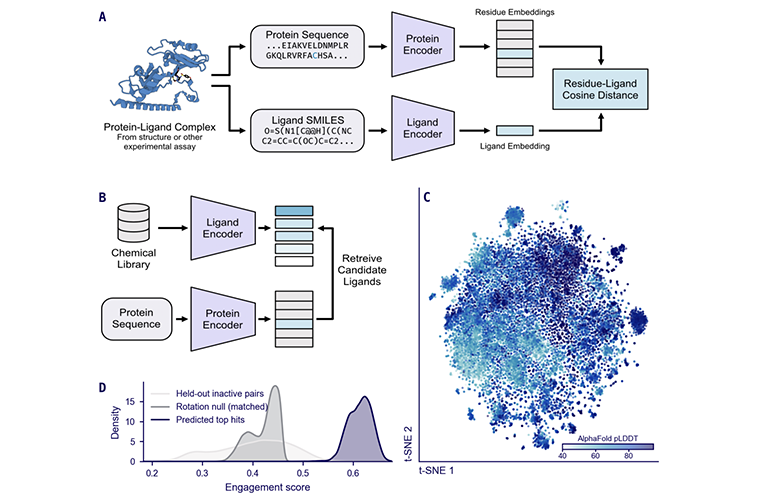
Talus Bio’s Ptarmigan-1 matches compounds to potential protein targets without predicting their 3-D structures. The team searched a 3.4-billion-compound library across 20,431 human proteins. Credit: Talus Bio, bioRxiv preprint, Figure 1 (2026), CC BY 4.0.
Few software releases have shaken drug discovery like AlphaFold. Its creators shared a Nobel Prize, and its public database put predicted structures for more than 200 million proteins open to researchers worldwide. Turning those structures into drugs poses another set of problems.
Seattle-based Talus Bio is going after proteins that resist that approach, notably transcription factors, which control which genes a cell switches on. Many contain flexible regions that shift shape, leaving no fixed pocket for a folding model to find.
“If you go talk to any scientist or oncologist and ask them what drugs they wish they had, they’re usually for these proteins called transcription factors,” says Alex Federation, Talus Bio CEO said. While they are involved in many diseases, cancer among them, drugmakers have long written them off as undruggable.
Lindsay Pino, Ph.D.
Talus CTO Lindsay Pino estimates that about half of human proteins lack a stable structure that folding models can use. That gap is part of why, of roughly 20,000 human proteins, 87% still have neither an approved drug nor a potent small-molecule ligand, according to a Talus preprint posted in July.
So Talus skips folding altogether. “If you try to fold a transcription factor, you just get a plate of spaghetti,” Pino said. “You can’t do drug discovery on a plate of spaghetti.”
Instead, its model, Ptarmigan-1, learns from mass spectrometry data that records where a compound engages a protein inside cells, with no 3-D shape required.
Skipping structure prediction also sidesteps a second problem: cost. Even when a target lends itself to structural prediction, screening bills can mount. Federation notes that co-folding, which predicts the structure of a protein and a potential drug molecule together, is inexpensive for a single use. Repeat that calculation for every compound in a discovery-scale library, however, and the budget snowballs. “A big experiment in drug discovery in the real world is a million compounds,” Federation said. He offered a ballpark: “That would cost something like $100,000 to $1 million and take months, for one protein. Folding the protein is the computational expense.”
Talus’s benchmark, run on a single Nvidia H100 GPU, found that Ptarmigan-1 averaged about 10 milliseconds per compound, compared with 54 seconds for Boltz-2, an open-source model that predicts molecular structures and binding affinity, the company reported in its preprint. The authors estimate that this roughly 5,000-fold speed advantage would shrink a million-compound screen against a single protein from nearly two years to under three hours.
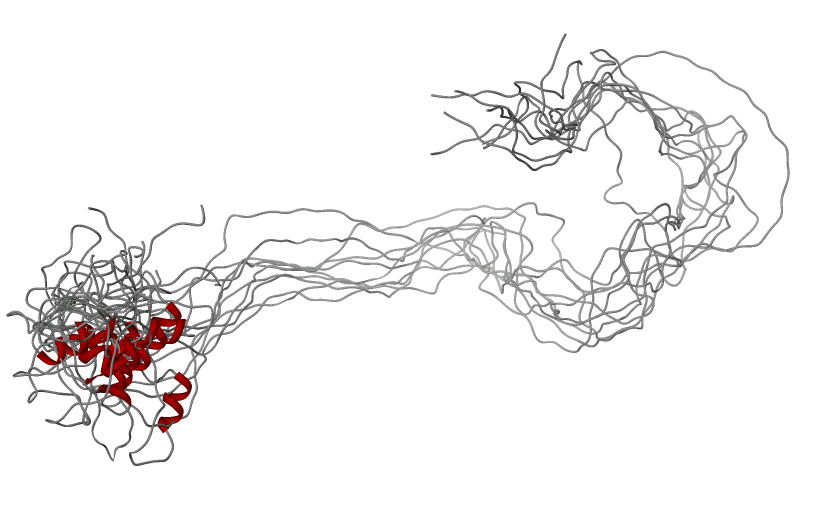
Many proteins lack a single fixed shape, and even those with stable folds undergo conformational changes. These overlaid models of amelogenin (pictured), a tooth-enamel protein, show a compact folded region (red helices) trailing long, floppy strands that never settle into one form. Image: LPKozlowski via Wikimedia Commons, CC BY-SA 4.0. Related research: PMID 22624656.
With its compound library already encoded for searching, Talus retrieved the top predicted binders for all 20,431 human proteins from 3.4 billion compounds in under a day, using about 20 H100 GPU-hours.
Alex Federation, Ph.D.
In a retrospective test on STAT6, a transcription factor, Ptarmigan-1 picked out 40 inhibitors from Pfizer patents published after Boltz-2’s training cutoff with an area under the curve (AUC) of 0.94. Boltz-2 and a docking baseline both scored 0.58, close to chance.
On well-folded targets, Boltz-2 still ranked actives better, and the authors pitch the two as complementary: Ptarmigan-1 narrows billions of compounds cheaply, and a structural model refines the survivors.
Talus has high hopes for Ptarmigan-1 and its potential to shift how fast nominated compounds can be made and tested. “We’ve been sitting on these targets we’ve known about for decades, that we know are good targets,” Pino said. “We just haven’t had the tools to find them yet.”
Filed Under: machine learning and AI