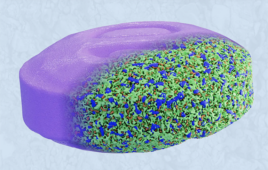
The 1990-founded scientific software firm Schrödinger recently announced a strategic collaboration and software agreement with Bristol Myers Squibb (BMS) built around Bunsen, Schrödinger’s newly announced agentic AI co-scientist. While the term “AI co-scientist” can have varying definitions, Schrödinger is positioning Bunsen as a sort of execution engine for computational chemistry, including workflows already used across large pharmaceutical research organizations.
BMS has been “a customer of ours forever,” said Pat Lorton, Schrödinger’s chief technology officer and chief operating officer. The latest agreement has the two companies working together to develop new functionality in Bunsen, and also covers RetroSynth, Schrödinger’s AI-driven synthesis planning platform.
That history includes LiveDesign, Schrödinger’s collaborative molecular-design platform, where medicinal chemists, computational chemists and other project scientists can work from centralized project data, including proposed compounds, experimental results and in silico predictions.
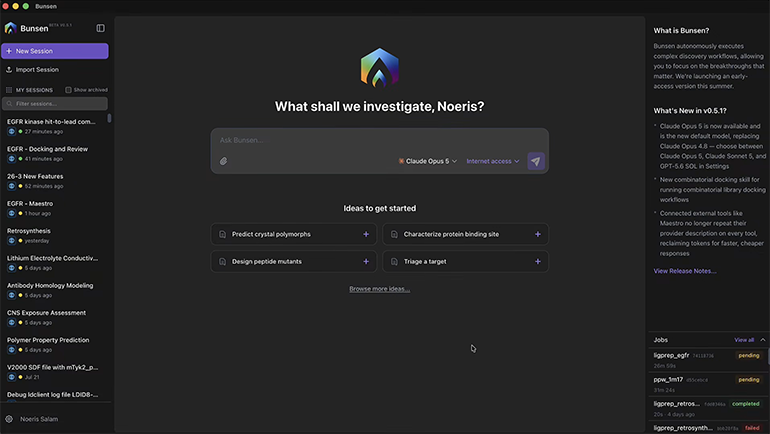
A Bunsen demo shown in a Schrödinger video. [Image: Schrödinger]
On redefining scale and drawing inspiration from aircraft design

Pat Lorton
The Bunsen agreement brings that model into a computational environment where the scale of molecular exploration has expanded significantly. BMS plans a large-scale deployment, although Lorton said the term itself is somewhat elastic in pharma. Five years ago, Schrödinger could enumerate roughly 100 billion compounds around a lead molecule in a weekly cycle, progressively filter them using increasingly accurate predictive methods, and narrow the field to roughly 50 candidates for a CRO or internal synthesis team. Today, Lorton said, “we can easily go into the trillions.” As the pool has grown, so has the number of properties the company can predict, which makes each screen more selective. “The 50 coming out at the end are becoming higher and higher quality over multiple different properties that we can predict,” he said. Each added property forces Schrödinger to widen the top of the funnel if it still wants dozens of candidates at the end. “We need to keep increasing the size of the funnel that goes in at the top.”
Lorton finds inspiration for that evolution in aircraft design, which moved from heavy reliance on empirical testing to, eventually, sophisticated simulation and modeling. “In the ’40s and ’50s, they literally built wind tunnels and carved balsa, and that’s how you figured out the drag on an airplane and how to design it,” he said. The technique was older still, and the Wright brothers helped pioneer wind tunnels in the early 1900s. Decades later, NASA Ames developed a flight simulator and a computational fluid dynamics division. Eventually, the industry embraced supercomputing to address aerodynamic problems numerically, reducing the wind tunnel testing required.
In pharma, the tools for a similar transformation are arriving in stages. “It wasn’t necessarily that we were going to pick one method or one technology,” Lorton said. In Schrödinger’s early years, physics-based simulation was the available path. GPUs became a turning point in the early 2010s, enabling Schrödinger to run physics-based methods such as Free Energy Perturbation (FEP) at greater scale.
How Claude Code helped close the loop
The arrival of Claude Code in limited research preview in February 2025 provided another catalyst for building more agentic workflows. “What Claude Code proved was not that agents work,” Lorton said. “People have had this agent idea for years.” The ability of Claude Code and similar coding agents to write code, compile it, inspect errors or unit-test results and modify what they did next served as an inspiration for scientific workflows as well.
But Schrödinger had been building toward that combination well before the current agent wave, in a lineage separate from the language models Bunsen now runs on. Its January 2020 IPO filing described both “Large-Scale Molecule Exploration,” which used computational enumeration and generative machine learning to propose synthetically feasible molecules, and “Large-Scale Molecule Evaluation,” which applied machine learning and physics-based calculations to idea sets exceeding a billion compounds. AutoDesigner, published in 2022, could generate and progressively filter large molecular spaces, and by January 2024 the company was publicly describing workflows that coupled AutoDesigner with Active Learning FEP+, combining large-scale molecular exploration with physics-based evaluation of potency and selectivity. In Lorton’s analogy to coding agents, those predictive tools offered a counterpart to the compiler and the unit test. “We have these predictive tools that are highly accurate. They’re expert tools, so they require something really smart to interpret the output and decide what to do next,” he said. “But they give you concrete quantitative answers that an agent should be able to understand, and descriptions that maybe we can train an agent to understand what to do next. And that’s what happened.”
Big Pharma adds more computational firepower
The Big Pharma sector’s growing embrace of supercomputing opens up more opportunities. So far this year, Lilly and Roche have both brought major NVIDIA-powered AI computing infrastructure online. Lilly launched LillyPod in February, a DGX SuperPOD with 1,016 Blackwell GPUs, while Roche followed in March with an AI factory spanning more than 3,500 Blackwell GPUs across its on-premises and cloud infrastructure. And then on July 20, BMS announced plans to deploy one of Big Pharma’s top supercomputers, an NVIDIA DGX SuperPOD built on eight DGX Vera Rubin NVL72 systems. BMS has said its “Predict First” approach already brings AI-generated predictions into every small-molecule program and most of its large-molecule programs.
Lorton said supercomputing hardware generally could serve Schrödinger’s physics calculations, its machine-learning algorithms, or a customer’s own locally hosted language models. As open-weight models improve, he said, some pharmaceutical companies may eventually choose to run more of their LLM workloads themselves. Bunsen was designed with that possibility in mind. “The product we’ve built is LLM agnostic,” he said. “It plugs into Claude and works amazing there, but if you install your own open-weight LLM … if you run it locally on your own SuperPod, we’ll be able to use that just as well.” Schrödinger, he added, had “intentionally engineered this product to give customers all the flexibility with that, without trying to tell them which way to go.”
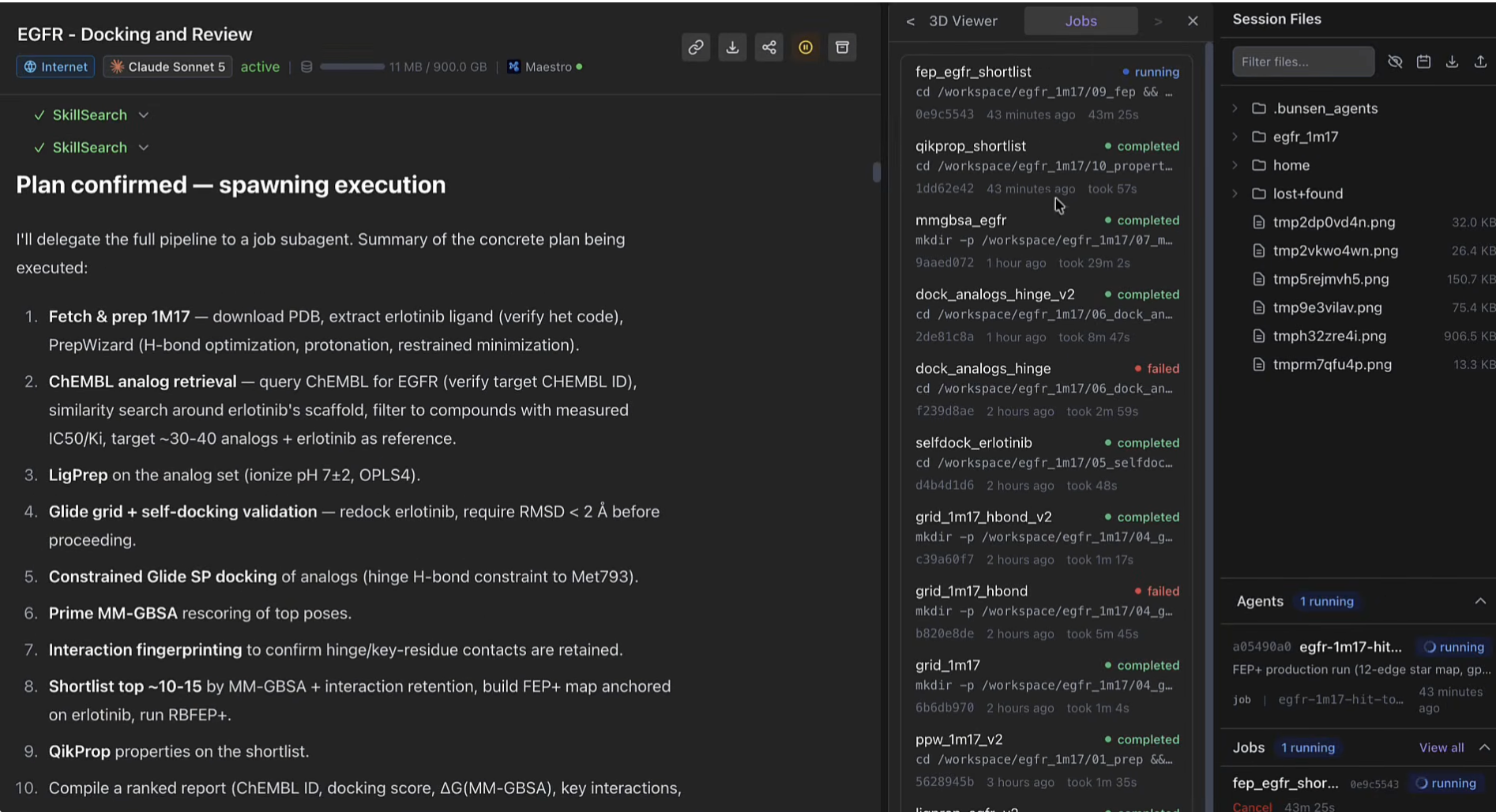
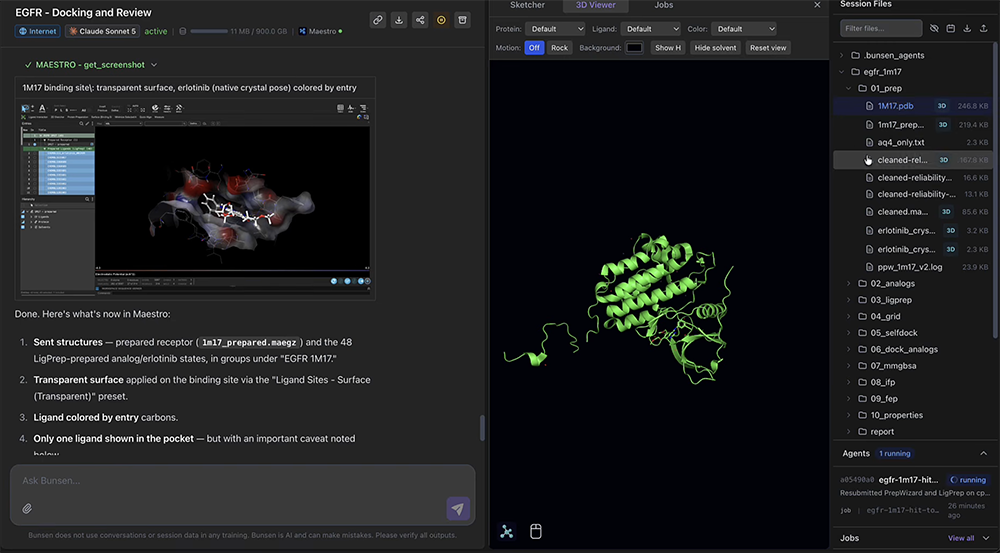
Bunsen can launch and coordinate multi-step drug discovery workflows, similar to how coding agents can execute and iterate through software engineering tasks.
For BMS’s part, Stephen Johnson, vice president of computational sciences at Bristol Myers Squibb, said in the announcement that Bunsen “allows our scientists to think differently about how physics-based tools can be used to navigate molecular design space and accelerate the discovery of innovative medicines for patients.”
BMS has operated a DGX SuperPOD for roughly three years, and in July, an NVIDIA article noted that BMS was building its own AI models. “We’re in production with some very large-scale predictions around large molecules,” said Erin Davis, BMS vice president of Research Business Insights & Technology. “We’re building our own foundational models, and that takes a lot of GPUs.”
Lengthening computational chains and scarce human talent
Adding compute does not by itself connect the pieces. In computational drug discovery, an agent may pass work among predictive models, physics calculations and other specialized tools, and as those workflows grow longer, Lorton argues, accuracy at each step becomes increasingly consequential. “If you have eight different computational products and they’re not built to work together and they don’t perfectly talk to each other, they compound, and by the time you get to the end it’s really hard to have a successful result,” he said.
Lorton sees the availability of computational chemistry expertise as another bottleneck. “Right now the biggest problem we see in the industry for computational prediction is that there aren’t enough people who are experts,” he said. Schrödinger typically assigns up to five computational modelers to each of its own drug discovery programs, according to Lorton. At some customer organizations, he said, an individual program may receive only a quarter or half of one modeler’s time. That can leave computational chemists spending scarce time assembling workflows, locating data and setting up calculations. “For them, the arduous task of just putting these things together is a limiter, a blocker,” Lorton said. “It limits their impact dramatically.” He continued: “When they see something where they can go to a plain text interface, it’s kind of the equivalent of a postdoc for them, where they can say, I really need to run this modeling campaign like this, and you have a really smart co-scientist on the other side able to fill in all the details and ask you where it needs to.”
Bunsen also gives scientists control over how much of a proposed computational workflow the agent can execute itself. Lorton said he expects one of its most-used options to be disabling automatic job launches, leaving the agent to propose a plan and wait. “Come up with a thesis of how you would run calculations to validate what I want to do or not want to do, and then Bunsen will come back and say, this is exactly what I would execute, in this order, with these settings. What do you think? Should I go forward?” Even when scientists allow automatic launching, he said, the agent returns with questions when it encounters ambiguity, and human review remains part of the process. “Sometimes it’ll make mistakes even when it thinks it’s obvious. So you have the ability to review the work.”
Lorton also expects better results when scientists steer the work rather than hand over an open-ended request, which he compared to trying to “one-shot” a large coding project. “You’re going to have a lot more luck if you say, I’m experienced in this space, I think you should probably focus on this part of the molecule, I think you should probably worry about hydrogen bonding in this part of the pocket,” he said. “The human expertise of having seen over many years what they typically change to improve properties, we encode as much as we can in there that’s generic, but often it’s not generalizable,” he added. “If you know your target and know what you’re going after, you will be able to direct Bunsen in ways that it would never be able to come up with on its own.”
Filed Under: machine learning and AI