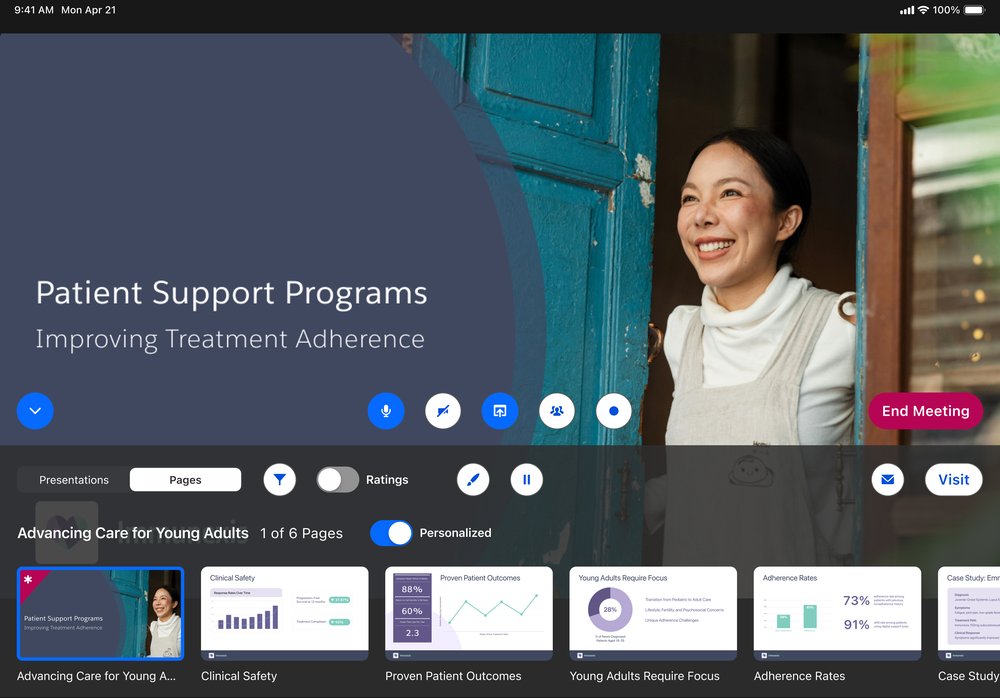
A patient support program engagement run as a remote call, with meeting controls for audio, screen share and recording alongside the approved deck. (Image: Salesforce)
As Peter Gassner, CEO of Veeva Systems, the influential cloud software provider for the life sciences industry, took the stage at the Veeva Commercial Summit in Boston, Salesforce announced that more than 140 life sciences organizations are using its competing Agentforce Life Sciences platform. In the mix as Salesforce clients are several marquee industry names like Novartis, AstraZeneca, Moderna and Merck Animal Health.
“The 140 represents customers across our entire portfolio,” said Joe Ferraro, SVP and GM of life sciences at Salesforce, “regardless of whether they are using it for patient engagement, clinical engagement, commercial engagement or medical engagement.”
Salesforce is positioning Agentforce Life Sciences as a broad, AI-native platform across clinical, medical, patient and commercial engagement. So is Veeva. As Gassner put it at the Commercial Summit: “The Agentic Commercial model changes everything about how we approach commercialization.” For example, he pointed to everything “from digital and non-personal promotion,” how field teams operate as well as content approval and creation.
‘Everybody is using agents’
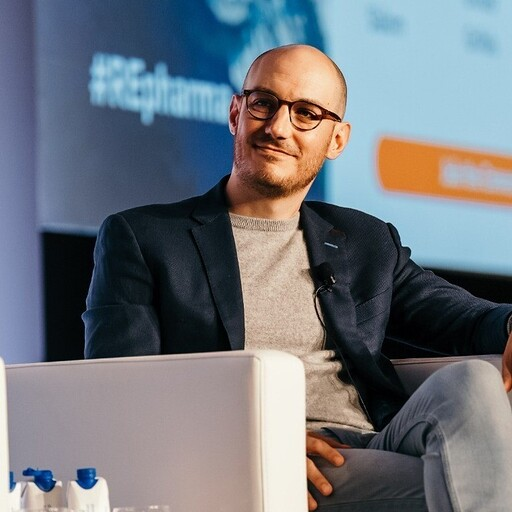
Joe Ferraro
When asked about how Salesforce’s agentic AI strategy compares to Veeva’s, Ferraro said, “Everybody is using agents now. Salesforce has been pioneering AI for the last decade, whereas many legacy systems have been slow to innovate. I would say a combination of our product vision two years ago, when we started this process of [building Agentforce Life Sciences], and customer pressure really forced Veeva’s hand on this.”
Ultimately, Ferraro differentiates Agentforce Life Sciences from Veeva’s offerings in terms of experience. “We are talking apples and oranges,” he said. “We have been in the AI game at Salesforce since the predictive and machine-learning days.”
Salesforce CEO Marc Benioff may have ramped up Salesforce’s AI focus in the wake of the ChatGPT launch, but the history goes back further. At an internal all-hands in 2014, he declared Salesforce an “AI-first company”, the same year it acquired the machine-learning startup RelateIQ for $390 million, and Salesforce launched Einstein, its first CRM AI, at Dreamforce in 2016. In the years since, Benioff has made autonomous agents the company’s central pitch, launching the Agentforce platform at Dreamforce in September 2024, branding it “digital labor,” and setting a goal to empower one billion agents by the end of 2025.
That focus has not died down. On the company’s first-quarter fiscal 2027 earnings call on May 27, Benioff told investors Salesforce had processed 28.6 trillion AI tokens, up 152% quarter over quarter, and called agentic AI “the biggest growth opportunity” for the company since it brought CRM to the cloud, with Agentforce annual recurring revenue at $1.2 billion.
“We have thousands of engineers working on AI at Salesforce right now,” Ferraro said. “There is nowhere near that scale for Veeva, so we are able to move a lot faster from an agentic standpoint.”
For its own part, Veeva announced Falcon on May 27, an agentic platform and set of standard agents for drug development that run in Veeva Development Cloud across its clinical, regulatory and safety applications, with early-adopter availability set for November 2026. Gassner called it the company’s “first offering in agentic labor.”
Vault CRM’s Free Text, Voice, and Pre-call agents went live in December 2025. Veeva’s public roadmap listed Safety and Quality agents for April 2026, and its 26R1 release introduced a Narrative Agent for Veeva Safety. Veeva has been buying as well as building. In March 2026 it acquired Ostro, an AI brand-engagement platform for life sciences, for about $100 million. The acquisition adds conversational AI that answers patient and HCP questions from Medical, Legal, and Regulatory (MLR)–approved content rather than generating novel responses.
At its Commercial Summit event, Gassner previewed a Vault AI Tab coming in August, coming in August, a conversational layer that answers questions against a customer’s Vault data within existing security permissions.
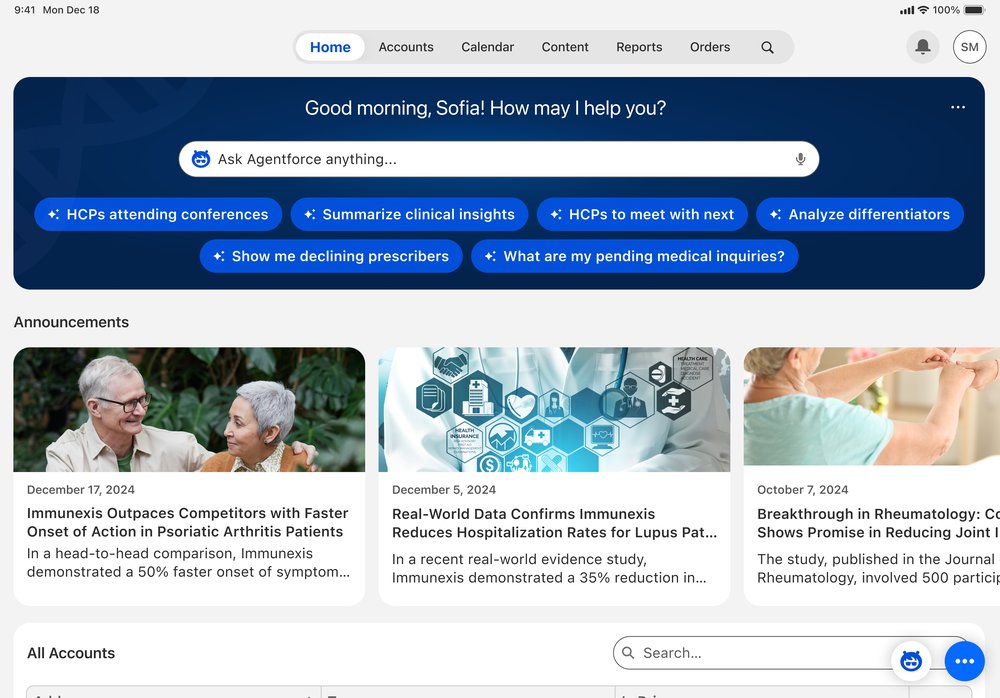
The Agentforce Life Sciences home screen, where a user queries the assistant with prompts such as “HCPs to meet with next” or “Show me declining prescribers.” (Image: Salesforce)
The bet on ‘headless’
The larger agentic strategy is what Salesforce calls “headless.” Ferraro described it as “popping the top off the platform, exposing all the APIs, and exposing all the data models and workflows as MCP tools,” referring to the Model Context Protocol standard that Anthropic introduced in 2024. MCP has since been donated to the Agentic AI Foundation, a Linux Foundation directed fund, in December 2025. Rather than requiring users to work inside Salesforce’s own interfaces, the company exposes its productized workflows as MCP servers that surface inside whatever AI tool a customer already uses. “I was with a customer yesterday who has made a significant investment in Anthropic, and they are going to use our MCP service for Agentforce Life Sciences to bring all of those compliant workflows directly inside Claude,” Ferraro said.
Meanwhile, Veeva’s Vault AI Agents are built to run inside Veeva’s own applications, working in-context against its data, documents, and workflows, a depth-inside-the-app posture rather than a surface-it-anywhere one. Publicly visible examples of connectors that expose Veeva data to outside models today include third-party offerings such as CData. The two also split on the model layer. Salesforce supports a range of Salesforce-managed and customer-supplied models for Agentforce. Veeva fixes the model layer for its standard agents, Vault CRM’s included, running them on Anthropic and Amazon models hosted on Amazon Bedrock, and opens model choice only for custom agents, where customers can use Veeva-hosted models or bring their own on Bedrock or Microsoft Azure AI Foundry.
Agents help speed onboarding
Salesforce has noted that some of its smaller life science customers have completed onboarding in about a month. Meanwhile, companies like Chiesi and CSL are using Salesforce to unify customer data and coordinate engagement across commercial and medical operations. In terms of the rapid onboarding, agents deserve part of the credit, Ferraro said, reducing the need for large teams of consultants to oversee the process. “You get one forward-deployed engineer, and they can do the work of five or 10 previously, because they have Claude Code, or they have Codex, and they can point those tools at the Salesforce platform,” he said. For instance, Salesforce built an MCP server inside Agentforce Life Sciences that configures the product itself. A request like adding a quick action to the iPad app that launches a prompt in the UI, a task a human would handle by navigating through nested configuration screens, gets executed by the agent automatically.

A rep’s in-visit view in Salesforce’s life sciences customer-engagement app with sample content. (Image: Salesforce)
Large models are probabilistic by design, trained to predict likely next tokens from context. That can help summarize a long PDF in seconds, but life sciences workflows demand predictability: how often a rep can message a physician, what the message says, and whether consent exists are all regulated. For that reason determinism is the core theme hanging over agentic software in regulated industries. On compliance, Salesforce and Veeva land in a similar place. Salesforce uses a feature it calls Agent Script to weave deterministic checks, approved templates and consent status into the probabilistic layer. Meanwhile, Veeva runs its standard agents in-context inside its own applications against its data and workflows.
As a result, the model can synthesize and surface, but the regulated action runs through a fixed set of tools backed by deterministic workflows and confined actions. “[The model] cannot go off script, because those tools are unavailable,” Ferraro said. “The tools are outside its toolbox.”
Filed Under: machine learning and AI