
[Adobe Stock]
But the investing weather has changed: there is now greater caution both from U.S. regulators and investors, which has dovetailed with both a surplus of capital and increased regulatory streamlining in China. This creates an even challenging environment for innovative biotech firms.
The key, then, is for U.S. biotech to forge a new path that navigates the challenge of IP appropriation by lower cost Chinese firms, maximizing investment in drug development areas viewed as popular and low risk, or finding an innovative model to operate under that can both open up new markets and create potential cost efficiencies. Each approach carries risks, but also brings the potential to differentiate not only from crowded markets for existing drugs and their derivatives, but also to effectively differentiate from Chinese competition.
Three examples illustrate different solutions to this conundrum.
Keep secret: Variant Bio
Elliott Hershberg writes convincingly about biopharma modality commodification has led inexorably to the modern world of target herding. The progress China has made in streamlining the regulatory constraints on drug development has led to an explosion of innovation, but also an incredible amplification of the target-herding phenomenon. Put simply, the instant a good, new target emerges publicly with clinical data, a dozen companies spring up overnight to pursue the same idea. Given their development cost advantages, these fast followers are increasingly coming from China.
Even 10 years ago this was a big problem—at one point there were over 200 PD-(L)1 inhibitor programs!—but AI has now supercharged the phenomenon. Even for protein therapeutics (and even more so with chemical drugs), it is now trivially easy to work around patent claims and come up with a new molecule that does the same thing. At that point, the profound development cost and speed advantages of China’s regulatory system mean that the copycat program may beat the innovator to market, or at least fast-follow in a way that effectively shortens the patent exclusivity period that makes it possible to recover clinical development costs.
Variant Bio’s solution is simple: develop technology that turns up novel targets that others cannot easily see, and withhold patent filings until the last possible minute. Variant uses its privileged access to genomic sequencing data from very rare, isolated populations to reveal novel genetic clues for human diseases. Rather than scrapping out it in the commodity target space, this allows it to work in quiet isolation throughout most of the development period, a durable advantage.
Funds-maxxing polypharmacology: Spyre and Kailera
There is a silver lining to modality commodification: as an industry we are now very, very good at developing certain kinds of drug molecules.
The expertise translates into lower development risk, so minds eventually turned to the idea of combining things for better efficacy. In turn, combinations can generate an extra layer of patent protection (on the combination itself) and requires a superior level of execution that is likely beyond most would-be copy-cats. And the better therapeutic efficacy that combinatorial synergies unlock allows the developer to grab market share from incumbents.
Spyre Therapeutics is pursuing this strategy aggressively with its portfolio of bio-better IBD monoclonal antibody drugs targeting the old-school targets IL-23, TL1A, and α4β7. Mark Cuban may be selling generic Humira for 95% off, but if efficacy can be doubled the U.S. healthcare system will still pay up. Kailera is doing much the same with weight-loss peptides: semaglutide targets GLP-1, but much better efficacy is generated by bivalent, trivalent, or even quadrivalent peptide constructs (though, sadly, no less vomiting). Like Spyre, none of the targets are novel.
There’s a catch though: development risk may be lower, but development costs are not. Each company raised over a billion dollars to pursue these sprawling clinical programs.
Novel platforms: Lumen Bio
A more cost-efficient approach is represented by Seattle’s Lumen Bio (disclosure: co-founded by co-author Brian Finrow). Like Spyre and Kailera, its pipeline includes biologic cocktail drugs that yield powerful therapeutic synergies, but leveraging a completely novel biomanufacturing platform technology—one with far greater scalability and delivered cost advantages that also make preventive drugs and international markets far more addressable.
However, this novelty comes with pros and cons. A disadvantage is that novel biomanufacturing platforms have been out of fashion with investors since the end of the Covid era in 2022. Relatedly, biopharma companies generally prefer to work with technologies that are compatible with their existing manufacturing footprints—commodified modalities, as it were. Nevertheless, the competitive advantages outweigh these considerations.
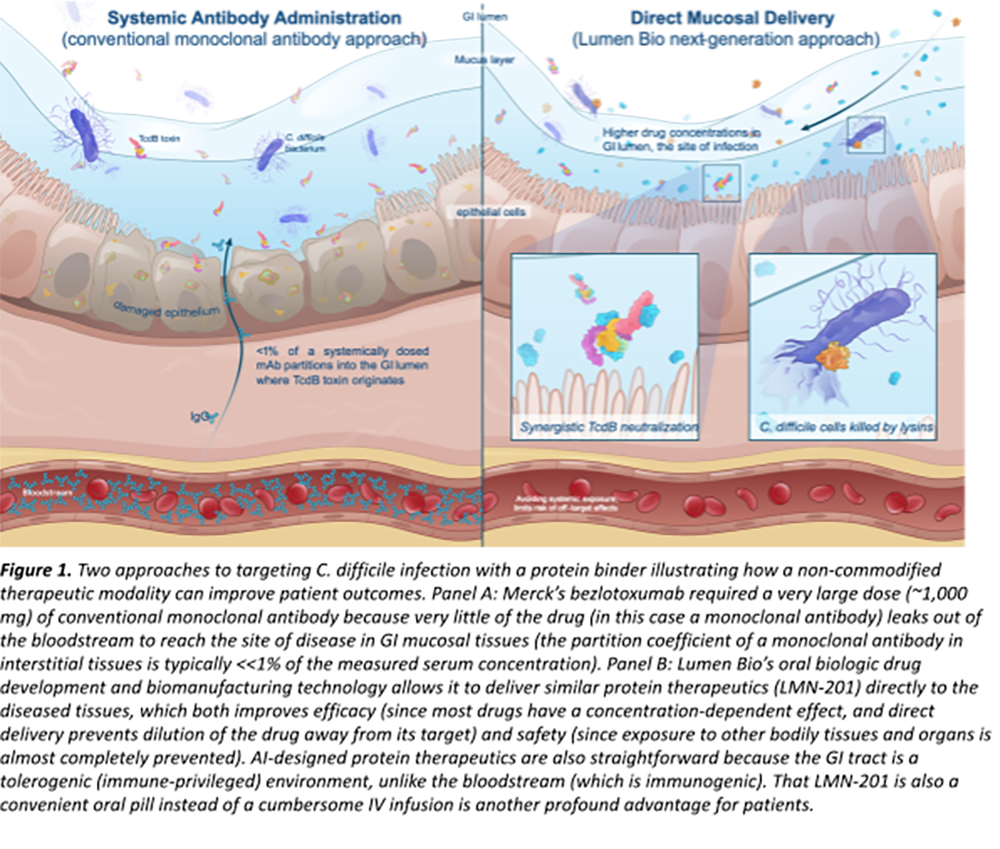
Beyond just the competitive considerations, new therapeutic modalities represent new ways of going after unmet medical needs. For example, LMN-201 attacks the same target as the IV-infused Merck antibody bezlotoxumab (Figure 1, left panel), but orally not by injection, which makes it far easier to treat the disease, specifically, Clostridioides difficile (C. diff) infection (Figure 1, right panel). Moreover, the lack of pre-existing manufacturing capacity means that would-be competitors have a much steeper hill to climb when they try to catch up to a novel product launch. Moderna’s triumph with its Covid-19 mRNA vaccine illustrates the huge upside potential given that all other legacy vaccine manufacturing approaches ultimately failed the market test.
Conclusions
Deep, durable innovation requires not only an appetite for risk, but identifying both a potential market and a pathway to delivery. Keeping a product secret provides a huge potential payoff, if the secrecy can be kept and investors are patient. Modality commodification can reduce development risk, but it then requires proving both increased efficacy and successful market differentiation. Developing a new platform also runs real risks, as any fully novel approach does, but also carries with it the opportunity for new markets and reduced product costs. The key to American biotech keeping its competitive edge amidst Chinese competition lies in the artful balancing of the tradeoffs among these three approaches.
Brian Finrow is CEO, co-founder, and co-chair of Lumen Bioscience, a clinical-stage biotechnology company in Seattle. Kevin Klowden is an economist and principal at Melcene Advisory and senior fellow at the Milken Institute.
Filed Under: Biotech