 Proteolysis Targeting Chimera (PROTAC) drugs have evolved from a promising concept to a clinically validated modality. In May 2026, the U.S. FDA approved vepdegestrant (Veppanu®), the first PROTAC drug, marking an important milestone for targeted protein degradation and reinforcing the approach across a multitude of disease areas.
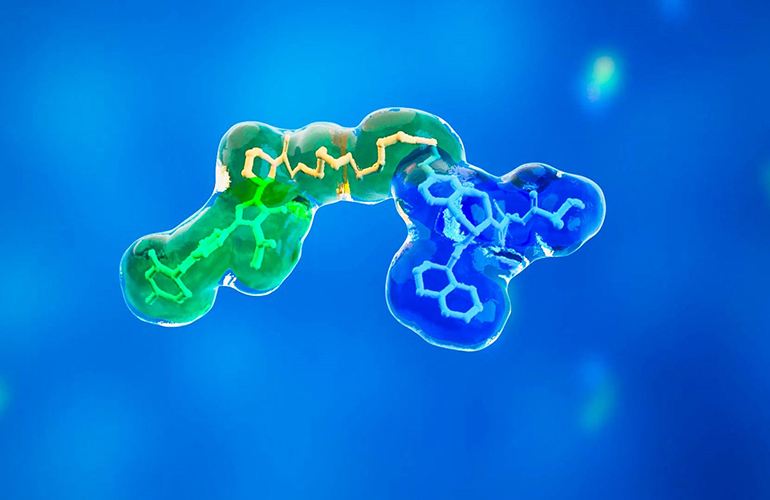
PROTACs usually consist of three parts: a target-binding warhead, an E3 ligase recruiter, and a connecting linker. Rather than directly inhibiting a target protein, PROTACs induce target degradation by proximity-driven ubiquitination via the ubiquitin-proteasome system—a process termed “chemical knockdown.”
The chemical knockdown mechanism creates several intriguing options for drug developers and sponsors. For example, PROTACs operate through an event-driven, catalytic mechanism rather than stoichiometric target occupancy, enabling sustained degradation even after drug dissociation. This critical difference means they can maintain efficacy at low concentrations and may offer a solution to reaching “undruggable” proteins.
However, the same properties that make PROTACs biologically powerful make them difficult to develop as oral medicines. Their large size, high polarity, and beyond-Rule-of-Five (bRo5) characteristics can limit solubility, permeability, and systemic exposure. Thus, oral optimization should be approached as a cross-functional challenge encompassing molecular design, target vulnerability assessment, DMPK strategy, ultrasensitive bioanalysis, and translational development planning.
Outlining one of PROTACs’ biggest problems
PROTACs’ oral drug properties are one of their biggest development challenges. Many degraders sit in the bRo5 chemical space, where traditional small-molecule rules of thumb provide useful context but do not fully explain which compounds will achieve meaningful oral exposure.
Most discussions about PROTAC challenges begin with Lipinski’s Rule of Five, which links poor absorption and/or permeation to properties like more than 5 hydrogen-bond donors (HBD), more than 10 hydrogen-bond acceptors (HBA), molecular weight above 500 Da, and calculated log P above 5. By those criteria, many PROTACs appear inherently disadvantaged. They frequently exhibit high molecular weight (>700 Da), elevated polar surface area (> 150 Ų), and excessive rotatable bonds (>15)—pushing them beyond traditional drug-like space.
This is why oral PROTAC optimization needs a more specific framework than Rule-of-Five screening. Recent studies of orally bioavailable PROTACs suggest that solvent-exposed hydrogen-bond donors (eHBD), conformational behavior, and polarity shielding may be especially important in bRo5 approaches. In fact, a 2024 analysis identified an upper limit of approximately eHBD ≤2 as a useful discriminator within related oral PROTAC series.
In practical terms, many PROTAC molecules struggle with the same interconnected liabilities: poor aqueous solubility, limited membrane permeability, and insufficient systemic exposure after oral dosing. Improving one property does not guarantee success because modifications intended to increase exposure can alter formation, cellular activity, selectivity, or metabolic stability, which is why oral bioavailability is best treated as a multifaceted developmental challenge instead of a single-parameter chemistry one.
Drug development programs are more likely to find success when liabilities are identified early. Using a combination of structural biology, fit-for-purpose biochemical and cell-based assays, and early DMPK profiling, teams can improve exposure without losing the results needed for lead optimization, candidate selection and IND progression.
Addressing PROTACs’ oral exposure problem
A PROTAC can show strong results in a lab yet struggle as an oral therapy. Solving that challenge means understanding where oral exposure is being lost and addressing each issue in a practical way.
Figure out the food effect
One practical way to improve oral exposure is to determine whether a PROTAC performs better under fed-state conditions. Since solubility in the gastrointestinal tract is one of the key factors for oral absorption, poorly soluble degraders may exhibit different behavior in biorelevant intestinal media than in simple aqueous buffers.
This point is especially relevant to PROTACs, which often combine poor aqueous solubility with bRo5 physicochemical properties. Prior studies have shown improved solubility for PROTAC molecules in biorelevant matrices like fasted- and fed-state simulated intestinal fluid (i.e., FaSSIF and FeSSIF). The fed-state matrix may provide better solubility, suggesting that food can improve exposure for at least some compounds in this class.
Clinical and translational examples make the argument more concrete. The FDA-approved label for vepdegestrant recommends 200 mg orally once daily with food, and ARV-110 has also shown a food-related increase in oral bioavailability in preclinical ADME work. The big takeaway is not simply to “dose with food,” but to “understand the food effect early.” Biorelevant solubility testing, exposure measurement, and fit-for-purpose DMPK and bioanalytical studies can help determine three important things:
- Whether a fed-state dosing meaningfully improves absorption;
- Whether the effect is formulation-dependent;
- Whether the resulting PK profile is robust enough to support candidate selection and later clinical planning.
Optimize linker design
Many PROTACs are large and polar, so permeability is often a major barrier to systemic exposure and pharmacological activity. Linker optimization can improve cellular permeability, which matters for oral PROTACs in two ways. First, the molecule must cross the intestinal epithelium to be absorbed, and then it must enter target cells to degrade the proteins of interest. Studies have shown that replacing a PEG linker with a 1,4-disubstituted phenyl ring can improve cellular permeability. Reducing unnecessary hydrogen-bonding features, including multiple amide motifs, may also help improve PROTAC membrane permeability.
In other words, the linker has a profound impact on passive cell permeability by its length, shapes, polarity, rigidity, and conformational folding. More recent studies have shown cell-permeable PROTACs often adopt folded, lower-polarity conformations in nonpolar environments. They also show that nitrogen atoms and other linker edits can help balance solubility with membrane permeability. However, permeability gains are only useful if degradation biology is retained. For this reason, fit-for-purpose cell-based assays, mechanism studies, and early ADME profiling should be conducted together. That can help teams determine whether a linker change improves the overall candidate profile or just shifts the balance between solubility, uptake, and activity.
Even when dissolution and absorption improve, oral PROTAC exposure can still be limited by metabolism in the intestine and liver. Therefore, improving metabolic stability is a central strategy for preserving systemic exposure after oral dosing. The linker is often the best place to start. Studies have shown that linker length, attachment site, and conformational constraint can affect metabolic stability. In some cases, cyclic or shorter linkers have reduced metabolic liability while supporting better overall PK. These changes can also affect complex formation and degradation efficiency. Metabolic optimization works best when lead optimization is paired with mechanism-relevant assays, early ADME/DMPK, and bioanalysis. This kind of integrated approach helps teams improve exposure without compromising the biology that makes the degrader worth further development.
Choose E3 ligases wisely
Linker design is only part of the oral exposure equation. The E3 ligase determines molecular weight, polarity, conformational behavior, and ultimately how “oral drug-like” a PROTAC can become. In practice, CRBN and VHL are the most widely used E3 ligases in PROTAC design, with IAP and MDM2 also used in the field. Among these, CRBN-based degraders are often the better choice for oral optimization because CRBN ligands can support smaller designs. Vepdegestrant, for example, is an oral CRBN-recruiting degrader. Analyses of orally bioavailable PROTACs tend to be more drug-like compared to their ligase class. This makes E3 ligase selection as much a decision about developability as it is about biology. That is why target biology, hit finding, structural biology, and early property assessment should be aligned early when selecting ligase-recruiting strategies or exploring new E3 ligands.
Introduce intramolecular hydrogen bonds
Once the linker and ligase framework is in place, the next challenge is conformation. Many PROTACs carry high polarity and multiple rotatable bonds, making passive membrane diffusion difficult without changing the molecule’s shape and size. This is where intramolecular hydrogen bonds can help. PROTACs with stronger folding propensity can form internal hydrogen bonds and other intramolecular interactions, reducing exposed polar surface area and improving cell permeability.
The potential is real, but so is the design challenge. Intramolecular hydrogen bonding depends on the placement of donors and acceptors, linker flexibility, and the molecule’s ability to adopt the right folded state. This is why oral PROTAC optimization must include integrated design and testing. Structural insight, conformational analysis, cell-based permeability assays, and early PK data can help determine whether the scaffold is truly improving the candidate profile.
Consider using a prodrug
If tweaking the molecule’s design does not work, a prodrug strategy may be the best path forward. Modified versions of active compounds designed to improve solubility, permeability, or absorption; prodrugs convert in vivo to release the active agent. For PROTACs, that approach is promising but selective. Prodrugs help mask liabilities that limit oral delivery, but they also add molecular complexity.
In one study, researchers improved oral bioavailability by attaching a lipophilic group to the CRBN ligand of a PROTAC prodrug. This suggests carefully designed promoieties can help CRBN-based degraders overcome exposure barriers.
This underscores why discovery and development testing should be closely linked. An effective prodrug strategy depends on chemistry, as well as bioanalysis, ADME, and PK studies to show when and where conversion occurs, whether the active degrader reaches the right exposure window, and whether the added complexity is justified before candidate progression.
Consider molecular glues
Because PROTACs combine two ligands and a linker in a single molecule, their size and polarity can create limits that cannot be solved through linker or formulation changes. At that point, it may be worth considering adjacent targeted protein degradation modalities, including molecular glue. It is mechanistically similar to a PROTAC but structurally distinct. They are typically small molecules that alter or stabilize protein-protein interactions without relying on the linker-ligand architecture. The simpler architecture can create different property and formulation opportunities, including a more favorable starting point for permeability and PK testing. However, molecular glues should not be considered a replacement for PROTACs. Instead, they are an alternative strategy when the desired biology is clear and oral exposure remains difficult.
The bottom line on PROTACs
PROTAC drugs now have what the field has been working toward for years: clinical and regulatory validation. Their event-driven mechanism of action provides a differentiated way to eliminate disease-causing proteins, and the 2026 approval of vepdegestrant demonstrated that this approach can translate into an oral medicine. The bottom line is that PROTACs can be powerful drugs, but many will succeed or fail based on whether drug developers and sponsors can solve the oral-development challenges of solubility, permeability, metabolism, and exposure early enough to support confident candidate selection and IND readiness.
Tao Xiong is a Director in the DMPK Department at WuXi AppTec, with more than 19 years of experience in drug metabolism and pharmacokinetics. She has extensive expertise in the preclinical development of novel therapeutics and led the establishment of a permeability assessment platform for emerging drug modalities. She has supported more than 200 global IND-related programs.
Filed Under: Drug Discovery, Preclinical testing