Negative biosensors have often been unusable because, as the sensors lose signal when activity is detected, regions of high enzyme activity can look identical to regions with no activity. Researchers at the University of Illinois Chicago have solved this problem with a new cell imaging method that allows scientists to see previously hidden enzyme activities by flipping the optical readout of negative biosensors into positive feedback. Their findings were published in the Proceedings of the National Academy of Sciences.
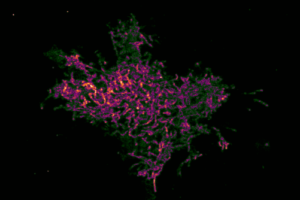
A cell responds to an incoming signal by activating responses only where needed, as shown in yellow. Credit: Gary Mo
The technique, called Fluctuation Increase Negated by Intra-Chain Interaction, or FINICI, allows researchers to visualize biosensors at a resolution below the diffraction limit, letting them see activity in cellular structures that are too small to distinguish with conventional light microscopy.
“The FINICI platform reversibly changes the electronic state potential of a chromophore, by using an electrostatic interaction between fluorescent proteins,” Gary Mo and Kriti Srivastava, who worked on the research, explained in an email to R&D World. “This interaction restricts the chromophore, disallows electron delocalization and reduces the number of transitions possible, and so suppresses fluorescence and blinking.”
Validating FINICI
The team tested FINICI by using it to image the activity of Src kinase, Syk kinase and cGMP.
They found that Src kinase, a protein linked to cancer and cell movement, showed bursts of activity in small areas of the cell membrane, including cholesterol-rich lipid rafts. Some of the regions appeared briefly before dissolving while others persisted longer. These differences are not visible in traditional, whole-cell measurements.
The team also found that cGMP formed small clusters that were quickly overwhelmed as the signal spread and that Syk kinase was most active near immune cells’ internal scaffolding.
“From our perspective, the findings together showcased new ways that cells actively use compartmentalization. We knew that enzymes are anchored by adaptor proteins, and that appears true for Syk, only away from the membrane where it’s activated. But the case with Src hints that membrane lipids can also control anchoring. And cGMP showed that forming a nanodomain is not the end, we can still tune its usefulness via a dynamic background,” Mo and Srivastava said in an email.
The researchers validated the detection sensitivity of FINICI against Förster resonance energy transfer (FRET), the gold standard, they said in an email. They found that FINICI is usually more sensitive than FRET in cells where receptor expression is low, showing activity where FRET saw no response.
To ensure that FINICI’s response reflects only the enzyme of interest, the researchers used biological controls such as cells without the target enzyme or receptor to check against artificial responses.
Expanding information
The scientists believe FINICI will expand the information available during the drug discovery process.
“Activity images allow us to ask questions like: was enzymatic action diffuse or have a cohesive spatial pattern? Are they indicative of organelles or unknown locale? What dynamics do these patterns follow? And how much does each cell vary? These are the previously hidden dimensions, now made identifiable and open to screening,” the researchers said in an email.
FLINC, a cousin to FINICI, showed that a small molecule kinase inhibitor used far beyond its IC50, the concentration typically needed to cut an enzyme’s activity in half, still did not completely inhibit the enzyme. Phosphorylation was still active in microdomains 250 nm in size, and the kinase could further signal.
“It took a peptide that dissociated the anchoring complex to abolish the microdomains for complete inhibition,” Mo and Srivastava said in an email.
“We believe that drug discovery with FINICI will have more information, like a transcriptomic screen,” they added.
FINICI could also have implications outside of drug discovery, they said. For example, it could be used to detect heterogeneity in biomaterials to highlight locations of stress or compression.
Their next goal is a larger scale assay development. Mo and Srivastava said they are focusing on automation and pattern learning in microscopy as they work on multiplexing more observables. They are also considering higher resolution, as the compartments they have resolved so far range from 150 nm to 200 nm. It’s not clear whether cells use compartments smaller than that.
Filed Under: Drug Delivery, Genomics/Proteomics

![A display of DNA sequencing output from an automated ABI 373 sequencer. [National Human Genome Research Institute (NHGRI)]](https://www.drugdiscoverytrends.com/wp-content/uploads/2024/06/51187236177_b7b566a401_k-268x170.jpg)