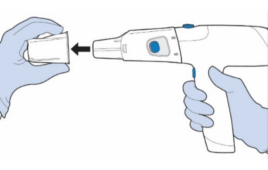
Micron Biomedical, a company working on painless, microneedle drug delivery, secured a National Institute of Allergy and Infectious Diseases (NIAID) $4.5 million contract through the institute’s Radiation and Nuclear Countermeasures Program, announced July 27.
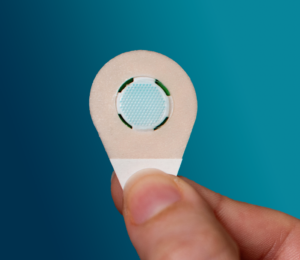
Micron Biomedical’s dissolvable microarray-based drug and vaccine administration technology. Credit: Micron Biomedical
The contract is for the development of a medical countermeasure against radiation injury that combines Micron’s dissolvable microarray delivery technology with Connext‘s TLR5 agonist, xempritolimod, aimed at Acute Radiation Syndrome (ARS), the illness that follows a high-dose radiation exposure over a short period. The platform would be thermostable, deployable by minimally trained personnel or self-administered and disposable as sharps-free waste, making it suitable for rapid deployment in an emergency.
“If something happened, we’d be able to quickly get it to that location and to those people, and they’d be able to self-administer it. It would allow a fast response,” Steven Damon, CEO of Micron Biomedical, said in an interview with Drug Discovery and Development.
The technology features what Damon calls a “button,” or microarray patch, that patients or caregivers put on the back of the wrist, push to release the medicine and then discard.
In addition to rapid deployment of treatment during emergencies, the technology can be used for vaccines and injectable weight loss medications, Damon said.
For low-income countries that struggle with outbreaks of diseases like measles, the platform can remove barriers to access, according to Micron Biomedical. “They don’t need a doctor to administer it. They can self-administer it, or a mom can administer it to her child… it can be put on a moped and driven into villages that don’t have access,” Damon said.
Additionally, because the microarray patches don’t have to be refrigerated, they could be stockpiled for biosecurity events or pandemics.
How the microarray patch works
Micron’s technology originates from Mark Prausnitz’s lab at Georgia Tech. Micron was cofounded by Prausnitz, Devin McAllister and Sebastien Henry and licenses the microneedle technology from Georgia Tech.
Micron describes the technology as needle-free, though its patents call it a microneedle patch. The projections are microscopic and dissolve in the skin.
To use a medicine in the microarray patches, Micron first formulates it into a liquid solution and casts it onto a micro-molded template. Then, they apply vacuum from beneath the mold to pull the solution into the microscopic needle cavities and eliminate air bubbles.
The mold is then dried, which solidifies the drug, making it stable without cold storage. Finally, Micron adds a backing layer and removes the finished array from the mold.
The patient or a caregiver applies the microarray patch to the skin and administers the medicine by pressing a button. The microarray only penetrates the upper layers of skin, and doesn’t reach deeper nerve endings, allowing for virtually painless delivery.
“It’s the first delivery system like this in the world; nothing like it existed before,” Damon said.
A trial published in The Lancet tested the patches against three strains of influenza, finding that the patch showed numerically higher seroconversion, a measure of immune response, than injection across all three strains, though the study found the differences were not statistically significant. Most notably, the patch showed a seroconversion of 71% at day 28 compared to 32% for the injection for the B strain.
Through a separate CEPI-funded partnership, Micron is applying its patch technology to CastleVax’s rapid-response vaccine platform, aimed at compressing development timelines for future pandemic and epidemic threats.
The technology, however, could not be used for large-dose therapeutics due to the size of the array cavities, Damon said. “We’re dose limited, but within that limit we can handle many, many drugs.”
The next steps for Micron
Now, Micron is partnering with Connext, a Korean clinical-stage biotech company, under the NIAID contract to use its technology for radiation countermeasures.
“It’ll go into warehouses and be stockpiled, so it’s available if we ever need it,” Damon said.
Micron hopes to get its first products on the market as soon as 2028, Damon said.
“The key to improving that timeline was building out manufacturing, we actually had to invent the equipment, and that equipment is being built domestically. Facilities and manufacturing for commercial-scale production are essential. So my vision is that our first products, even if they’re smaller products to start, will be out no later than two years from now,” he said.
The company is working on proving its platform to the FDA, but once that is done, Damon hopes things can move faster as the company apples the delivery technology to drugs that are already approved while it simultaneously pursues new drugs through the three phases.
Figuring out how to produce the product at scale is the company’s top focus, Damon said, followed by getting other companies’ vaccines and therapeutics onto the platform.
Filed Under: Drug Delivery, Immunology