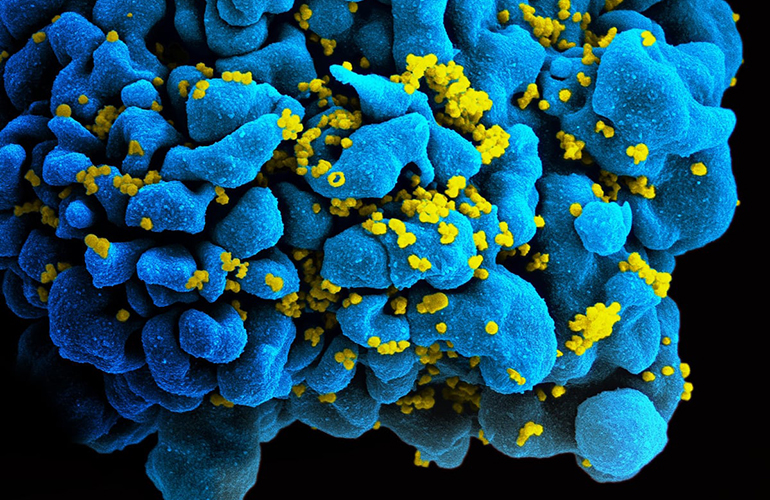
Colorized scanning electron micrograph of an HIV-infected T cell. *Image credit: NIAID/NIH*
The FDA has approved ViiV Healthcare’s Tivicay PD (dolutegravir) for treating HIV-1 in pediatric patients weighing at least 2 kg, including eligible newborns, the company and FDA announced.
FDA first approved Tivicay in August 2013 for adults and adolescents aged 12 or older weighing at least 40 kg (about 88.2 pounds). The agency approved the dispersible Tivicay PD formulation in 2020 for patients at least four weeks old and weighing at least 3 kg, or about 6.6 pounds. The expanded indication removes the minimum-age requirement and lowers the weight threshold to 2 kg, or about 4.4 pounds.
Though UNICEF reports that roughly half of babies living with HIV die before age 2 without treatment, perinatally acquired HIV infections are relatively rare in the U.S. Since 2018, they have numbered fewer than 50 annually among people born in the country, while preventive care has reduced the perinatal transmission rate to 1% or less.
“For too long, newborns living with HIV have had too few treatment options designed and studied to meet their unique needs, despite the importance of starting treatment as early as possible,” said Diana F. Clarke, Pharm.D., a Boston University School of Medicine professor and lead investigator of the IMPAACT 2023 study, in a statement. Clarke called the expanded approval “an important advance for the care of newborns.”
The expanded label covers dolutegravir in combination with other antiretroviral agents. Eligible patients can be treatment-naive or treatment-experienced and integrase strand transfer inhibitor-naive. ViiV described Tivicay PD as the first second-generation integrase inhibitor approved for children in this age and weight group.
FDA granted the application Priority Review. ViiV said the decision was supported by the NIH-funded IMPAACT 2023 study and pharmacokinetic modeling incorporating additional pediatric data.
IMPAACT 2023 was a multicenter phase 1 study designed to establish the pharmacokinetics, safety and tolerability of dolutegravir during the first four to six weeks of life. The network enrolled 48 mother-infant pairs at sites in South Africa, Thailand and the United States.
According to FDA, 48 newborns exposed to HIV-1 and weighing at least 2 kg received Tivicay PD from birth for up to six weeks, along with standard-of-care antiretroviral medications used to prevent mother-to-child transmission. Researchers followed the newborns for 16 weeks. Drug levels were similar to adult exposures associated with efficacy, and the safety profile resembled that observed in older pediatric and adult patients.
Preliminary results presented at CROI 2025 provided more detail on a 15-infant chronic-dosing cohort. The full-term infants weighed 2.3 to 3.6 kg and began treatment during the first five days of life. They received a 5-mg Tivicay PD tablet every other day through the first two weeks, followed by daily dosing.
Commercially, the standalone Tivicay brand has plateaued. GSK reported £1.323 billion in Tivicay sales during 2025, down 2% at actual exchange rates and flat at constant exchange rates from £1.350 billion in 2024. First-half 2026 sales totaled £629 million, down 3% on a reported basis and 2% at constant exchange rates.
GSK’s wider HIV portfolio continued to grow, reaching £7.687 billion in 2025, an 11% increase at constant exchange rates. GSK attributed the growth primarily to Dovato and the long-acting products Cabenuva and Apretude, which offset declines among its older HIV products.
Filed Under: Infectious Disease