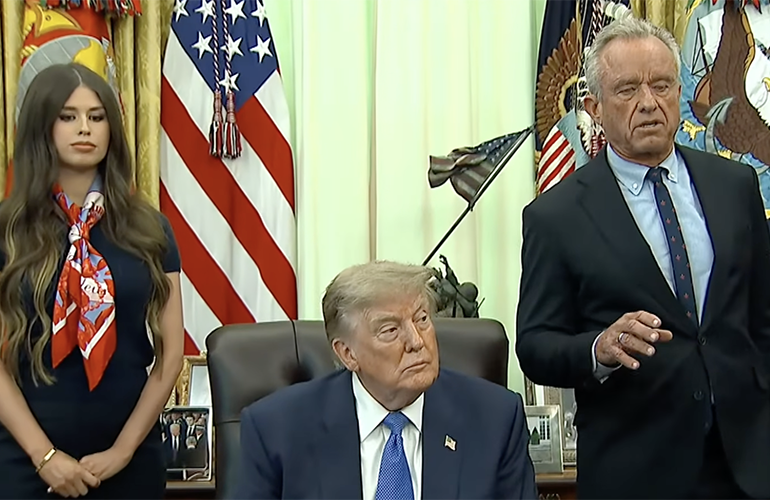
President Donald Trump, center, with Jayme Franklin, founder and CEO of The Conservateur, and HHS Secretary Robert F. Kennedy Jr. during the Aug. 10 announcement of an executive order on childhood vaccine recommendations.
The U.S. entered August with more measles cases so far this year than it recorded during all of 2025. With kindergarten MMR coverage down to 92.5% from 95.2% before the pandemic, and Stanford modeling published in JAMA projecting measles could become endemic again within roughly two decades at current rates, President Donald Trump issued a new Executive Order calling for fewer childhood vaccines for most children.
The order, titled “Delivering gold standard childhood vaccine recommendations for Americans,” was issued on Monday, gives the HHS Secretary 90 days to present plans to offer MMR vaccines as separate single vaccines, assess the timing and sequencing of childhood vaccines and adjust the schedule based on “gold standard science” and develop alternatives to aluminum adjuvant and conduct safety and efficacy studies.
The executive order partly rationalizes the decisions on the basis that the U.S. administers more childhood vaccines than other industrialized countries and “more than twice as many doses as some European nations.” It also asserts “maximizing parental choice,” threatening federal legal action against states that propose their own vaccine laws.
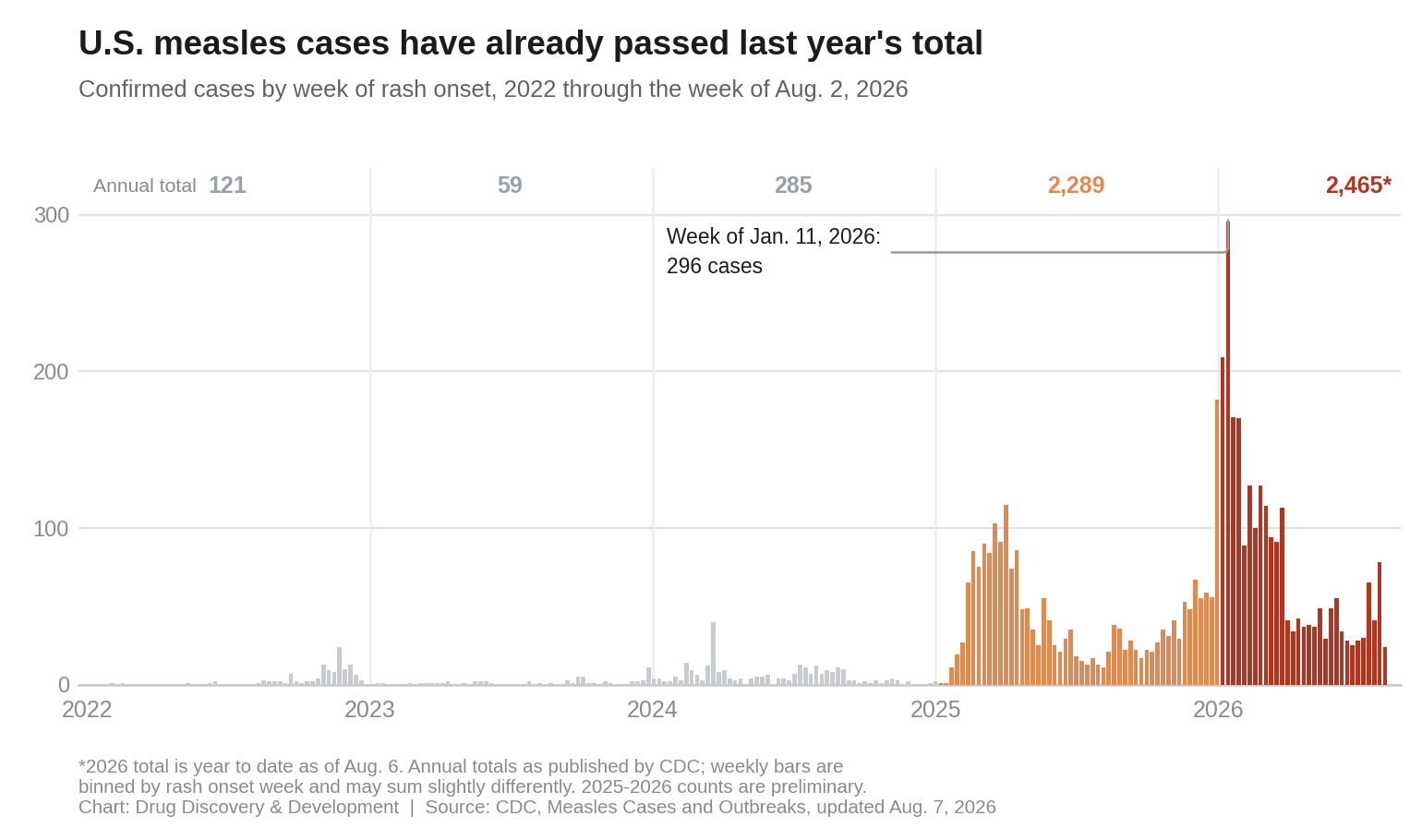
Weekly confirmed U.S. measles cases by rash onset date. The 2026 year-to-date total of 2,465 as of Aug. 6 already exceeds the 2,289 cases reported for all of 2025. Source: CDC | accessed August 11, 2026.
The American Academy of Pediatrics (AAP) called the executive order “disheartening and dangerous,” while separately backing annual influenza vaccination of “all children without medical contraindications starting at 6 months of age” on the same day.
“Dozens of studies involving millions of people show there is no link between vaccines and autism, and yet federal leaders continue to promote this outdated, disproven idea to scare families,” said AAP President Andrew Racine in a statement.
Administration backs reducing vaccinations for most children
Trump’s executive order also recommends reducing the number of diseases covered by the childhood vaccine schedule from 18 to 11, moving vaccines for COVID-19, rotavirus, influenza, hepatitis A, hepatitis B and bacterial meningitis to high-risk-only or shared clinical decision-making categories.
The changes closely match the childhood vaccine schedule HHS announced in January, which was blocked by a federal judge in March. Executive orders are not the typical mechanism for decisions about vaccine recommendations.
Dorit Reiss, a professor at UC Law in San Francisco, told CNN that “Several Congressional laws put the power to make these recommendations on the [CDC’s] Advisory Committee on Immunization Practices, with approval or rejection by CDC director. The President can direct CDC to convene ACIP and consider these changes, but an Executive Order is not a substitute to that process.”
The MMR vaccine, which protects against measles, mumps and rubella, has been given as a combined vaccine in the U.S. since 1971. The standard schedule calls for two doses, one at 12 to 15 months of age and another at 4 to 6 years old.
Distrust in this vaccine is commonly traced to a 1998 paper that falsely claimed causative links between the MMR vaccine and colitis and between colitis and autism. One of the authors, Andrew Wakefield, was employed by a lawyer representing parents in lawsuits against vaccine producers. The Lancet retracted the paper in February 2010, and that May the UK General Medical Council found Wakefield guilty of serious professional misconduct and struck him from the medical register. He called the move “predictable and inevitable.”
Individual single-disease measles, mumps and rubella vaccines have not been available in the U.S. since they were phased out in 2009.
The two-dose schedule dates to the last major U.S. measles resurgence. From 1989 through 1991, more than 55,000 cases were reported, peaking at 27,672 in 1990. CDC attributed the resurgence primarily to children missing vaccination at the recommended age, while outbreaks among vaccinated school-age children prompted ACIP, the AAP and the AAFP to recommend a second MMR dose.
The administration asserts a link between vaccines and autism
The current Trump administration has repeatedly claimed there is a link between vaccination schedules and autism rates, with HHS Secretary Robert F. Kennedy Jr. being especially vocal on this point.
While autism is not mentioned in the order itself, it featured prominently in the press conference announcing it.
“I want to find what’s going on with autism,” Trump said. The incidence is “many, many times what it used to be years ago, and it gets progressively worse, and we add progressively more and more vaccines,” Trump claimed.
Kennedy, in suggesting a link, referenced a 1970 Wisconsin study, calling it “the biggest epidemiological study at that time in history.” He said researchers examined “all the eight-year-olds in Wisconsin, about 900,000 children” and found an autism rate of 0.8 per 10,000.
The study appears to be psychiatrist Darold Treffert’s Epidemiology of Infantile Autism, published in the Archives of General Psychiatry in May 1970. Treffert counted cases already coming to attention or under treatment between 1962 and 1967 across Wisconsin’s mental health clinics, hospitals, training schools and diagnostic centers, against a state population of roughly 900,000 children aged 12 and under. “They kept an incidence rate of 0.8 per 10,000, so less than one in 10,000,” Kennedy said. CDC’s own database of autism prevalence studies lists 69 cases from that study, or 0.077 per 1,000, and records its case ascertainment as health records and its case definition as Kanner criteria, referring to the original clinical features of “early infantile autism.” A later University of Wisconsin account of Treffert’s work reports 280 children ages 3 through 12 meeting criteria for “infantile autism,” corresponding to 3.1 per 10,000. The fourfold difference comes from how narrowly the condition is defined, within a single study.
Kennedy noted that the current autism rate, according to CDC, is “one in every 31 children.” He continued: “In California, it’s one in every 19 children, one in every 12.5 boys.”
Those figures align with CDC’s 2022 surveillance data, with one qualification. The one-in-31 estimate is the average across 16 sites in 14 states and Puerto Rico. CDC cautions that those areas are not nationally representative. Prevalence ranged 5.5-fold, from 9.7 per 1,000 in Laredo, Texas, to 53.1 in the California site, which covers part of metropolitan San Diego. CDC’s researchers attribute part of that 5.5-fold spread to differences in screening practices, diagnostic access and services rather than underlying rates. Study co-author Walter Zahorodny of Rutgers told Reuters in 2022 that the true national rate is probably closer to what the report found in California or Pennsylvania, adding that “California in particular has a longstanding and excellent program for screening and early intervention.”
Kennedy has separately rejected that explanation for the national trend, calling the argument that autism is simply being noticed more “an absurdity” that “has been debunked again and again and again by peer-reviewed literature.” He continued: “It’s also debunked by common sense.”
Some researchers have found that identification changes cannot account for the full increase. Hertz-Picciotto and Delwiche, analyzing California service data through 2006, attributed 12% of the rise to earlier diagnosis and 56% to the inclusion of milder cases, leaving a remainder they said warranted investigation.
HHS has argued the rise cannot be attributed to broader diagnosis alone, noting that the share of identified cases with IQ above 85 has declined across successive reports to 36.1%. A CDC author has said that pattern may partly reflect a 2018 change in methodology.
A number of researchers have reached conclusions pointing in the opposite direction. A 2015 JAMA Pediatrics analysis of 677,915 Danish children found that a 1994 change in diagnostic criteria and a 1995 change in which records were counted together explained 60% of the increase in that cohort. In addition, a 2015 BMJ study of more than a million Swedish children found that registered autism diagnoses climbed over a decade while the prevalence of measured autistic symptoms in the population stayed flat. King and Bearman attributed roughly a quarter of California’s increase to diagnostic substitution from other categories.
In addition, a 2026 analysis in Autism Research complicates the administration’s counterargument that severity data rule out broader diagnosis. Examining ADDM data from 2000 through 2016, the authors found that the entire increase occurred among children with mild or no significant adaptive challenges, and that autism with the highest level of adaptive challenges declined slightly.
A recurring theme in the press conference was the argument that there were hidden causes for the uptick in autism rates. NIH Director Jay Bhattacharya framed the increase as evidence that researchers should look for environmental factors. Genetic predisposition “cannot possibly explain why we’ve seen such a large rise in autism,” he said. “There must be some other environmental factors involved.” Bhattacharya said the administration had “changed how people and the scientific community thinks about autism” and given scientists permission “to find the link for the first time.”
Kennedy has pointed in the past to aluminum salts, including aluminum hydroxide, aluminum phosphate and aluminum potassium sulfate, which are used as adjuvants in some vaccines, meaning they boost immune response to the antigen. Aluminum adjuvants are used in seven childhood vaccines: DTaP, pneumococcal, meningococcal, hepatitis A, hepatitis B, Hib and HPV. Three of those, the pneumococcal, meningococcal and Hib vaccines, protect against the bacterial meningitis the order moves out of universal recommendation.
Kennedy has repeatedly claimed that aluminum adjuvants are neurotoxic and cause autism, asthma, autoimmune disease and food allergies.
After a 2025 Danish nationwide cohort study in Annals of Internal Medicine found no association between aluminum-adsorbed vaccines and chronic childhood conditions including autism, Kennedy wrote that its authors “meticulously designed [the study] not to find harm,” in an article for TrialSiteNews.
He has separately pointed to a 2022 study that found an association between cumulative vaccine aluminum exposure and persistent asthma. CDC-funded investigators conducted the study using the Vaccine Safety Datalink, the same surveillance system Kennedy now cites as central to his new vaccine safety agenda. In addition, its authors cautioned against reading it as causal. First author Matthew Daley told STAT the results would not change how he practices medicine. CDC said it agreed with the authors that the study “has important limitations and does not show that aluminum in some childhood vaccines can cause development of persistent asthma,” and did not change its recommendations.
An accompanying editorial in Academic Pediatrics called the findings “intriguing” but “by no means” determinative. Its author was Andrew Racine, the pediatrician who now leads the AAP and who this week called the executive order “disheartening and dangerous.” Racine also used that editorial to argue that the aluminum question deserved a hearing, writing that scientists “must be ‘prepared to see'” possible complications from vaccines.
Japan, cited as a model, tells a more complicated story
Also speaking at the press conference, White House Deputy Chief of Staff for Policy Stephen Miller referenced the executive order’s recommendation to split the MMR vaccine into single doses, pointing to Japan.
“Why is it that in Japan you can get a separate measles shot, a separate mump shot, a separate rubella shot, but in America it has to all be packaged together?” Miller asked.
Japan does give those vaccines separately, for reasons that had nothing to do with spacing doses. The country introduced MMR in 1989 and withdrew it in 1993 after unexpectedly high rates of aseptic meningitis tied to the Urabe mumps strain, then amended its immunization law in 1994 so that childhood vaccination was no longer mandatory.
What followed is the part the comparison leaves out. A 2001 measles epidemic in Japan produced an estimated 265,000 cases, and the country was not verified as having eliminated measles until 2015. Rubella epidemics in the 2010s produced more than 12,000 cases and 45 infants born with congenital rubella syndrome.
Japan has also not stayed with three separate shots. Since 2006, its routine schedule has called for two doses of a combined measles-rubella vaccine. Mumps vaccination remains voluntary and outside the routine schedule.
The executive order gives HHS 90 days to produce a plan for separate MMR shots. Japan spent 22 years between dropping its combined vaccine and being verified measles-free, and it got there with measles and rubella back in the same syringe.
Brian Buntz also contributed to this article.
Filed Under: Infectious Disease