The COVID-19 pandemic left most of the world’s population with an immune memory for COVID. A Cleveland-based biotech wants to use that memory to fight cancer.
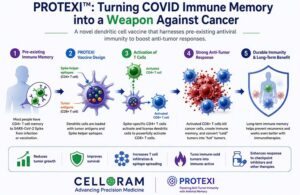
Credit: Celloram
Celloram, a preclinical stage company focusing on therapies for cancer, autoimmune diseases and chronic inflammatory and metabolic disorders, in partnership with Case Western Reserve University and University Hospitals Cleveland Medical Center, published preclinical results for a new dendritic cell vaccine in Nature Communications.
Pairing Spike-specific CD4 helps with tumor-specific CD* targets
Dendritic cell vaccines initiate and activate antigen-specific CD8 T cell responses to attack cancer cells. However, only approximately 15% of patients show an objective response.
The new vaccine, called Protexi, uses epitopes, the small pieces of a protein that an immune cell recognizes, derived from the Spike protein of SARS-CoV-2 to activate CD4 T cells in addition to CD8 cells. CD4 cells help draw CD8 cells to the tumor and give dendritic cells the signal they need to fully activate them. Activating both types of T cells could make the vaccine more effective than activating CD8 alone.
In one experiment where mice received CD4 cells engineered to recognize the target, Protexi showed 100% survival to day 40, compared to 40% for a conventional dendritic cell vaccine in mice. A melanoma model showed five of seven mice had tumors measuring under 200 cubic millimeters on day 26.
The paper states that over 80% of the U.S. population and 65% of the global population are fully vaccinated for COVID, and that many who remain unvaccinated have the necessary immune memory from natural infections.
“Spike-specific CD4⁺ T-cell memory is broadly durable across the population that’s been vaccinated or infected. Indeed, this is the whole premise the platform depends on,” John Letterio, a co-author on the paper, said.
Studies have confirmed that CD4 T cell responses to COVID are durable for up to 2 to 4 years in vaccinated patients, Letterio said, while viral CD4 T cell memory for SARS-CoV-1 could be retained for up to 17 years.
“If a given patient’s response turns out to be too weak, the platform has a built-in fallback: in mice, we showed that a short ‘priming’ dose of Spike/ovalbumin-loaded dendritic cells beforehand restores a strong CD4 T-cell response even without pre-existing immunity,” he said. Ovalbumin, a chicken egg protein, stood in for spike in the mouse experiments.
He expects this option to be available for patients without the immune memory.
Building on past research
“The idea builds on two separate threads of research that came together at a good moment,” Letterio said.
Research as far back as the 1990s showed that CD4 T helper cells are required for optimal CD8 induction against MHC-II-negative tumors. More recent research has shown that tumor rejection during immunotherapy requires both CD4 and CD8 tumor-specific T cells, he said. However, CD4 epitopes are difficult to identify computationally, which has limited how often they are integrated into vaccines.
The second thread comes from the pandemic, when studies found that COVID-19 vaccination seemed to improve outcomes for patients on checkpoint inhibitor therapies.
“Putting those together, the logical next step was: instead of waiting to discover a patient’s own tumor-specific CD4 epitope, why not deliberately load a dendritic cell vaccine with a CD4 epitope we already know is highly immunogenic across most of the population — the SARS-CoV-2 Spike protein — alongside the tumor antigen we actually want a CD8 response against? That’s Protexi,” Letterio said.
The team chose COVID because its CD4 T cell antigen has been extensively mapped, and a large proportion of the global population carries the immune memory, whether from vaccination or infection, but the mechanism could work with other epitopes.
“Any CD4 T-cell epitope that a patient already has strong, durable memory against should, in principle, be able to serve the same helper function,” Letterio said.
The researchers are now working to advance Protexi toward IND submission to the FDA and a first-in-human clinical trial in patients with sarcoma at the Angie Fowler Adolescent & Young Adult Cancer Institute.
Filed Under: Immunology, Infectious Disease, Oncology