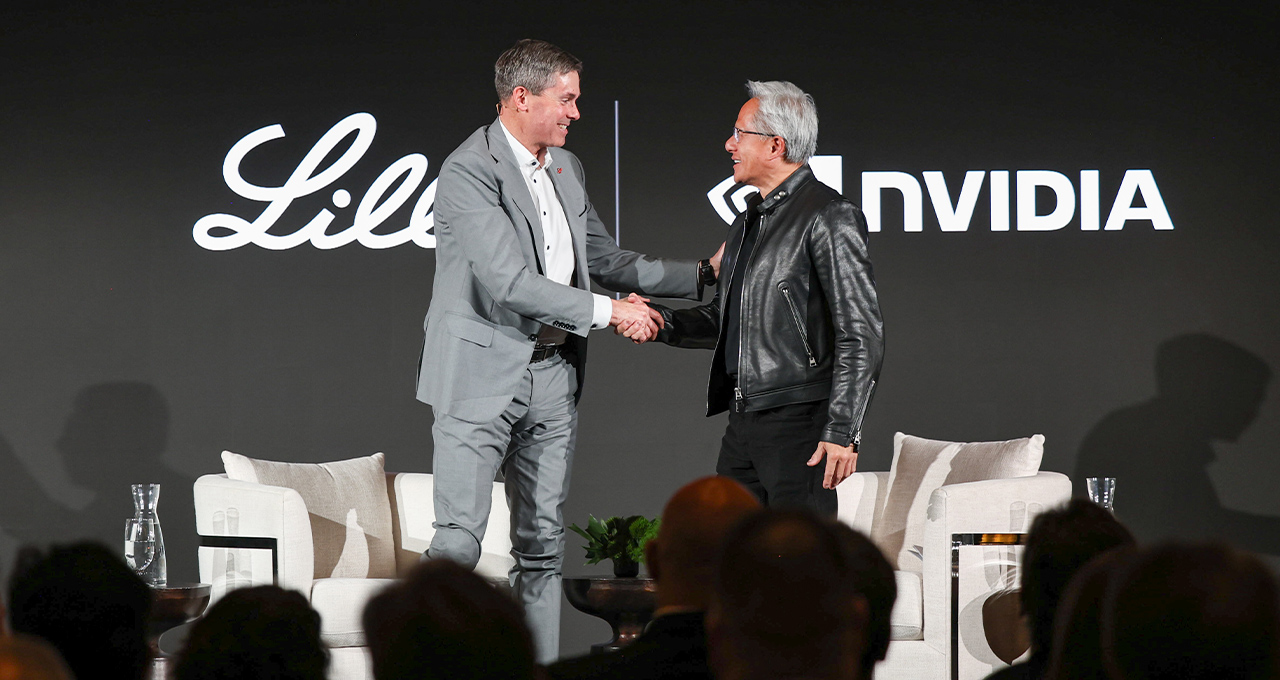
Lilly CEO David Ricks and NVIDIA CEO Jensen Huang at the J.P. Morgan Healthcare Conference, January 2026.
The NVIDIA and Eli Lilly co-innovation lab announced January 12, 2026 at the JPM Healthcare Conference is one of the largest disclosed AI collaborations in pharma. It also extends a relationship that has been building as NVIDIA deepens ties across the pharma and life sciences sectors. Framed as up to $1 billion over five years, the effort follows Lilly’s October 2025 plan for a major AI supercomputer, described as a 1,016 Blackwell Ultra GPU system rated at more than 9 exaflops of AI performance, meaning roughly 9 quintillion AI-optimized calculations per second (a mixed-precision throughput metric that is not directly comparable to the double-precision benchmark used for many Top500 rankings.)
The “most powerful supercomputer owned and operated by a pharmaceutical company” was unveiled at NVIDIA GTC Washington, D.C. on October 28, 2025. The system represents the world’s first NVIDIA DGX SuperPOD built with DGX B300 systems, NVIDIA’s turnkey AI supercomputer architecture that combines modular clusters of GPU servers with high-speed InfiniBand networking and optimized storage.
The lab is expected to open by the end of March. “Each small molecule discovery is like a work of art,” Ricks said at a JPM fireside chat with Huang. “If we can make that an engineering problem, versus this sort of discovery, this artisanal drug-making problem, think of the impact on human life.”
Ricks described the ultimate goal: “The holy grail is that you put those [molecule simulation and target identification] together, and we can model the whole system at once”—simulating molecules and identifying biological targets simultaneously.
The investment amount was not separately disclosed but fits within Lilly’s $50 billion commitment to U.S. manufacturing and R&D expansion. The system runs on 100% renewable electricity. It also uses existing Lilly facilities with liquid cooling from chilled water infrastructure, and aligns with the company’s 2030 carbon neutrality goals.
Based in the Bay Area
The San Francisco Bay Area lab will co-locate Lilly scientists with NVIDIA AI engineers to build a continuous 24/7 experimentation loop connecting wet labs with computational dry labs. Beyond drug discovery, the partnership will extend AI across clinical development, manufacturing, and commercial operations, including robotics and digital twins of production lines.
“We’re systematically bringing together some of the brightest minds in the field of drug discovery and some of the brightest minds in computer science,” Huang said. “We’re going to have a lab where the expertise and the scale of that lab is sufficient to attract people who really want to do their life’s work at that intersection.”
The lab’s compute stack will run on NVIDIA’s BioNeMo platform, built on NVIDIA’s BioNeMo platform and the upcoming Vera Rubin architecture, NVIDIA’s successor to Blackwell, which NVIDIA says will deliver up to 10x reduction in inference token cost versus Blackwell. The first technical priority: a “continuous learning” system that cycles data between robotic lab equipment and AI models around the clock, so each experiment improves the next. Beyond discovery, Lilly will use NVIDIA Omniverse and RTX PRO Servers to build digital twins of manufacturing lines for virtual stress-testing before making changes on the floor. The partnership also connects NVIDIA’s Inception startup program with Lilly’s TuneLab platform, with future workflows expected to incorporate NVIDIA Clara foundation models.
NVIDIA partnerships span many pharma companies
NVIDIA has built direct AI infrastructure partnerships with an expanding number of major pharmaceutical companies.
Amgen/deCODE Genetics (BioNeMo early access March 2023; DGX SuperPOD announced early 2024): A DGX SuperPOD installation at deCODE’s Reykjavik headquarters powers genomics foundation models for precision medicine, enabling model training in days rather than months.
Genentech/Roche (November 2023): A multi-year strategic collaboration using DGX Cloud and BioNeMo for a “lab-in-a-loop” framework that feeds experimental data directly into computational models for target identification and molecular design.
AstraZeneca (Cambridge-1 era, 2020–2021): As a founding partner of NVIDIA’s Cambridge-1 supercomputer in the UK, AstraZeneca collaborated on MegaMolBART, an open-sourced transformer model for chemical structure prediction trained on about 1.45 billion molecules.
GSK (October 2020): Another Cambridge-1 founding partner, GSK established a London AI hub integrating DGX A100 systems and Clara Discovery for AI-driven drug and vaccine R&D.
Bristol-Myers Squibb (operational by March 2024): A DGX SuperPOD deployment, colocated at Equinix data centers, supports oncology R&D and imaging workflows, with BMS reporting 55% overall cost savings compared to prior computing infrastructure.
Merck & Co. (December 2025): The most recent pre-Lilly partnership produced the KERMT model for small-molecule drug discovery, pretrained on about 11 million molecules for ADMET property prediction.
Filed Under: machine learning and AI