[Adobe Stock]
The GLP-1 wave keeps widening
Semaglutide hits the GLP-1 receptor alone, tirzepatide adds a second in GIP, and next-generation candidates layer on a third in glucagon or drop incretins altogether for amylin and FGF21 biology. The competitive map is widening, too, as the Novo Nordisk and Eli Lilly duopoly meets oral small molecules, monthly dosing, and a wave of contenders from China.
2017 Semaglutide (Ozempic) is approved for type 2 diabetes.
2021 Semaglutide (Wegovy) is approved for obesity, kicking off the weight-loss era.
2022 Tirzepatide (Mounjaro), a dual GIP/GLP-1 agonist, is approved for type 2 diabetes.
2023 Tirzepatide (Zepbound) is approved for obesity.
Mar 2024 Wegovy is cleared to reduce cardiovascular risk in heart-disease patients.
Dec 2024 Zepbound becomes the first drug of any kind approved for obstructive sleep apnea.
Jan 2025 Ozempic is approved to slow chronic kidney disease in type 2 diabetes.
Aug 2025 Wegovy becomes the first GLP-1 approved for MASH with moderate-to-advanced fibrosis.
Dec 2025 The Wegovy pill, the first oral GLP-1 for weight loss, is approved.
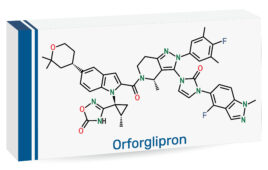
Apr 2026 Orforglipron (Foundayo), the first oral small-molecule GLP-1, wins approval for obesity in the fastest new-drug clearance since 2002.
On July 1, Medicare starts covering GLP-1 drugs for weight loss for the first time, at about $50 a month for patients. As recently as late last year, one in eight American adults were taking a GLP-1 drug for weight loss, diabetes or another condition, but half of them, then, reported the drugs were hard to afford. List prices then ran past $1,000 a month, and the manufacturers’ discounted cash-pay programs had only just begun pulling that toward $350 to $500.
In under a decade the class has climbed from type 2 diabetes to obesity, then to cardiovascular risk, obstructive sleep apnea, chronic kidney disease, and, last year, MASH, with neurodegeneration and obesity-associated cancers now under active study, though the marquee neurodegeneration trials have so far disappointed.
That maturation has created demand for biospecimens that reflect the new indications and patient populations now under investigation, tumor samples and oncology cohorts, cerebrospinal fluid or brain tissue for neurodegeneration work, and clinically annotated collections tied to the specific comorbidities and disease contexts being studied. Many of the specimens and datasets assembled when GLP-1s were still viewed primarily through a weight-loss or diabetes lens were optimized for those original metabolic endpoints and do not automatically serve the new research questions.
“If you think about what GLP-1s were first developed for, a lot of it was around weight loss, so a lot of the data that goes with those specimens, and a lot of the specimens that were collected, were very specific to weight loss,” said Cathie Miller, Ph.D., director of product management operations at BioIVT, a global biospecimen and ADME-Tox services provider for drug and diagnostic development. “As the science has evolved, and we’ve gotten a better understanding of how these drugs can potentially work for other diseases, those original samples the biobanks collected are no longer as relevant. The weight-loss-era banks are not going to have the oncology samples, the tumors, in their banks, and they’re not necessarily going to have the neurological conditions, the Alzheimer’s, and so on.”

Cathie Miller, Ph.D.
For many of these new indications, investigators cannot source the required tissue through surgical resection at all. “Some of these diagnoses people are looking for, the actual tissue is hard to source, so we’re seeing a drive toward the biofluids that represent that,” Miller said. “It’s not just blood-derived biofluid, plasma, serum, or whole blood; we’re seeing a lot of interest in urine, feces, or saliva that support these different areas. … Ten years ago it was predominantly tissue. People needed oncology tissue resections and matched normals.” Now BioIVT is seeing a drive toward biofluids, both blood-derived and non-blood-derived.
That same pivot from tissue toward biofluids, indication by indication, also shows up in BioIVT’s overall book of business. “Historically our tissue-to-biofluid business was probably 60/40 tissue to biofluids, and I’d say now it’s more 60/40 biofluids to tissue,” Miller noted. “This has to do with more than just GLP-1; that’s not the only thing driving it. There’s a lot of biology being discovered that we can now do from biofluids that we used to say had to be done with tissue only. There’s a lot of interest in exosomes and liquid biopsy analysis, and those are also driving the shift.”
Market researchers valued the global biospecimen procurement market at about $5 billion in 2024, with projections topping $11 billion by 2033. At the same time, roughly four in five researchers have said they narrowed the scope of their studies because they could not obtain high-quality, well-annotated specimens.
New indications, new specimens
One example of the specimen shift comes courtesy of MASH. Once the FDA approved Wegovy for the liver disease in August 2025 (see timeline, above) and FGF21-mimic compounds such as efruxifermin (Akero Therapeutics, now part of Novo Nordisk) began posting Phase 2b cirrhosis-reversal data at 96 weeks despite missing its primary endpoint, the specimen and assay requirements changed in lockstep. Sponsors needed hepatocytes that carried actual disease characteristics, liver-fattiness scores or other MASH-like features, rather than normal liver cells, along with longer-term in vitro liver models able to run the chronic, fibrotic studies these agents require. One new indication created demand for both a new class of biospecimen and a new service in a single step.

Brian Ogilvie, Ph.D.
BioIVT’s ADME team felt that directly in its hepatocyte and liver-modeling business. “I’d also add that on MASH there have been a lot of developments, and that really affects our ADME portfolio in terms of hepatocytes,” said Brian Ogilvie, Ph.D., vice president of scientific consulting at BioIVT. “People are asking, for example, do you have scores for liver fattiness? It may be difficult to get a true diagnosis or pathological confirmation of MASH, but they’re looking for any indications, so they can look at samples that have those characteristics. We also have services like HEPATOPAC, where we’ve done a lot of work on drugs trying to treat MASH.”
Where the tissue is hardest to source
The newest research targets push past even the biofluid workarounds. In neurodegeneration, the relevant tissue is largely off-limits in living donors, so the demand shifts to cerebrospinal fluid. “On the neurological side, we’re seeing huge demand for CSF, both normal and associated with neurological diseases,” Miller said. That demand has held even as the headline clinical results disappointed. Oral semaglutide’s EVOKE and EVOKE+ Phase 3 trials in early Alzheimer’s, reported in late 2025 and published this year, did not slow disease progression against placebo, though the drug did move Alzheimer’s-related biomarkers. The largest GLP-1 trial in Parkinson’s, Exenatide-PD3, likewise found no benefit in 2025. A run of biomarker-positive, outcome-negative results still leaves sponsors needing well-characterized CSF to chase the mechanism.
Oncology raises the same sourcing problem, since the tumors of interest are the ones tied to metabolism. “On oncology, it’s really the tumors that are driven by metabolism, driven by obesity,” Miller said. “Breast, especially post-menopausal breast cancer… Colorectal, endometrial, liver, pancreatic, some kidney.” The interest tracks a growing observational signal that GLP-1 use is associated with lower rates of several obesity-related cancers, including lower breast cancer incidence, though no oncology indication has been approved.
What makes those samples usable, Miller argues, is the clinical data wrapped around them. “If it’s a biobank like BioIVT’s, we collect as much medical history as the donor will provide,” she said. “We collect the historical medical information, any current or past medications, any past or current treatments… we’ll know whether, after being on a GLP-1, the donor did or did not develop a cancer. That’s where we’re making a concerted effort to add that kind of information.”
Related
Pens to pills: what oral GLP-1s change at the bench. A companion Q&A with BioIVT’s Brian Ogilvie on how the move from injectable peptides to oral small molecules reshapes the ADME work.
Filed Under: Biospecimens