A team of Vanderbilt University Medical Center investigators has developed a group of chemical compounds that could represent a new class of drugs for treating cancer.
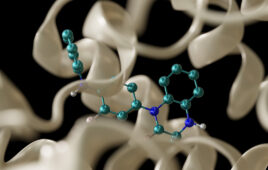
The compounds are the first selective inhibitors of the protein phospholipase D (PLD), an enzyme that has been implicated in multiple human cancers including breast, renal, gastric, and colorectal.
The new inhibitors block the invasive migration of breast cancer cells, supporting their further development as antimetastatic agents. They will also be useful tools for understanding the complex roles of PLD in cellular physiology, said H. Alex Brown, Ph.D., professor of Pharmacology and one of the team leaders.
‘PLD is associated with many fundamental cellular processes like secretion, migration, growth and proliferation. But the absence of selective inhibitors has really interfered with the ability of biologists to study this important enzyme,’ Brown said.
There are two related isoforms of PLD: PLD1 and PLD2. Both PLD enzymes produce phosphatidic acid, a key lipid metabolic and signaling molecule. But whether the two PLDs have different roles is an open question, one that the new isoform-selective inhibitors can now be used to address.
Brown and colleagues had discovered that PLD was important to the invasive migration of breast cancer cells in culture using a genetic tool called small interfering RNA (siRNA).
‘When we had evidence from siRNA and other methods that blocking PLD resulted in dramatic effects of blocking metastatic invasion of breast cancer cells, we were highly motivated to attempt to make isoform-selective inhibitors,’ Brown said.
Craig Lindsley, Ph.D., a medicinal chemist who joined the Vanderbilt faculty after five years at Merck Research Laboratories, and his group used a previously described PLD inhibitor as a starting point for a chemistry process called diversity-oriented synthesis. The team screened resulting compounds for activity against PLD1 and PLD2 using in vitro and cell-based screening tools developed in Brown’s laboratory.
‘Without these high quality screening assays and rapid turnaround, this process wouldn’t have worked,’ said Lindsley, associate professor of Pharmacology and Chemistry. The researchers were able to generate compounds that selectively inhibited PLD1 or PLD2, and other compounds that inhibited both isoforms.
‘With the compounds we’ve made, we can almost choose the range at which we’d like to inhibit the different isoforms, something that’s never before been possible,’ Lindsley said.
The researchers demonstrated that the compounds act directly on the PLD enzymes (using purified proteins), and they showed that they blocked the invasive migration behavior of three different breast cancer cell lines.
‘These inhibitors are the key tools we need to really probe the biology, and we’re obviously hoping to develop them for therapeutic applications too,’ Brown added. ‘Not only is Craig an excellent chemist, but he really knows about making compounds that have the potential to become drugs, and that has had a very positive influence on this collaboration.’
The researchers will now optimize their new compounds for in vivo studies and to give them characteristics compatible with being good medications. They are also expanding their research into other areas of biology – in addition to studying the inhibitors in breast cancer models, they will explore how they work in cell systems that model brain tumors, rheumatoid arthritis, and viral infections.
Release Date: February 3, 2009
Source: Vanderbilt University Medical Center
Filed Under: Genomics/Proteomics