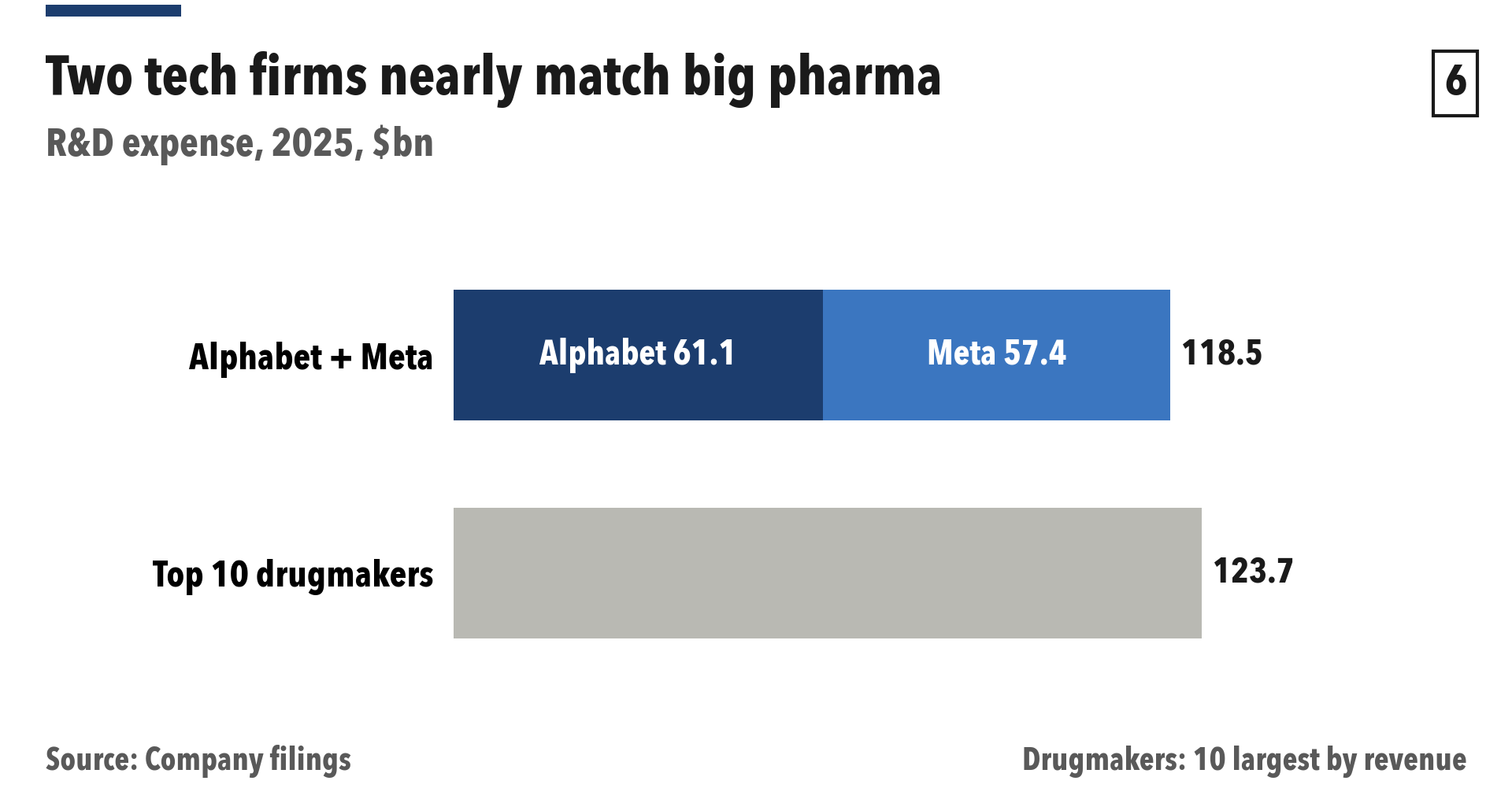
Google parent Alphabet and Meta reported a combined $118.5 billion in R&D expense for 2025, close to the $123.7 billion spent by the 10 largest drugmakers by revenue, a figure that includes J&J’s medtech and Roche’s diagnostics units.
While Big Tech’s R&D budgets keep swelling, Big Pharma is aligning itself with Big Tech firms. In April, Merck & Co. announced a multi-year alliance with Google Cloud worth up to $1 billion. The two companies once spent similar sums on research. In 2013, Merck’s R&D expense of $7.5 billion edged out Google’s $7.1 billion. In 2025, Alphabet spent $61.1 billion, nearly four times Merck’s $15.8 billion.
Eli Lilly’s LillyPod supercomputer, built with NVIDIA, went live in Indianapolis in February after four months of assembly. Lilly now runs NVIDIA’s roughly 550-billion-parameter Nemotron 3 Ultra model on premises with “no token or budget limits,” and a foundation model on the system has co-designed a small-molecule candidate with a novel chemical fragment, Chief AI Officer Thomas Fuchs told R&D World earlier this year. Separately, Lilly and NVIDIA announced a Bay Area co-innovation lab in January, backed by up to $1 billion over five years.
Roche is also working with NVIDIA. In March, it announced 2,176 Blackwell GPUs on premises, which, together with its cloud capacity, brought its total above 3,500. Bristol Myers Squibb is building its second NVIDIA supercomputer, based on Vera Rubin systems, after running its first DGX SuperPOD for nearly three years.
Frontier AI labs, which are heavy R&D spenders themselves, are also moving closer to pharma, and in Anthropic’s case into the lab itself. Anthropic has set up a wet lab in the San Francisco Bay Area for physical biology experiments, its head of life sciences, Eric Kauderer-Abrams, confirmed to Reuters this month, although a spokesperson later said the lab is not specifically for drug discovery. The company said in June it would run preclinical programs in disease areas drugmakers find financially unattractive, and that same day it partnered with Basecamp Research on its EDEN biological models for antibiotic discovery and vaccine design. It is holding off on clinical trials for now, partly because of competition concerns, Kauderer-Abrams told Reuters. Anthropic has also acquired Coefficient Bio, a small New York startup founded by former Genentech computational biologists, in a stock deal media reports valued at just over $400 million, and added Novartis CEO Vas Narasimhan to its board.
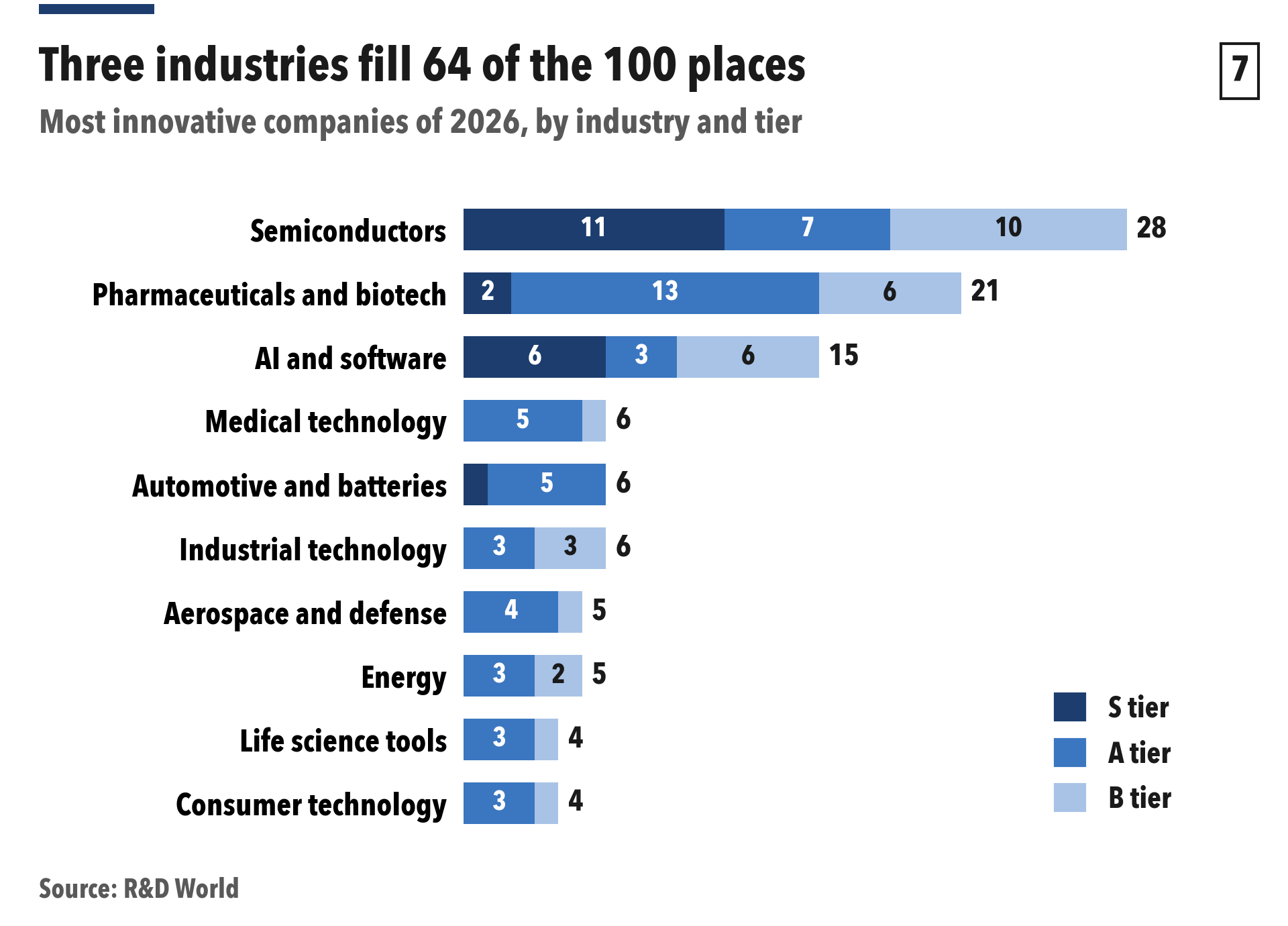
From the forthcoming Global R&D Funding Forecast to be published on R&D, which ranks 100 innovative companies across industries.
Anthropic also sells Claude to drugmakers. In January, Genmab said it would build custom Claude-powered agents for clinical development. In May, BMS said it was rolling Claude Enterprise out to more than 30,000 employees across research, development, manufacturing and commercial operations. Novo Nordisk, which signed an enterprise partnership with OpenAI in April and an Amazon Web Services deal in August, added joint drug-discovery work with Anthropic on Sept. 16, its third major AI partnership this year. Novo will start by testing Claude Science, Anthropic’s research workbench, in selected R&D workflows.
OpenAI, for its part, launched GPT-Rosalind in April, a purpose-built life sciences model offered to qualified customers through a trusted-access program. Amgen and Moderna are among the early users. Alphabet, meanwhile, has its own drug-discovery arm. Isomorphic Labs raised $2.1 billion in May and added a research collaboration with Johnson & Johnson in January, joining earlier partners Lilly and Novartis. It has pushed back its goal of reaching the clinic to the end of 2026, according to Reuters.
Filed Under: Drug Discovery