Drug Discovery and Development

  • Home Drug Discovery and Development
  • Drug Discovery
  • Women in Pharma and Biotech
  • Oncology
  • Neurological Disease
  • Infectious Disease
  • Resources
    • Video features
    • Podcast
    • Views
    • Webinars
    • PharmSci360
  • Pharma 50
    • 2026 Pharma 50
    • 2025 Pharma 50
    • 2024 Pharma 50
    • 2023 Pharma 50
    • 2022 Pharma 50
    • 2021 Pharma 50
  • Advertisers
    • Advertise
    • PR Submissions
    • Eblast Submissions
  • SUBSCRIBE

Insilico’s AI-designed TEAD inhibitor shrank tumors in 4 of 22 mesothelioma patients; randomized Phase 2a planned for 2027

By Brian Buntz | November 9, 2026

mesothelioma

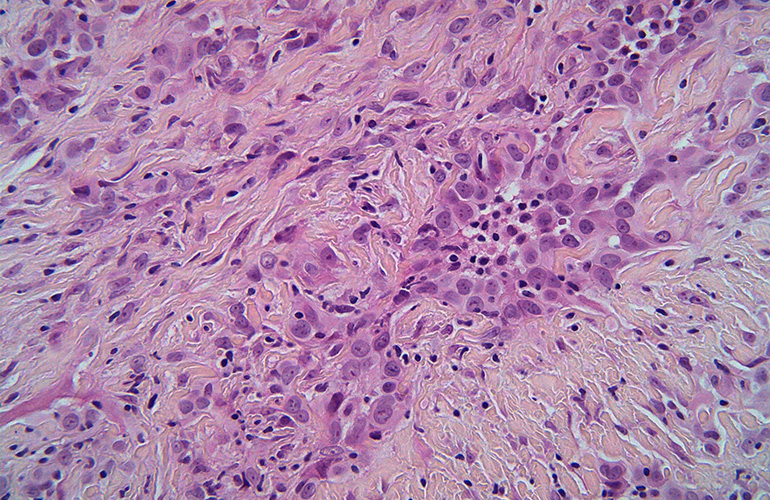
Microscopic view of mesothelioma cancer cells. [Adobe Stock]

Patients with mesothelioma, a cancer of the lining of the chest or abdomen, have few treatment options after their disease progresses. Insilico Medicine, a Cambridge, Mass.-based drug developer that designs molecules with generative AI, is testing its oral TEAD inhibitor ISM6331 in previously treated patients and reported the first human results at the ESMO Congress in Madrid on Oct. 25.

In an ongoing Phase 1 study, four of 22 evaluable mesothelioma patients had partial responses, for a response rate of 18.2%. At the first scan, 68.2% had disease control, meaning their tumors shrank or held steady. Three of the four responses appeared at the first scan, at week 8, and three were ongoing at the Aug. 14 data cutoff, including one lasting approximately a year.

Participants in the uncontrolled dose-escalation trial had received a median of two prior lines of therapy, and responders included patients who had received five or six. Melina Marmarelis, an oncologist at the University of Pennsylvania’s Abramson Cancer Center, presented the results in Madrid. At 130 mg once daily, the highest reported dose, two of five evaluable mesothelioma patients had partial responses.

Halle Zhang

Halle Zhang

Investigators reported no dose-limiting toxicities across doses of 15–130 mg, and escalation continues. “Proteinuria is the on-target effect described for TEAD inhibitors as a class, so we monitor kidney function as dose increases,” Halle Zhang, Insilico’s vice president of clinical development for oncology, said in emailed answers. Across all 36 patients treated for mesothelioma or other solid tumors, four developed treatment-related proteinuria, protein leaking into the urine. All cases were grade 1 or 2 and reversible. Three patients, all at 130 mg, had grade 3 treatment-related adverse events, including asymptomatic increases in pancreatic enzymes, fatigue and a drug rash.

ISM6331 targets all four members of the TEAD family, proteins that work with YAP and TAZ to switch on genes involved in tumor growth. The Hippo pathway normally restrains that activity. Defects in the pathway, including loss of the NF2 gene, provide a rationale for targeting TEAD in mesothelioma. Designed with Insilico’s Chemistry42 generative chemistry software, ISM6331 blocks TEAD palmitoylation, a fatty-acid modification involved in TEAD activity. Zhang said the drug blocks every family member because “they can compensate for one another.”

ISM6331 joins a field of experimental TEAD inhibitors that includes VT3989, a palmitoylation blocker from Vivace Therapeutics, a San Mateo, Calif., biotech. VT3989 produced responses in 26% of 47 mesothelioma patients treated at optimized doses in a Phase 1/2 trial published in Nature Medicine in October 2025. Vivace registered its randomized Phase 3 sTEADfast trial in September to compare VT3989 with chemotherapy in previously treated epithelioid pleural mesothelioma. Responses in the earlier trial occurred in patients with and without identified NF2 mutations.

ISM6331’s Phase 1 trial enrolled patients regardless of Hippo pathway status, and Insilico is “evaluating tumor biology to understand which patients may benefit most,” Zhang said. Alongside that work, the company will select doses based on “the totality of the data, including PK, PD, safety, efficacy and overall benefit-risk,” she said. Subject to those findings, Insilico plans to start a randomized Phase 2a dose-optimization study in mesothelioma in 2027.


Filed Under: clinical trials, Drug Discovery, machine learning and AI, Oncology
Tagged With: AI drug discovery, Alex Zhavoronkov, Chemistry42, ESMO 2026, generative AI, Halle Zhang, Hippo pathway, IAG933, Insilico Medicine, ISM6331, Melina Marmarelis, mesothelioma, NF2, Novartis, pan-TEAD inhibitor, TEAD, Vivace Therapeutics, VT3989
 

About The Author

Brian Buntz

As the pharma and biotech editor at WTWH Media, Brian has almost two decades of experience in B2B media, with a focus on healthcare and technology. While he has long maintained a keen interest in AI, more recently Brian has made making data analysis a central focus, and is exploring tools ranging from NLP and clustering to predictive analytics.

Throughout his 18-year tenure, Brian has covered an array of life science topics, including clinical trials, medical devices, and drug discovery and development. Prior to WTWH, he held the title of content director at Informa, where he focused on topics such as connected devices, cybersecurity, AI and Industry 4.0. A dedicated decade at UBM saw Brian providing in-depth coverage of the medical device sector. Engage with Brian on LinkedIn or drop him an email at [email protected].

Related Articles Read More >

If Trump gets Europe to pay more for drugs, more new medicines could follow — eventually
Antibody - visual concept of immune System - 3D illustration
Fresenius picks the biosimilars, WuXi Biologics builds them in a deal covering up to 37 candidates
Physician in a white coat reviewing information on a tablet with a patient in an exam room.
What real-world data shows about current cancer care
Roche Towers, Basel, Switzerland
Roche picks cancer targets, Hansoh builds the ADCs in deal with $400 million upfront
“ddd
EXPAND YOUR KNOWLEDGE AND STAY CONNECTED
Get the latest news and trends happening now in the drug discovery and development industry.

MEDTECH 100 INDEX

Medtech 100 logo
Market Summary > Current Price
The MedTech 100 is a financial index calculated using the BIG100 companies covered in Medical Design and Outsourcing.
Drug Discovery and Development
  • MassDevice
  • DeviceTalks
  • Drug Delivery Business News
  • Medtech100 Index
  • Medical Design Sourcing
  • Medical Design & Outsourcing
  • Medical Tubing + Extrusion
  • Pharmaceutical Processing World
  • R&D World
  • Subscribe to our E-Newsletter
  • About Us
  • Contact Us

Copyright © 2026 Arrowfly LLC. All Rights Reserved. The material on this site may not be reproduced, distributed, transmitted, cached or otherwise used, except with the prior written permission of Arrowfly
Privacy Policy | Advertising | About Us

Search Drug Discovery & Development

  • Home Drug Discovery and Development
  • Drug Discovery
  • Women in Pharma and Biotech
  • Oncology
  • Neurological Disease
  • Infectious Disease
  • Resources
    • Video features
    • Podcast
    • Views
    • Webinars
    • PharmSci360
  • Pharma 50
    • 2026 Pharma 50
    • 2025 Pharma 50
    • 2024 Pharma 50
    • 2023 Pharma 50
    • 2022 Pharma 50
    • 2021 Pharma 50
  • Advertisers
    • Advertise
    • PR Submissions
    • Eblast Submissions
  • SUBSCRIBE