 In a potential marriage that analysts said faces long odds, AstraZeneca and Bristol Myers Squibb have held talks on a merger that would create the world’s largest drugmaker by revenue and rank among the biggest deals in pharmaceutical history, the Financial Times reported.
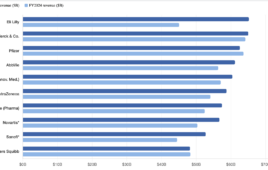
The merger would also mark the most significant reshaping of pharma’s top tier since Lilly jumped from ninth-largest to the top slot by revenue on the strength of its metabolic franchise. It claimed the top spot with $65.18 billion, roughly two-thirds of the $100.33 billion Pfizer booked at its pandemic peak in 2022.
A combined AstraZeneca and BMS would reset that bar. The company would hold one of the industry’s broadest oncology portfolios, pairing AstraZeneca’s Tagrisso, Imfinzi and Calquence and the Daiichi Sankyo-partnered ADCs Enhertu and Datroway with BMS’s Opdivo, Yervoy and Opdualag, while adding BMS’s hematology, cell therapy and neuroscience franchises to AstraZeneca’s current mix. Based on their FY2025 filings, the pair would have spent $24.18 billion on R&D, above every standalone company in the Pharma 50 data. Reported spending among Roche, Lilly, J&J and Merck ranged from $12.52 billion to $15.79 billion, although acquired in-process R&D and differences in reporting scope make the comparison approximate.
AstraZeneca and BMS generated a combined $106.94 billion in 2025, compared with Lilly’s $65.18 billion. Current AstraZeneca and BMS guidance and an R&D World model of Lilly’s full-year revenue, built from its reported first quarter and historical quarterly pattern, put 2026 revenue at roughly $112.6 billion for the hypothetical combination and $87 billion for Lilly. That would leave Lilly growing about 33% this year against roughly 5% for the merged pair. Running both forward, the model puts the median crossover around 2030; in about a third of simulations, the merged company remained ahead in 2032 or later.
Analysts remained skeptical. Jefferies analysts led by Michael Leuchten wrote that they were “a bit perplexed” given AstraZeneca’s growth and innovation profile, adding that if any company does not need financial engineering, it is AstraZeneca. Citi called the report a surprise given the pipeline. RBC told clients that agreeing on value may prove difficult. BMO Capital Markets wrote that significant business overlap makes a deal less likely to materialize and estimated deal capacity at roughly $32 billion for BMS and $37 billion for AstraZeneca, meaning neither can buy the other outright.
Filed Under: Pharma 50