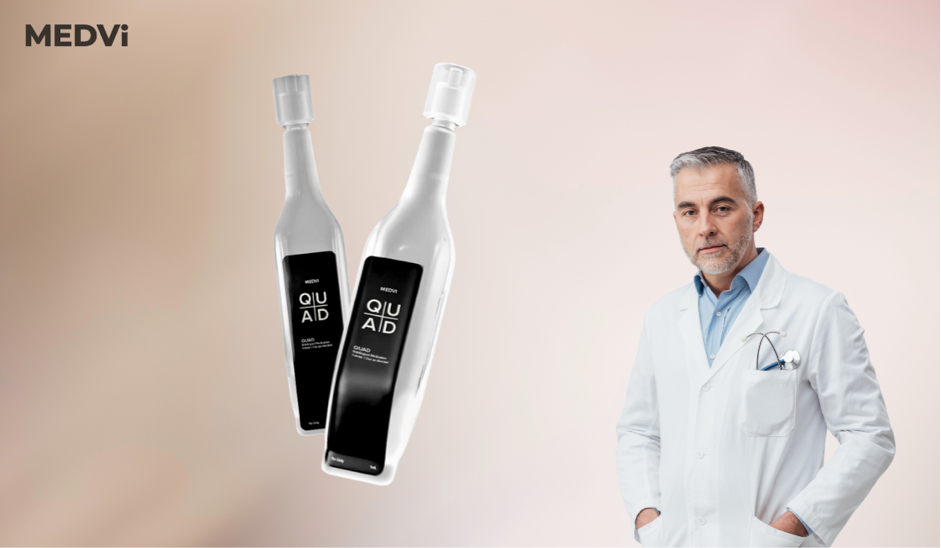
An image on an April 2026 affiliate marketing page pairs MEDVi QUAD with a stock art apparently endorsing the product, which is not FDA-approved. The website also advertises that users can: “Check your eligibility for MEDVi QUAD in minutes.”
In the wake of The New York Times’ April 2 profile portraying MEDVi CEO Matthew Gallagher as a vibe-coded unicorn, the blowback has been swift. Reporting from Futurism, Forrester, Drug Discovery & Development, Business Insider and others has surfaced an FDA warning letter for misbranding compounded GLP-1 drugs, a number of lawsuits and a history of using Meta ads with apparently AI-generated “doctor” personas, and questions about affiliate oversight.
But one factor that has received little coverage to date is QUAD, a compounded erectile dysfunction product MEDVi sells that combines three PDE5 inhibitors (sildenafil, tadalafil and vardenafil) plus apomorphine in a single sublingual dose. Compounded drugs are not FDA-approved and are not premarket reviewed by FDA for safety, effectiveness or quality.
Apomorphine is not FDA-approved in the U.S. for erectile dysfunction. The drug is FDA-approved in the U.S. for motor fluctuations, or OFF episodes, in adults with advanced Parkinson’s disease. In veterinary medicine, it is used to induce vomiting in dogs. In Europe, apomorphine was marketed for erectile dysfunction starting in May 2001, but that authorization expired in May 2006 after its then developer, Abbott Laboratories, decided not to renew it for commercial reasons. One UK study involving 11,185 patients found that two-thirds of men stopped using it because they felt it simply didn’t work. Meanwhile, nausea was a fairly common side effect. A 2020 systematic review and meta-analysis in Archives of Sexual Behavior was more positive, concluding that sublingual apomorphine is generally well tolerated only at the 2 mg and 3 mg doses. It acknowledged that discontinuation owing to adverse events climbed at higher doses.
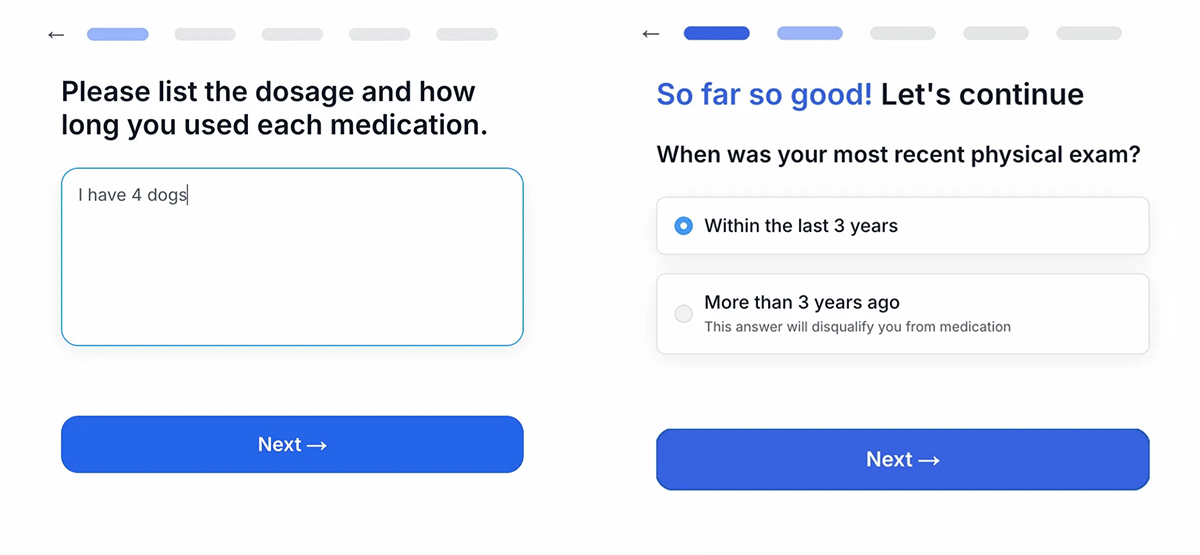
A screenshot from April 7, 2026 testing of MEDVi’s onboarding tool that determines if patients are eligible for a medical treatment. It appears to, at least initially, accept free form responses that don’t answer the question.
In response to questions about QUAD, an HHS public affairs spokesperson told Drug Discovery & Development that “the FDA generally does not discuss compliance matters except with the company involved” and that “when violations occur, the agency takes action as appropriate.” The spokesperson referred the publication to an April 1, 2026 FDA statement titled “FDA clarifies policies for compounders as national GLP-1 supply begins to stabilize.”
That document, published a week before this article’s April 7 testing, states that FDA “intends to consider a compounded drug product to be essentially a copy of a commercially available drug product” when it “contains the same APIs as two or more commercially available drug products in the same, similar or easily substitutable strength.” It provides an exception for cases when a prescriber documents a significant clinical difference for an identified individual patient. Sildenafil, tadalafil and vardenafil, three of the four active ingredients in QUAD, are each commercially available in the U.S. as FDA-approved products under the brand names Viagra, Cialis and Levitra, and as generic versions.
The guidance adds that FDA does not intend to take action against compounders making essentially-a-copy products if the compounder fills “four or fewer prescriptions of that compounded drug product during a calendar month.” That threshold is designed to accommodate individualized compounding that a local pharmacy might perform when a specific patient has a documented clinical need, such as, say, an allergy to a dye in the commercial product or a need for a liquid formulation for a patient who cannot swallow pills.
The April 1 FDA document does not specifically address the compounding of drugs for uses outside their FDA-approved indications. Apomorphine is FDA-approved in the U.S. only for Parkinson’s disease, and MEDVi is not the first compounder to sell it for erectile dysfunction. What distinguishes QUAD is the stacking of apomorphine with three PDE5 inhibitors in a single sublingual dose.
In the U.S., Abbott and Takeda’s joint venture TAP Pharmaceuticals sought FDA approval for sublingual apomorphine under the brand name Uprima, but withdrew the application in June 2000 after an advisory committee flagged hypotension and syncope risks and Public Citizen’s Sidney Wolfe wrote a blistering letter to then CDER director Janet Woodcock, M.D. urging the FDA to reject it outright. Public Citizen warned the agency that approval would lead to serious injuries and a near-certain post-market ban. FDA approval for ED never materialized.
If the FDA approves this drug, it is certain that it will have to be banned within a short time after marketing begins because of the high probability of further occurrence of the serious injuries it has already been found to cause. —Sidney Wolfe, MD, Public Citizen, June 2000
An apparent affiliate marketing page titled “MEDVi QUAD Reviews: Is This Fast 4-in-1 ED Formula Worth the Hype?” says users can see if they are eligible for the therapy within minutes. It also admits the therapy is not safe for all patients: “It may not be suitable for individuals with certain medical conditions or those taking specific medications. A clinician review is required to determine safety.”
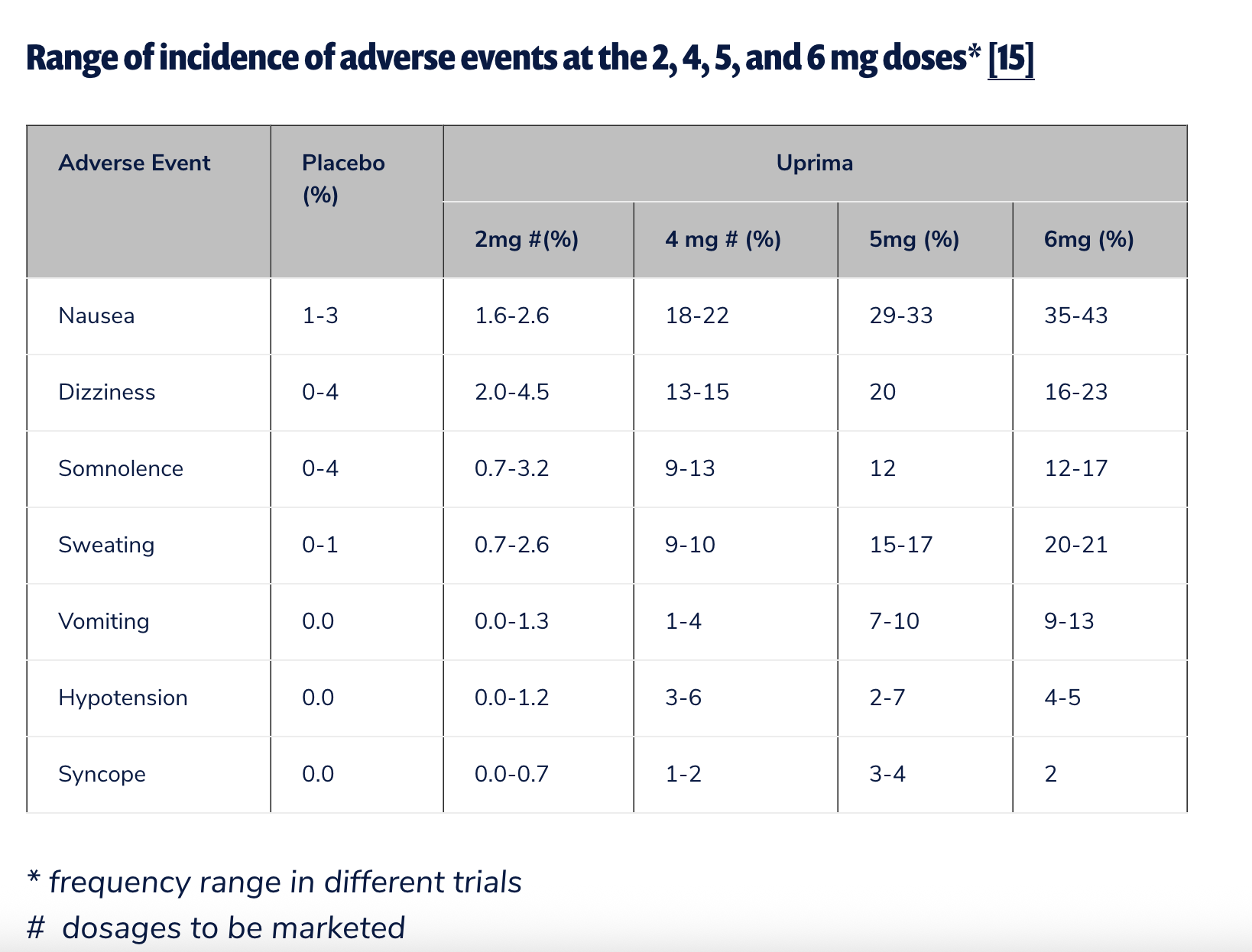
Adverse event rates for apomorphine alone between 4% and 5% of patients taking apomorphine complained of hypotension while 35% to 43% reported nausea. Source: Public Citizen’s June 2000 letter to the FDA, compiled from TAP Pharmaceuticals’ clinical trial data submitted to the agency’s Reproductive Health Drugs Advisory Committee.
MEDVi’s marketing for apomorphine claims it “ignites desires.” Its website promises to “[hit] your system in 10 minutes” while offering a 36 hour response window. It compares QUAD by name to Viagra, Cialis and Levitra in a head-to-head bar chart.
An affiliate marketing page says the therapy is designed for men who have already tried traditional ED therapies such as sildenafil or tadalafil individually and “want something different.” The same page says the combined formulation is not evaluated as a single product and is not FDA-approved as a single product.
The PDE5 inhibitors, better known as Viagra, Cialis and Levitra, respectively, can, albeit rarely, lead to dangerous hypotension for some patients. The drugs are contraindicated with nitrates and carry blood-pressure warnings and interaction cautions with alpha-blockers and some blood pressure medications.
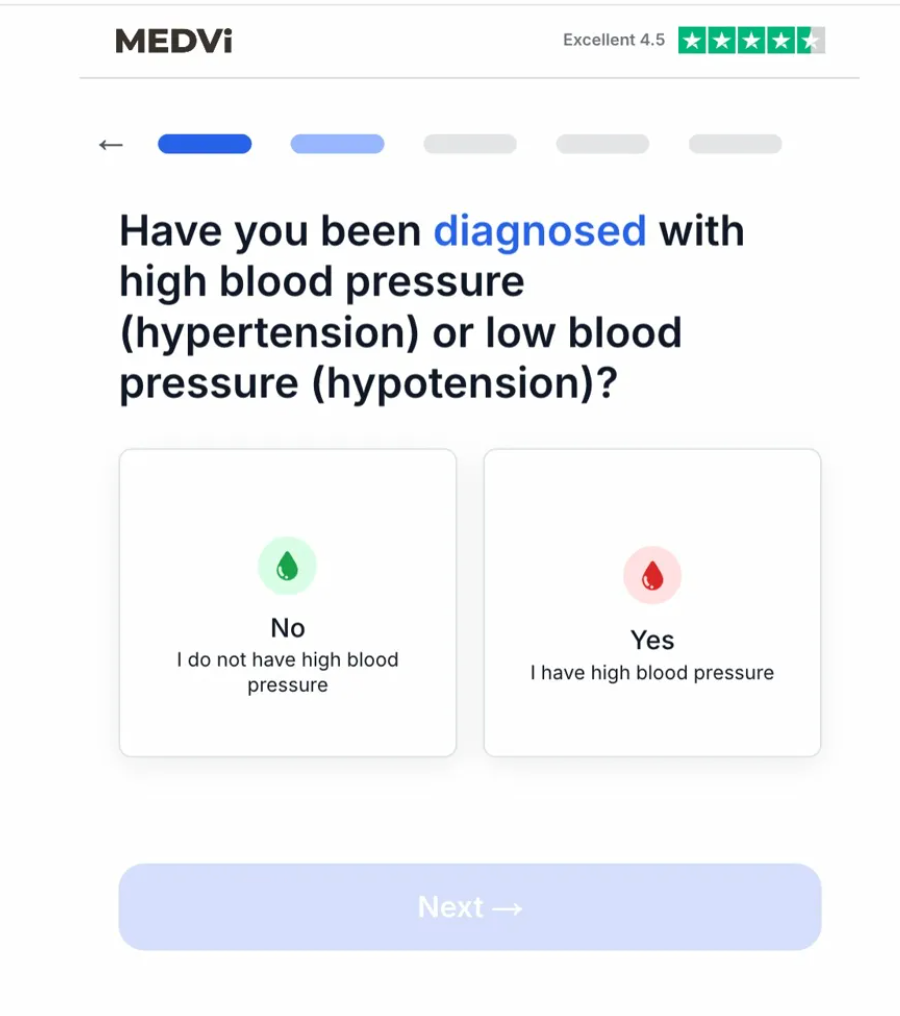
During April 7, 2026 testing, one intake page asked about severe hypotension but offered no off-ramp for that sub-population.
In test runs conducted on April 7, 2026 and documented by Drug Discovery & Development, MEDVi’s intake asked whether the user had been “diagnosed with high blood pressure (hypertension) or low blood pressure (hypotension),” then offered only two answer cards, both referring to high blood pressure. Hypotension, the condition the question explicitly invited, had no answer card. During those tests, selecting “Yes, I have high blood pressure” halted the intake with an “Eligibility Status” message reading “Based on your last answer, we cannot complete your assessment,” accompanied by a button to go back and “review your answer.” In those runs, the gating logic fired on hypertension and could not fire on hypotension.
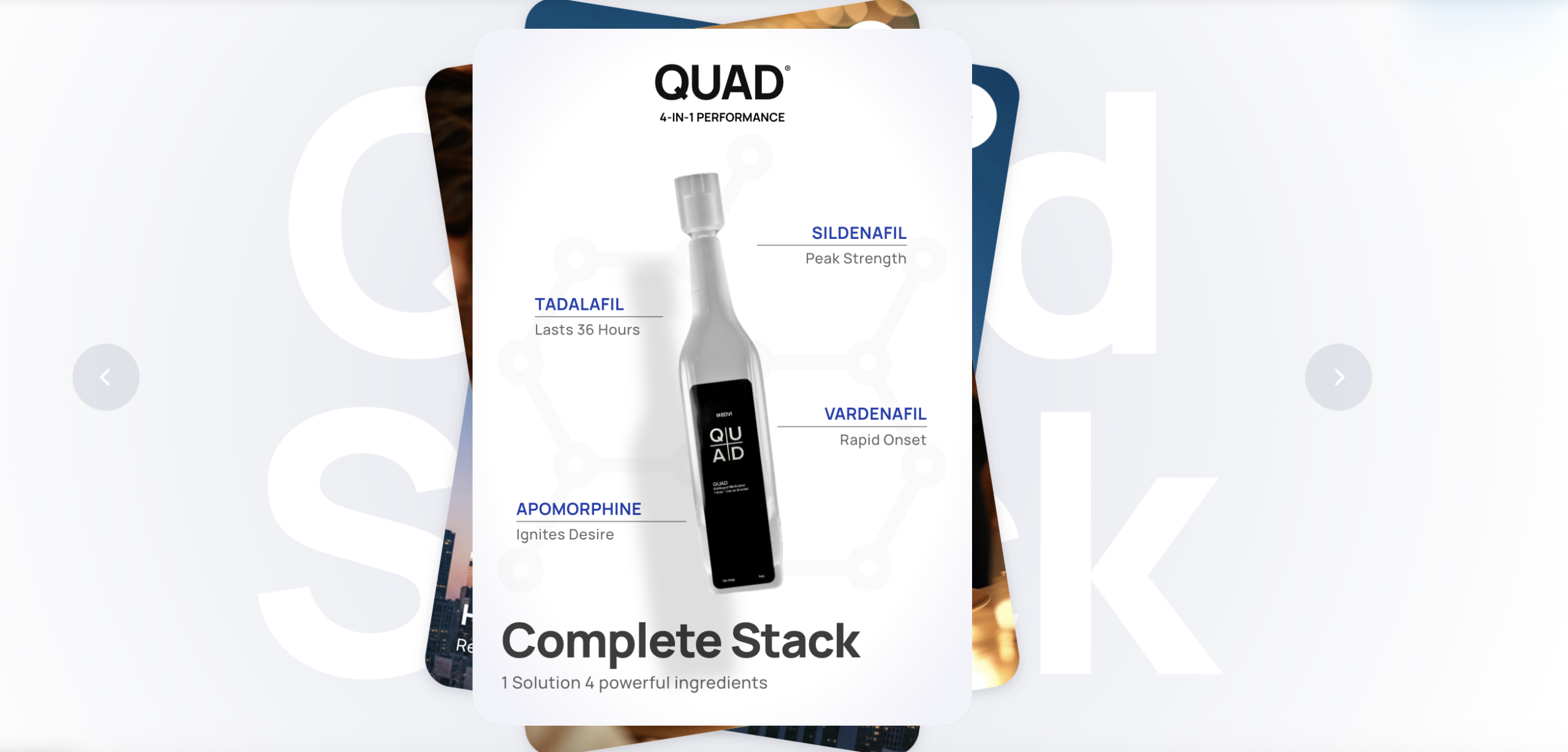
MEDVi’s marketing describes QUAD as a “Complete Stack.”
The FDA has addressed the question of stacking these drugs directly. In labeling for sildenafil, the agency notes that combinations of PDE5 inhibitors have “not been studied” and “may further lower blood pressure,” concluding that “the use of such combinations is not recommended.”
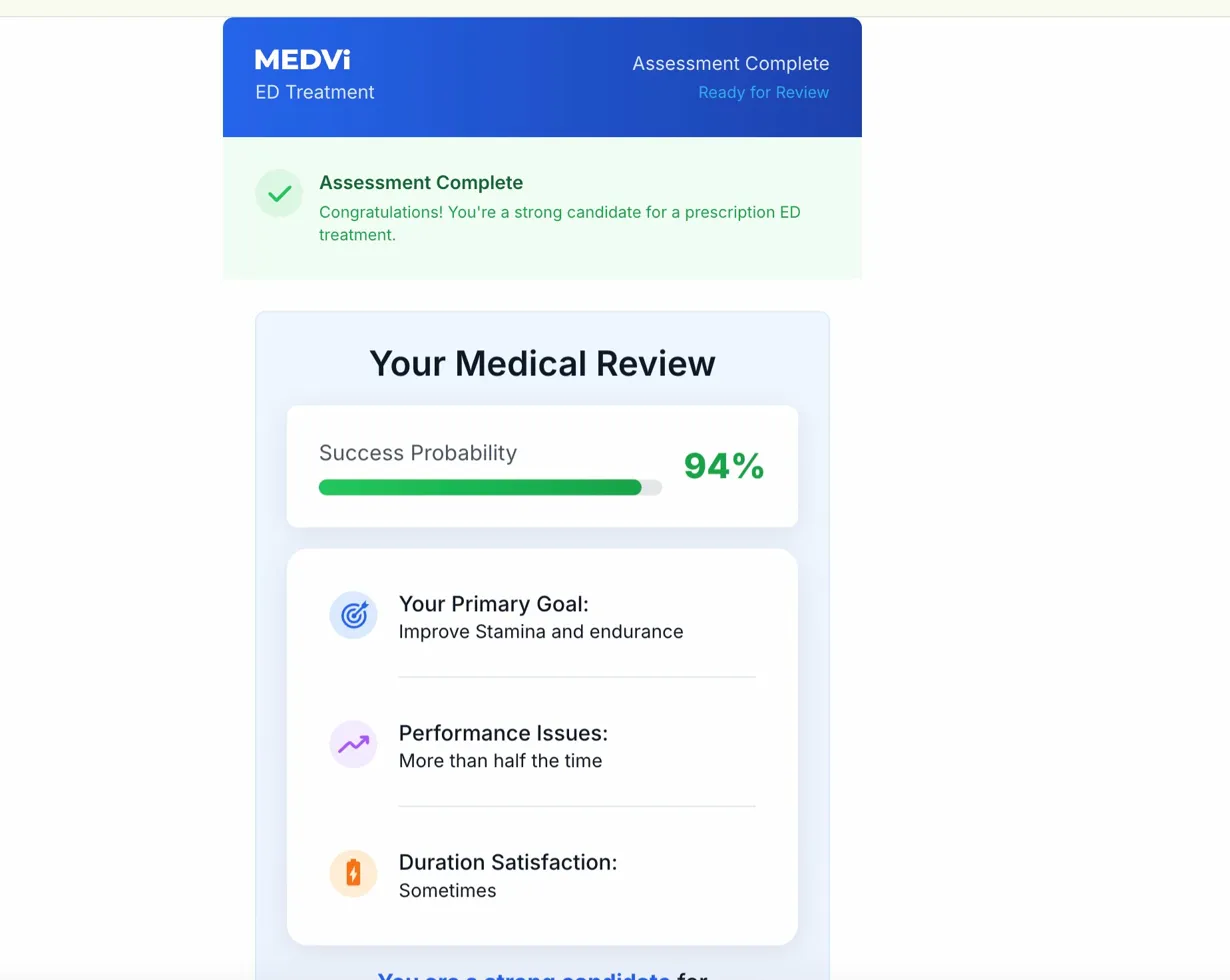
During April 7, 2026 testing, the onboarding portal told users who were not screened out from QUAD that they had a 94% success probability, which is the same figure that has frequently appeared on the GLP-1 onboarding process.
The standard professional drug-interaction databases used by U.S. pharmacies and electronic health records reach similar conclusions. Drugs.com classifies the combination of tadalafil and apomorphine as a “Major” interaction, the highest tier. The page cites additive blood-pressure lowering with risk of dizziness, fainting and changes in heart rate. The same databases flag hypotension as a “Major” disease contraindication for tadalafil, specifically naming patients with resting blood pressure below 90 over 50. And they trigger a therapeutic-duplication warning when more than one erectile-dysfunction agent is prescribed at the same time. The recommended maximum, the warning states, is one. QUAD, as its name suggests, contains four.
Yet an affiliate marketing page posted April 4, 2026 and updated April 6, 2026 on MedicalFoundationofNC.org points out that MEDVi’s ED therapies are not the reason for the regulatory scrutiny. It states: “the FDA warning letter and the GLP-1 regulatory crackdown are about a different product line” and that the February 2026 warning letter “did not reference MEDVi’s QUAD ED product line.”
The page goes on to tell readers to “ask hard questions before enrolling,” discloses that the site may earn affiliate commissions, says it is “not medical advice,” and discloses that MedicalFoundationofNC.org is “not a medical practice, pharmacy, or licensed healthcare provider” and is “not affiliated with The Medical Foundation of North Carolina, Inc., UNC Health Foundation, UNC Health Care, the UNC School of Medicine, or the University of North Carolina at Chapel Hill.”
In the same April 7 test runs, the website displayed a “Your Medical Review” screen showing a “Success Probability” of 94%. The same 94% figure appears in MEDVi’s GLP-1 weight-loss intake, as preserved in a screen recording filed as an exhibit in Day v. OpenLoop Health, the federal class action pending in Delaware. (MEDVi is mentioned in the case, but not as a defendant.) Across at least three QUAD intake test runs conducted that day with varied answer combinations, the 94% figure did not change.
Drug Discovery & Development reached out to MEDVi and OpenLoop Health for comment, and did not immediately receive a response. In an email to Drug Discovery & Development, Nicholas Chimicles, lead counsel for the plaintiffs in Day v. OpenLoop Health, declined to comment further on the litigation but said the firm was aware of the recent New York Times profile of MEDVi.
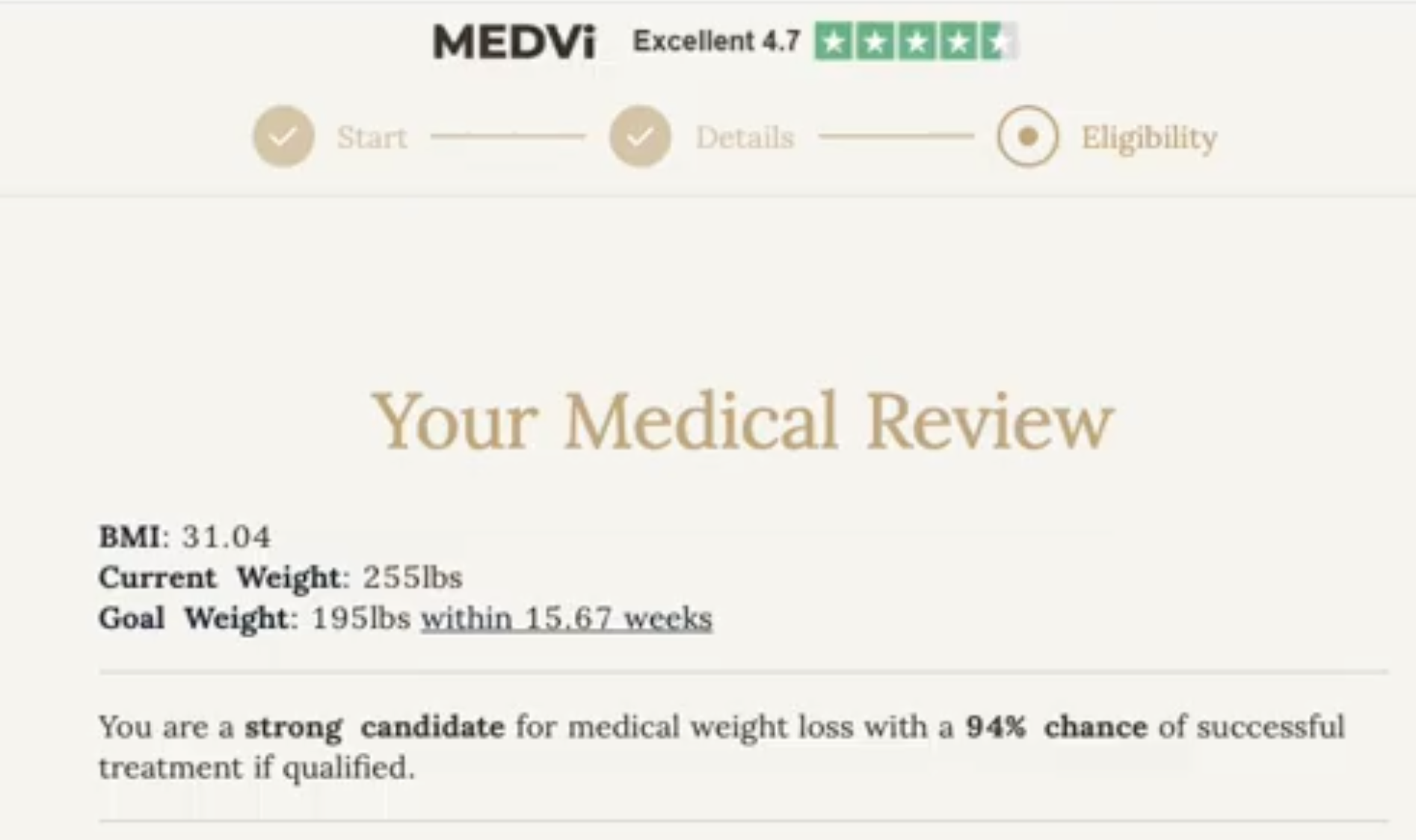
Users who successfully onboard for GLP-1 therapies are frequently told they have a 94% chance of successful treatment.
Filed Under: Regulatory affairs