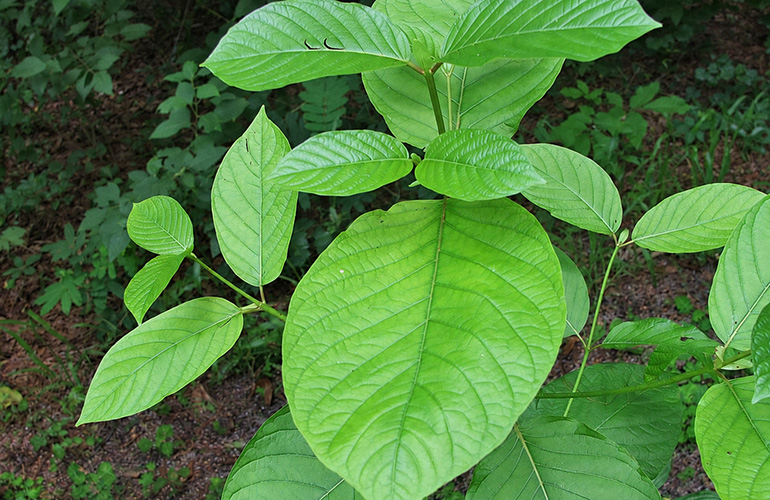
Mitragyna speciosa photo illustration adapted from Uomo vitruviano / Wikimedia Commons, CC BY-SA 3.0.
On August 25-26, the U.S. Drug Enforcement Administration (DEA) followed up on two Federal Register notices published on July 1 that signaled its intent to temporarily place several synthetic alkaloids associated with Mitragyna speciosa (commonly known as kratom leaf or kratom) in Schedule I of the Controlled Substances Act (CSA). One notice concerned three synthetic substances (mitragynine pseudoindoxyl, MGM-15, and MGM-16) and another included threshold levels of 7-hydroxymitagynine (7-OH). The official notices published in the Federal Register on July 6, including 7-OH (here) and three related substances (here).
According to the DEA, two naturally-occurring, psychoactive alkaloids in kratom, mitragynine, and 7-OH, have led to the “proliferation” of products containing drugs synthesized from mitragynine (mitragynine pseudoindoxyl, which is a chemical rearrangement product of 7-OH) and MGM-15 (a synthetic derivative of 7-OH) that have opioid-like effects. While not commercially marketed yet, MGM-16, the 9-fluoro derivative of mitragynine pseudoindoxyl, is also a product that has a highly potent opioid effect.
According to the notices, U.S. Department of Health and Human Services (HHS) and the U.S. Federal Food and Drug Administration (FDA) have confirmed that these kratom-related synthetic substances have no accepted medical use and a high potential for abuse. After the 30-day comment period for the notices, the Office of the Assistant Secretary for Health (OASH) provided comments submitted to the public docket to the Attorney General (AG) for consideration. The AG in turn has delegated the scheduling authority to the Administrator of the DEA.
On August 25, 2026, after the comments were considered, the DEA issued a temporary scheduling order placing the three synthetic kratom-related substances (mitragynine pseudoindoxyl, MGM-15, and MGM-16) in Schedule I. The scheduling order applies to isomers, esters, ethers, and salts of these substances and imposes regulatory controls and administrative, civil, and criminal sanctions for people who handle (manufacture, distribute, reverse distribute, import, export, engage in research, conduct instructional activities or chemical analyses with, or possess), or propose to handle these substances. The DEA temporarily scheduled these substances in Schedule I for two years because it was deemed necessary to avoid an imminent hazard to public safety, which may be extended for up to a year, if the substances are not scheduled in another category or there is an exemption or approval under the Federal Food, Drug and Cosmetic Act (FD&C Act). Prior to the notices, the ASH confirmed there were no investigational drug applications (INDs) or approved new drug applications (NDAs) for these three substances and that HHS had no objections to the temporary placement of these substances in Schedule I of the CSA.
The DEA’s Administrator is charged with considering three of the eight factors set forth in 21 U.S.C. § 811(c) for drug scheduling: the substances history and current pattern of abuse, the scope, duration, and significance of abuse, and what, if any, risk there is to the public health. Schedule I drugs have a high potential for abuse, no currently accepted medical use in treatment in the U.S., and a lack of accepted safety for use under medical supervision.
First, the DEA noted that there has been a shift from natural leaf kratom products to flavored, standardized and high potency semi-synthetic substances like mitragynine pseudoindoxyl, MGM-15, and MGM-16. These substances exhibit a strong affinity for the mu-opioid receptor and function as MOR agonists with health risks similar to morphine and fentanyl, including physical and psychological dependence, and respiratory depression.
Next, the DEA found the scope, duration, and significance of abuse was significant due to the substances’ high opioid potency and commercial availability with deceptive advertising misleading consumers to think the effects would be similar to kratom or that they could be used to ease stress and tension, provide internal calm or reduced restlessness, or provide mental clarity. The DEA said the products had a rapid onset with a duration of effect that lasted several hours with the potential for toxicity and a low barrier to entry with use of fruity flavors or chewable formats, and a prevalence of use at approximately 2 million by 2022.
Finally, the risk to the public health was consistent with other Schedule I products and substantial preclinical data demonstrated mitragynine pseudoindoxyl was about 100 times more potent than mitragynine, and MGM-15 and MGM-16 are about 50-240 times more potent than morphine with signs of opioid physical dependence in animal models. Given that these products are readily available in retail establishments with no age restriction poses additional risk. Therefore, the uncontrolled manufacture, distribution, reverse distribution, importation, exportation, conduct of research and chemical analysis, possession and abuse of these three substances posed an imminent risk to public safety.
Regarding the three substances described above, beginning on August 25, researchers will need Schedule I licenses to continue working with the substances. Retail sale of these three substances to the general public in any quantity are not allowed under the CSA. Any individual who does not obtain a Schedule I registration cannot handle three substances and must surrender all currently-held quantities, and for those with Schedule I registrations, appropriate security must be maintained. Any commercial sale consistent with Schedule I must maintain adequate records and controls and starting on August 25, 2026, and for at least the next two years, retailers will need to cease consumer sales of products containing mitragynine pseudoindoxyl, MGM-15, or MGM-16, and appropriate Schedule I registrations will be required for researchers or other non-public handlers of these substances to avoid regulatory actions. The DEA does not believe this temporary scheduling requires notice-and-comment under the Administrative Procedure Act (APA) or that it is a “rule”.
Regarding the Notice for scheduling 7-OH as Schedule I when contained in products above a particular threshold, OASH created a public docket to extend the comment period to September 10, 2026. The OASH noted that the DEA’s proposed schedule was as follows:
The DEA’s specified threshold for 7-hydroxymitragynine is as follows [emphasis added]:
(A) Any botanical material of the plant Mitragyna speciosa, also known as kratom, and contains more than 0.050 percentage of 7-hydroxymitragynine on a dry weight basis, or
(B) Any alternative article or material to that described in (A), that is:
- Resulting from synthetic methods and containing 7-hydroxymitragynine present in amounts greater than 0.050 percentage weight/weight, weight/volume, or volume/volume or greater than 1.00 milligram of 7-hydroxymitragynine in the article, or
- Material derived from Mitragyna speciosa and further processed to manufacture alternative dosage forms such as extracts, concentrates, processed edibles, or pressed pills, and which may have materials that have been exposed to chemical, thermal, or other methods leading to chemical transformations that result in 7-hydroxymitragynine present in amounts greater than 0.050 percentage weight/weight, weight/volume, or volume/volume, or greater than 1.00 milligram of 7-hydroxymitragynine in the article.
We highlighted the term “in the article” because the DEA did not define this term in either Notice, and it is not defined in the CSA or FD&C Act. The term, however, is used throughout the FD&C Act, and the legislative history for the CSA indicates that in general the CSA adopts the FD&C Act’s definition of “drug”. “Article” in the FD& C ACT in the pill (single unit dosage) v. bottle (packaged unit dosage) context has been interpreted by the FDA to mean “finished product” or “components of a finished product”, whereas the courts have limited FDA’s interpretation to “finished product”, i.e., a single unit dosage or the dosage intended for use versus a “per container” reading. However, we wanted to flag this potential ambiguity for consideration.
The OASH specifically requested comments on the DEA’s proposed thresholds to schedule 7-OH, asking:
- Whether any additional data exist that further support this or an alternative threshold level, and specifically, what concentration or quantity of 7-OH in a product constitutes an imminent hazard to public safety (1) and
- Whether data exist supporting alternative measurement expressions for purposes of specifying the threshold level that is necessary to avoid an imminent hazard to public safety.

Brian Malkin
Note that OASH is not soliciting comment on any permanent scheduling decision, the general safety or utility of kratom-derived products, or other policy questions outside the scope of the threshold determination for temporary scheduling. Public comments submitted to this docket will be provided by the Secretary for Health and Human Services for consideration by the Attorney General.
Key takeaways
The DEA’s temporary scheduling of synthetic 7-OH-related psychoactive substances does not affect botanical kratom products that contain naturally-occurring mitragynine and 7-OH. Instead, the DEA appears to be targeting scheduling products that contain synthetic 7-OH related substances with psychoactive opioid-like effects and higher risks or products higher than naturally-occurring thresholds of 7-OH. Manufacturers, retailers, and researchers for products containing these kratom-related substances should continue to monitor the DEA’s scheduling orders and develop action plans to respond as the deadlines for action have been coming quick and continue to be in flux.
This article was drafted by Brian Malkin, Co-Chair of the Spencer Fane Cannabis and FDA Pharmaceutical and Biologics Market Teams. For more information, visit spencerfane.com.
Filed Under: Regulatory affairs