 Today’s pharmacovigilance (PV) teams face mounting pressure to analyze increasingly larger volumes of safety data while meeting progressively complex global reporting expectations. According to Deloitte’s 2026 Life Sciences Outlook, 48% of life sciences executives say the rapid adoption of digital technologies and data analytics will substantially impact their organizations. Another area of growing interest is agentic AI, with 30% noting its importance. As clinical pipelines continue to expand and reporting obligations become more demanding, many safety organizations are reassessing whether their traditional PV workflows can continue scaling effectively.
For years, modernization efforts in PV focused heavily on automating repetitive and time-consuming tasks, such as intake, form standardization and data entry. These investments did improve efficiency, but they have not impacted how PV professionals evaluate risk or investigate potential signals. Teams still spend significant time collecting fragmented information from disparate systems before meaningful analysis can begin.
As data increases at an exponential rate and overall safety operations expand, their limitations are becoming impossible to overlook. Safety teams require structured reports, literature reviews, regulatory databases, real-world evidence sources and internal operational systems to fulfill their roles and responsibilities. If these systems are fragmented or siloed, teams spend more time assembling evidence than interpreting it.
Another barrier to advancing PV workflows is the outdated mindset of using AI only to automate individual tasks rather than rethinking the broader operating model. When organizations take this narrow view, they put a cap on AI’s potential before it can even meaningfully change how safety work gets done. AI’s real potential is in its ability to connect fragmented data environments and reduce the friction that slows decision-making across the organization. Some organizations adopting AI-supported safety workflows have already increased reporting throughput by roughly 40% without expanding review teams, showing how operational pressure is shifting from simply adding personnel to improving workflow efficiency.
Traditional automation solved intake while decision-making remained manual
The first wave of automation within PV workflows focused primarily on transactional work. Automation provided much-needed relief from repetitive intake tasks while also improving consistency across standardized workflows. During this period, organizations recognized that valuable safety expertise should not be consumed by manual data transformation. Automation, however, did not solve every safety issue, as many downstream processes remaining highly dependent on human coordination.
While automation was a great advance, PV teams are still tasked with comparing emerging trends against historical context, examining literature databases, reviewing regulatory reporting patterns and evaluating supporting evidence before escalating concerns. This is where friction and delays originate, because the contextual information needed for decision-making exists across disconnected repositories. AI-assisted workflows can mitigate these bottlenecks, with the average case progressing from company receipt to final submission in under two hours. AI is a key to compressing timelines that historically depend on multiple disconnected review steps.
While the benefits are clear, many organizations hesitate to adopt broader AI integration, not because of regulatory concerns, but because internal teams may not yet be prepared. Safety teams need confidence that AI-supported systems are producing reliable outputs consistently enough to support broader operational change. Internal readiness requires organizations to rethink governance models, escalation paths and review workflows alongside the technology itself.
AI agents are beginning to reshape signal detection
There remains plenty of discussion surrounding agentic AI in life sciences that focuses on autonomy, but there is a greater opportunity in pharmacovigilance: decision support. Human expertise is invaluable, but the time spent gathering required materials can be significant. These digital colleagues can assist experts by compiling and contextualizing information needed to support faster and more informed evaluations.
For example, signal detection models rely heavily on trend identification. Traditionally, the process starts when a reviewer identifies an emerging pattern. After that, reviewers will manually gather supporting context from literature systems, sales data, regulatory sources or external reporting databases. From here, the expert must conduct their review and determine whether the signal warrants escalation. Human expertise is the beginning and end of this entire process, but it also depends on time-consuming information retrieval.
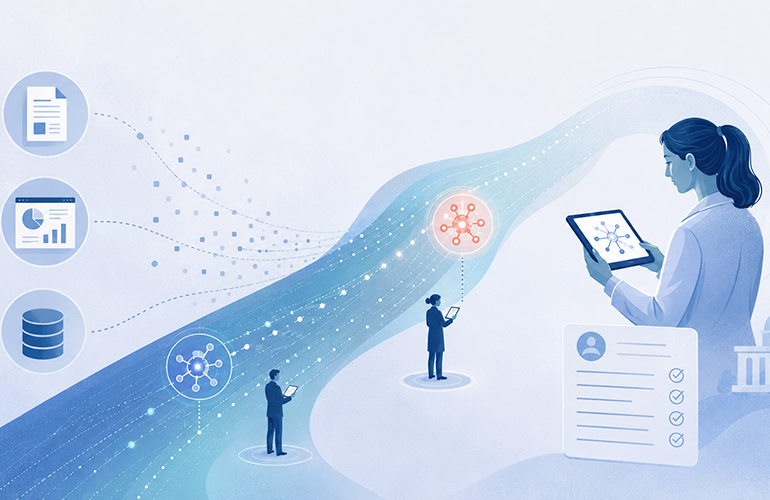
Agentic AI introduces the possibility of orchestrating those steps simultaneously. Rather than asking reviewers to navigate multiple systems independently, AI-supported workflows can aggregate relevant evidence into a unified package before human evaluation begins. This modernized approach allows safety professionals to focus their expertise more directly on assessing clinical significance, validating recommendations and determining appropriate action. The human must stay in the loop of agentic AI workflows while the technology, when implemented correctly, eases operational friction.
Each organization and team will have its own path to AI adoption, and early reports from those who have started have been encouraging. In one client case study, IQVIA’s Vigilance Detect reached 94% precision and 99% accuracy in audio review, alongside an 81% reduction in manual review for that client. Results like these help build confidence in human-guided deployment models. Growth in that confidence will be essential as organizations explore broader adoption across highly regulated environments.
The future of pharmacovigilance will depend on decision velocity
As pharmaceutical portfolios expand, PV teams face growing pressure to meet reporting obligations and maintain data transparency. At the same time, successful AI adoption depends on internal readiness, data quality and contextual consistency. AI systems cannot yet reliably transform information from documents into structured safety workflows without scientific context, standardized inputs and high-quality data.
The most effective organizations will combine AI-driven orchestration with strong human oversight. Today’s PV workflows depend on how quickly teams can assemble evidence, evaluate emerging signals and make confident decisions. Some teams are already reporting that more than 96% of cases are moving through automated submission pathways, signaling how quickly expectations around modern safety operations are evolving.
About the Author:

Updesh Dosanjh
Updesh Dosanjh is Practice Leader, Pharmacovigilance Technology Solutions at IQVIA. Dosanjh is responsible for developing IQVIA’s overarching strategy regarding AI and machine learning as it relates to safety and pharmacovigilance. He has over 25 years of knowledge and experience in the management, development, implementation and operation of processes and systems within life sciences and other industries.
As AI capabilities mature, the industry conversation will shift from “Do PV teams need AI?” to “How can organizations deploy it responsibly while preserving scientific rigor and regulatory trust?” Pharmacovigilance will always require a level of human expertise in the loop, but AI may finally allow safety professionals to spend less time searching for information and more time applying the expertise that matters most.
Filed Under: Pharmacovigilance


![[Adobe Stock]](https://www.drugdiscoverytrends.com/wp-content/uploads/2024/11/AdobeStock_844651123-copy-268x170.webp)