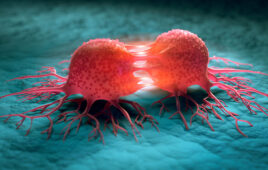
Research at the University of Adelaide has discovered cancer cells may be particularly susceptible to metabolic stress – opening the way for new targeted therapy that won’t harm normal cells.
The researchers showed that chromosomal instability – which is a hallmark of rapidly dividing cancer cells – makes them stressed and vulnerable to mild metabolic disruption. Metabolism is the normal process by which the body turns food into energy.
“A common problem in treating cancers is that they don’t respond to chemotherapy, or they respond for a while, but then come back,” says lead author Dr Stephen Gregory, Senior Postdoctoral Fellow with the University’s School of Molecular and Biomedical Science.
“One reason this happens is because a tumour is usually not made up of identical cells but rather a diverse population of cells that changes all the time, losing and gaining chromosomes as they divide – so-called chromosomal instability. Sooner or later they change enough to be able to resist chemotherapy drugs.
“Our research has shown that chromosomal instability has some consequences for cells – they get stressed, and it only takes a small metabolic push to kill them.”
Current chemotherapy is also very toxic to all dividing cells, particularly affecting cells in hair follicles, the gut lining and blood, often causing hair loss, pain and making patients unwell.
“We need to find ways to target cancer cells without affecting other normal dividing cells,” says Dr Gregory.
The researchers induced chromosomal instability in small experimental flies, Drosophila, and found that the unstable cells were “on the edge” of how much stress they could tolerate.
“This is significant because a change in metabolism is something people cope with very well normally,” says Dr Gregory. “That means that we hope to be able to develop treatments that have no side effects on patients, but are able to kill off the unstable tumour cells that cause relapses.”
Dr Gregory says this may give some validity to theories of alternative treatments such as going on a radical diet.
“People who have advanced cancer which isn’t responding to chemotherapy often try a range of different treatments such as a radical diet in the hope it may help,” he says. “In some situations, it may in fact work; but we hope to be able to point the way to a more targeted approach – finding the most appropriate steps for intervention in the metabolic process that will give the best results.”
The research has been published in the journal Oncogene. It is funded by the National Health and Medical Research Council and continues with a recent NHMRC project grant of $593,000.
Source: University of Adelaide
Filed Under: Drug Discovery