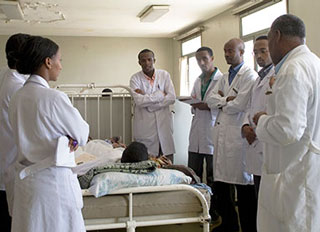
 Health care systems that keep HIV patients from dying early in low- and middle-income nations need urgently to be repurposed to treat the chronic diseases that many of these patients now have, experts say.
According to recommendations resulting from a multidisciplinary conference sponsored by the National Institutes of Health, scientists and physicians in low- and middle-income countries should build on existing HIV research to study and treat chronic conditions. Patients once condemned to death by AIDS now suffer from noncommunicable diseases such as cancer, heart and lung disease, kidney disease, diabetes, mental illness and gastrointestinal disorders. These conditions can be related to the infection itself, the drugs used to treat it, or the simple process of aging.
Increasing rates of chronic diseases among persons with HIV, if unaddressed may set back or even reverse the impressive health gains achieved over the last decade, according to the authors of a new series of articles. Additionally, clinics in many rural areas of Africa, Asia and Latin America are increasingly under strain as they attempt to provide services beyond acute care to treat long-term HIV. To address these issues, global health experts recommend increasing research capacity with respect to HIV-noncommunicable disease burdens in developing countries.
An international group of researchers detailed the problem in a special issue of the Journal of Acquired Immune Deficiency Syndromes. In eight articles and two commentaries, the scientists lay out a research agenda to determine the scope of the noncommunicable disease problems and study the most efficient and cost-effective ways to tackle them. Estimates indicate that chronic illnesses have already overtaken infectious diseases as the main killers in the developing world, the authors reported. These conditions can be simultaneous chronic diseases associated with HIV-related illness, whether HIV is being treated or not.
Research will play a critical role in providing the evidence, strategies and tools required to address this complex challenge, said the authors, who called for visionary scientific leadership, sustained investment and attention, and the breakdown of disciplinary silos.
“Just as the advent of widespread antiretroviral treatment demanded a seismic shift in global human capacity and health systems for the emergency response to HIV, emerging chronic conditions among those with HIV in lower- and middle-income countries will demand no less,” said K. M. Venkat Narayan, M.D., of Emory University, Atlanta, one of the supplement’s lead authors.
While the bulk of the supplement concerned circumstances in sub-Saharan Africa, two essays described similar challenges in low-resource settings in Asia, and in Latin America and the Caribbean. The authors suggested a number of complex health and implementation science topics in developing countries that merit further study, including:
- The lessons learned from the integration of tuberculosis care into HIV treatment should be examined to develop optimal strategies to combat chronic diseases.
- Drug delivery systems now devoted to antiretroviral therapy (ART) and tuberculosis medicines could add essential and affordable drugs for noncommunicable disease management, improving the long-term survival and quality of life of those living with HIV, while potentially increasing ART adherence.
- Virally triggered cancers associated with weakened immune systems are common — among them anal cancer, liver cancer and Hodgkin disease — but the epidemiology of HIV-associated cancers is not well studied.
- ART is known to increase the risk of heart failure and other cardiopulmonary conditions in high-income countries but little is known about the impact in low-resource settings, where individuals may face additional risk factors such as air pollution.
- Depression, alcohol abuse and nervous system disorders affecting memory, attention, decision-making and problem-solving are prevalent in people living with HIV but the diagnostic tools in low- and middle-income countries are inadequate.
- Kidney disease — whether caused by HIV-related infections or toxins from antiretroviral treatments — is on the rise, and registries should be established to study occurrence and severity of side effects to ART.
There was also consensus that enhancement of HIV research and care platforms — as well as expanded training for researchers and providers — could strengthen health systems and improve the overall care of persons living with HIV/AIDS and larger populations.
Date: August 14, 2014
Source: NIH
Filed Under: Drug Discovery


