

Drug Discovery and Development

  • Home Drug Discovery and Development
  • Drug Discovery
  • Women in Pharma and Biotech
  • Oncology
  • Neurological Disease
  • Infectious Disease
  • Resources
    • Video features
    • Podcast
    • Voices
    • Views
    • Webinars
  • Pharma 50
    • 2025 Pharma 50
    • 2024 Pharma 50
    • 2023 Pharma 50
    • 2022 Pharma 50
    • 2021 Pharma 50
  • Advertise
  • SUBSCRIBE

What’s behind the severe allergic reactions from COVID-19 vaccines?

By Brian Buntz | January 13, 2021

(Image by Sam Moqadam on Unsplash)

Reports of severe allergic reactions to COVID-19 vaccines have made consistent headlines in recent weeks. Still, such anaphylactic reactions are rare, occurring in approximately 11 out of every million doses for the vaccine from Pfizer (NYSE:PFE) and BioNTech (NSDQ:BNTX), according to CDC.

While that is roughly 10 times the flu vaccine rate, COVID-19 vaccines so far have been generally well-tolerated in the vast majority of patients.

“The anaphylaxis rate for COVID-19 vaccines may seem high compared to flu vaccines, but I want to reassure you that this is still a rare outcome,” said Dr. Nancy Messonnier, the director of the CDC’s National Center for Immunization and Respiratory Diseases in a recent call with reporters.

More recent CDC data suggests a lower rate of anaphylactic reactions of 5.5 per 1 million injected vaccine doses.

Anaphylaxis, a severe and potentially life-threatening allergic reaction, is generally responsible for approximately 200,000 emergency-room visits annually.

Patients with severe allergies were screened out of Phase 3 COVID-19 vaccine trials from Pfizer-BioNTech and Moderna (NSDQ:MRNA). Those trials cited hypersensitivity reactions rather than anaphylaxis.

Because most reactions occur soon after vaccination, CDC has recommended that vaccine sites have an epinephrine injection device available.

The reason for the reactions is still a mystery. Neither the Pfizer nor the Moderna vaccine contains common allergens such as eggs, latex, gelatin or preservatives.

One recent paper posits that polyethylene glycol plays a role in such allergies. Polyethylene glycol is used in some foods, cosmetics and medicines. Until recently, it had not been used in commonly used vaccines.

Some pundits have speculated that nanoparticles may be responsible for allergic reactions. Nanoparticle vaccines first appeared in 1986 with a virus-like particle vaccine for hepatitis B.

Anaphylactic reactions have been reported for both the Pfizer-BioNTech and Moderna vaccines, and forms of nanoparticles and polyethylene glycol are present in both vaccines.

Although anaphylactic reactions to polyethylene glycol have not been widely reported, in recent years, there has been a rise in complaints about allergic reactions related to the chemical from drugs and personal hygiene products.

Here are the ingredients in the two COVID-19 currently available in the U.S.:
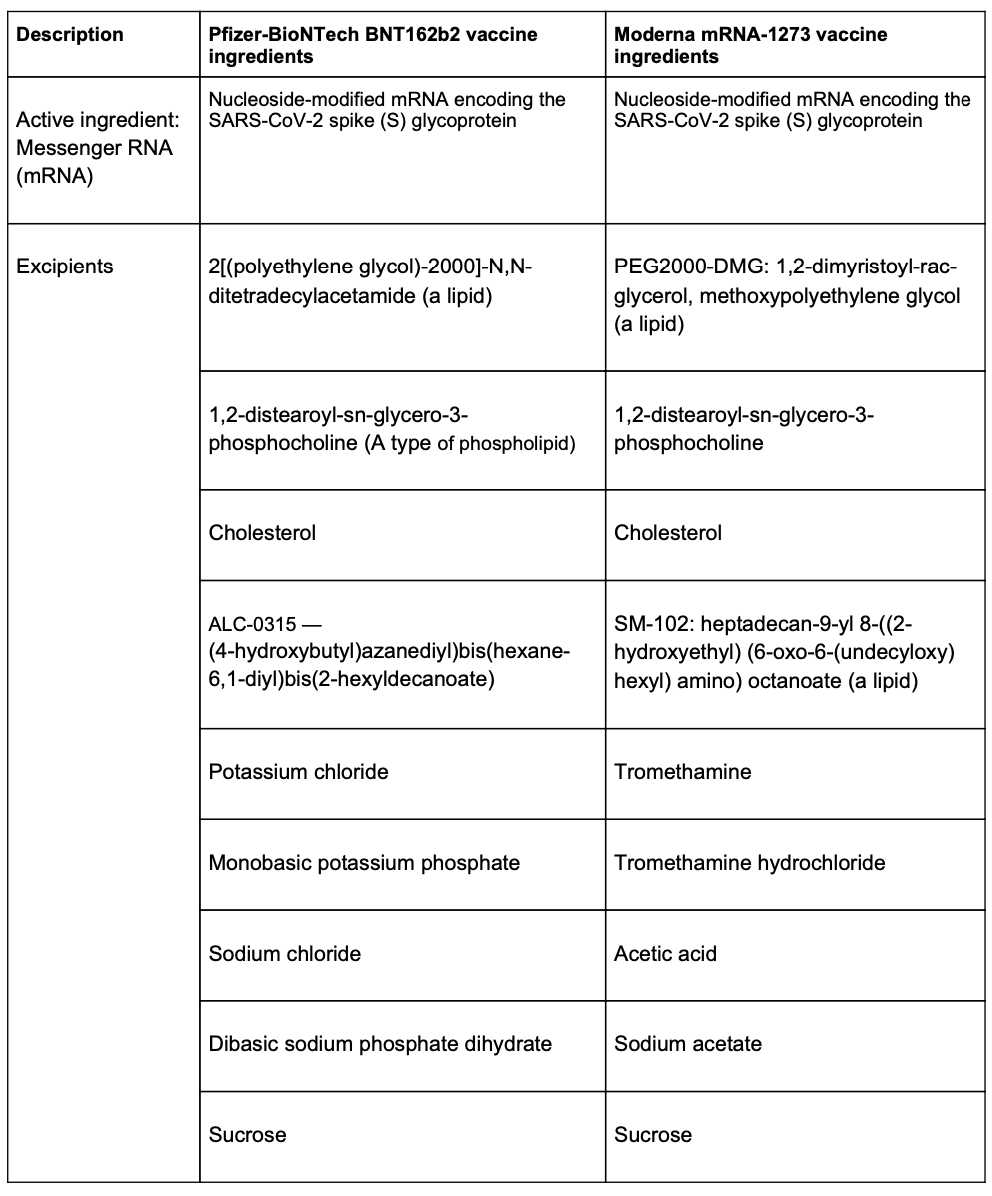
vaccine ingredients


Filed Under: Drug Discovery and Development, Infectious Disease
Tagged With: BioNTech, coronavirus, covid-19, COVID-19 vaccine, Moderna, Pfizer, vaccines
 

About The Author

Brian Buntz

As the pharma and biotech editor at WTWH Media, Brian has almost two decades of experience in B2B media, with a focus on healthcare and technology. While he has long maintained a keen interest in AI, more recently Brian has made making data analysis a central focus, and is exploring tools ranging from NLP and clustering to predictive analytics.

Throughout his 18-year tenure, Brian has covered an array of life science topics, including clinical trials, medical devices, and drug discovery and development. Prior to WTWH, he held the title of content director at Informa, where he focused on topics such as connected devices, cybersecurity, AI and Industry 4.0. A dedicated decade at UBM saw Brian providing in-depth coverage of the medical device sector. Engage with Brian on LinkedIn or drop him an email at [email protected].

Comments

  1. Shurie says

    February 14, 2021 at 4:29 am

    My concern is the platelets problem that has killed people what are they doing to figure out how to prevent that from occurring

    • Brian Buntz says

      March 1, 2021 at 4:18 pm

      Hi Shurie, if you are referring to immune thrombocytopenia, which has been a problem a few vaccine recipients have encountered, there still isn’t a lot of data on its link (if there is indeed one) to COVID-19 vaccines. CDC and FDA (and manufacturers) are reviewing adverse events from vaccines.

Related Articles Read More >

Vaccines, autism and America: A stress test for public health standards
RSV at IDWeek 2025: Competitive expansion of preventive and therapeutic modalities
Top 25 drugs by sales: 2025 H1
Bipartisan support for vaccines could be a balm for beleaguered vaccine companies
“ddd
EXPAND YOUR KNOWLEDGE AND STAY CONNECTED
Get the latest news and trends happening now in the drug discovery and development industry.

MEDTECH 100 INDEX

Medtech 100 logo
Market Summary > Current Price
The MedTech 100 is a financial index calculated using the BIG100 companies covered in Medical Design and Outsourcing.
Drug Discovery and Development
  • MassDevice
  • DeviceTalks
  • Medtech100 Index
  • Medical Design Sourcing
  • Medical Design & Outsourcing
  • Medical Tubing + Extrusion
  • Subscribe to our E-Newsletter
  • Contact Us
  • About Us
  • R&D World
  • Drug Delivery Business News
  • Pharmaceutical Processing World

Copyright © 2025 WTWH Media LLC. All Rights Reserved. The material on this site may not be reproduced, distributed, transmitted, cached or otherwise used, except with the prior written permission of WTWH Media
Privacy Policy | Advertising | About Us

Search Drug Discovery & Development

  • Home Drug Discovery and Development
  • Drug Discovery
  • Women in Pharma and Biotech
  • Oncology
  • Neurological Disease
  • Infectious Disease
  • Resources
    • Video features
    • Podcast
    • Voices
    • Views
    • Webinars
  • Pharma 50
    • 2025 Pharma 50
    • 2024 Pharma 50
    • 2023 Pharma 50
    • 2022 Pharma 50
    • 2021 Pharma 50
  • Advertise
  • SUBSCRIBE