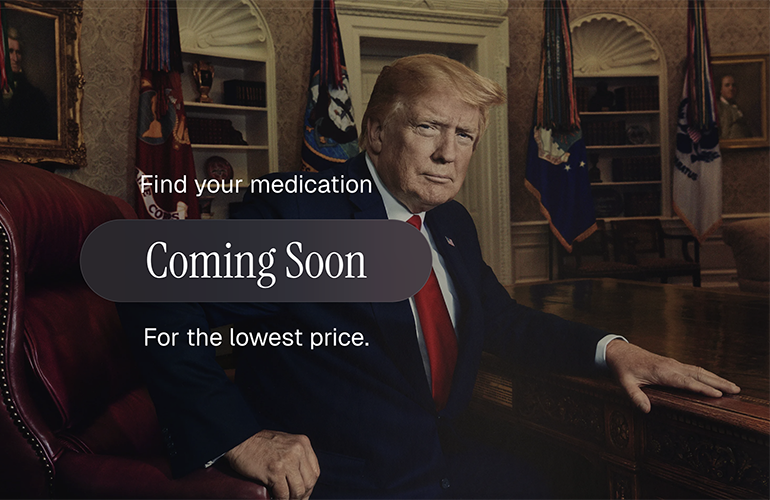
As of early February, TrumpRx.gov displays only a stylized Oval Office portrait of the president and the words “Coming Soon.”In early 2025, Donald Trump Jr. joined the board of BlinkRx, a digital pharmacy company that later began marketing a service it says can stand up direct-to-consumer drug programs in as few as 21 days. Within months, President Trump was pressuring major drugmakers to do exactly that. By fall, the White House announced TrumpRx.gov, a federal portal designed to funnel patients into those manufacturer-run channels.
TrumpRx functions as a referral portal, a federal front door that routes patients to drugmakers’ own direct-to-consumer websites, where they can pay cash prices negotiated between the White House and individual companies. Because those transactions bypass insurance, the dollars patients spend may not count toward their annual deductibles, potentially leaving them exposed to higher costs elsewhere.
The timeline
On July 31, President Trump sent letters to 17 pharmaceutical CEOs urging them to adopt direct-to-consumer channels. A week later, BlinkRx launched “Operation Access Now,” a service promising to help drugmakers stand up DTC programs in 21 days. By December, the company had scheduled a Washington summit on the “Future of Pharmaceuticals,” with invitations extended to senior administration officials including FDA Commissioner Marty Makary and HHS figures aligned with Robert F. Kennedy Jr. The event was postponed due to scheduling challenges stemming from the late-2025 government shutdown.
That direct-to-consumer machinery is already under scrutiny on a second front: prescribing. In a July 2025 investigative report on PfizerForAll and LillyDirect, Durbin and three other senators found that pharma-linked telehealth handoffs can resemble what they called “virtual pill mills,” citing payment relationships with telehealth partners and unusually high prescribing rates. In one LillyDirect cohort routed to Cove, 15 out of 15 patients received a prescription; at UpScript, 714 out of 842 patients routed through PfizerForAll did as well.
The report detailed the financial architecture behind those platforms. Eli Lilly paid telehealth partners roughly $942,500; one telehealth company charges pharma clients, including Pfizer, between $510,000 and $2.45 million over the life of a contract. At least two providers working for Form Health, a Lilly partner, received 41 separate payments from the drugmaker, and one of them generated more than $230,000 in Medicare spending on a single Lilly product in a year.
Rx in a blink
BlinkRx’s own marketing promises prescriptions “in a blink.” Its August 2025 press release for Operation Access Now touted “21 days” to stand up a direct-to-patient program, launched one week after President Trump sent letters to 17 pharmaceutical CEOs urging them to adopt direct-to-consumer channels.
Job postings for UpScript, one of Pfizer’s telehealth partners, advertised that providers could complete six to ten “visits” per hour, a pace that leaves roughly six to ten minutes per patient. A completed visit, the posting noted, means approving or denying a prescription request.
In many cases, patients arrive having already chosen the drug they want. Cove acknowledged to investigators that patients can identify a specific medication before the consultation; Populus prompts consumers to select the product they’re interested in obtaining. The visit, in effect, becomes less a diagnostic encounter than a fulfillment step.
The investigation also documented what flows back to drugmakers. Eli Lilly receives up to 28 data fields from its telehealth partners, including BMI, A1C levels and the date a patient first filled a Zepbound prescription. The senators also flagged what they called evidence of “steering”: LillyDirect’s provider-finder tool, powered by HealthGrades, appeared to surface a narrow subset of physicians, some of whom also do paid work for Lilly, even when hundreds more appeared in the same search run outside the platform.
The pattern echoes warnings federal investigators issued years earlier. In 2022, the HHS Office of Inspector General flagged telehealth arrangements that recruit patients through advertising, limit clinical contact, and direct providers toward preselected products. The senators’ January letter argues that TrumpRx-linked platforms “appear to reflect many aspects of this 2022 warning.”
Some of the drugs moving through these channels potentially carry serious risks. Xeljanz, a Pfizer arthritis drug available through PfizerForAll, has a black box warning, the FDA’s most serious, for heart attacks, strokes, blood clots, cancer and death. In the trial that triggered the warning, patients on Xeljanz had a 3.4% rate of major cardiovascular events compared to 2.5% for those on older alternatives. Still, JAK inhibitors can be highly effective for some patients with inflammatory disease, and rheumatology guidelines still include them as an option in selected cases, particularly when other treatments have failed or are not tolerated. The FDA requires screening for cardiovascular risk factors and latent tuberculosis before prescribing.