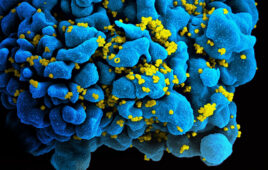
This colorized scanning electron microscope image shows SARS-CoV-2 (round blue objects), the virus that causes COVID-19, emerging from the surface of cells cultured in the lab. [Image courtesy of National Institute of Allergy and Infectious Diseases]
We performed a retrospective analysis of data from the Vaccine Adverse Event Reporting System (VAERS), focusing on the period covering the launch of the bivalent COVID-19 boosters in 2022 to August 25, 2023. The data captures 15,592 reported events for the Moderna vaccine and 21,553 for the vaccine from Pfizer and BioNTech.
COVID-19 reports: Correlation does not equal causation
Both Moderna and Pfizer vaccine boosters have associated reports of post-vaccination COVID-19. More than 16% of the total reports were classified as “COVID-19” for Moderna, slightly higher than Pfizer’s 15%. “SARS-COV-2 Test Positive” reports were also significant, representing nearly 15% for Moderna and 14% for Pfizer. The data for both vaccines also included classifications such as “Breakthrough COVID-19” and “Vaccine Breakthrough Infection.”
All of this is not to imply that the vaccines played a role in such reports. A myriad of factors are potentially at work here, including the following:
- Diagnostic errors: False positives from testing contamination or cross-reactivity.
- Timing of exposure: Individuals may have had a SARS-CoV-2 exposure before COVID-19 vaccination and remained pre-symptomatic until afterward.
- Vaccination errors: In some cases, health care professionals can administer an insufficient dose of COVID-19 boosters and other vaccines. See below for more on that point.
- Immune response variability: No vaccines offer 100% protection, and individual immune responses to vaccines can vary, with some people producing a less robust antibody response than others.
- Virus variants: Some emerging variants may evade current vaccines.
- Behavioral factors: Perceived protection post-vaccination might lead some to engage in riskier behaviors.
- Data considerations: VAERS is a valuable tool for detecting emerging data patterns, but relies on self-reported, unverified submissions. The system also does not capture data from the vast majority of individuals whose vaccination was uneventful.
Product storage error disparity
There was a stark difference between the storage errors associated with the Pfizer (4,270) compared to the Moderna (1,060) omicron boosters. One dimension here that could be at work is the more stringent storage requirements of the Pfizer vaccine. The Pfizer vaccine must be stored at -70°C (minus 94°F) or lower. In contrast, the Moderna vaccine requires long-term storage at -20°C (minus 4°F) and remains stable for up to 30 days at temperatures ranging from 2° to 8°C (36° to 46°F).
Underdose a more frequent report for Moderna’s COVID-19 vaccine than Pfizer’s
The Moderna omicron booster has a significant number of underdose reports (1,539) compared to Pfizer, which had 152.
Moderna Biotech Spain acknowledged the occurrence of such underdosing incidents in 2022, attributing them to confusion tied to the booster dose volume of the original monovalent Spikevax vaccine, which was 0.25 mL (equivalent to 50 mcg). In contrast, the correct dose for the Spikevax bivalent Original/Omicron booster vaccine is 0.5 mL (50 mcg). This discrepancy contributed to situations where individuals received half the intended dose. Moderna said then it was working with regulatory agencies to inform healthcare professionals about the correct dosing procedures for the booster.
Other common symptoms
Symptoms like fatigue, cough, headache, pain, oropharyngeal pain, and chills are common for recipients of many vaccines, including the bivalent omicron boosters from Moderna and Pfizer. Among the most frequently reported symptoms in VAERS reports for both boosters were fatigue, with over 1,500 cases for Moderna and almost 1,900 cases for Pfizer. Cough and headaches were also common among VAERS reports. Other common adverse events include chills. Reports of symptoms such as dizziness, tinnitus and hives were also noted. Dizziness was reported in 3.48% and 3.75% of cases for Moderna and Pfizer, respectively. Tinnitus appeared in 1.03% of Moderna VAERS reports and 1.05% of Pfizer reports. Hives, medically termed as urticaria, were reported in 1.99% of Moderna cases and 1.09% of Pfizer cases.
Expired product administered
Both boosters had reports of expired products being administered, with Moderna slightly surpassing Pfizer. AP noted in March 2022 that vaccines stockpiles were common. Demand for the bivalent COVID-19 boosters was also weak, with only 15% of eligible individuals getting the shot targeting the omicron variant, according to NPR in December 2022. Vaccine fatigue and misconceptions about the threat of the virus were factors behind the slump.
Filed Under: Immunology, Infectious Disease, Regulatory affairs