When MIT and Recursion released Boltz-2 last June, it marked a milestone: the first open-source AI model to jointly predict protein structure and small-molecule binding affinity. The model approaches the accuracy of physics-based free-energy perturbation methods at roughly 1,000x the speed. Its predecessor Boltz-1 had already been widely adopted, and Boltz-2 built on that momentum.
Now, Terray Therapeutics, a startup based in the Los Angeles area, is arguing that Boltz-2 and diffusion-based co-folding models like Boltz-2 share a fundamental bottleneck that limits their practical use in real drug discovery programs. The company today unveiled TerraBind, a potency prediction model that eliminates the diffusion-based pose generation step at the heart of Boltz-2’s architecture, claiming 26x faster inference, 16–20% better accuracy, and something no comparable model offers: built-in uncertainty quantification.
“One of the real untold challenges of the age of AI abundance is that you can generate and predict on millions of molecules, but you can still only test tens,” said Jacob Berlin, Ph.D., co-founder and CEO of Terray. “Picking those correctly is actually the entire value proposition.”
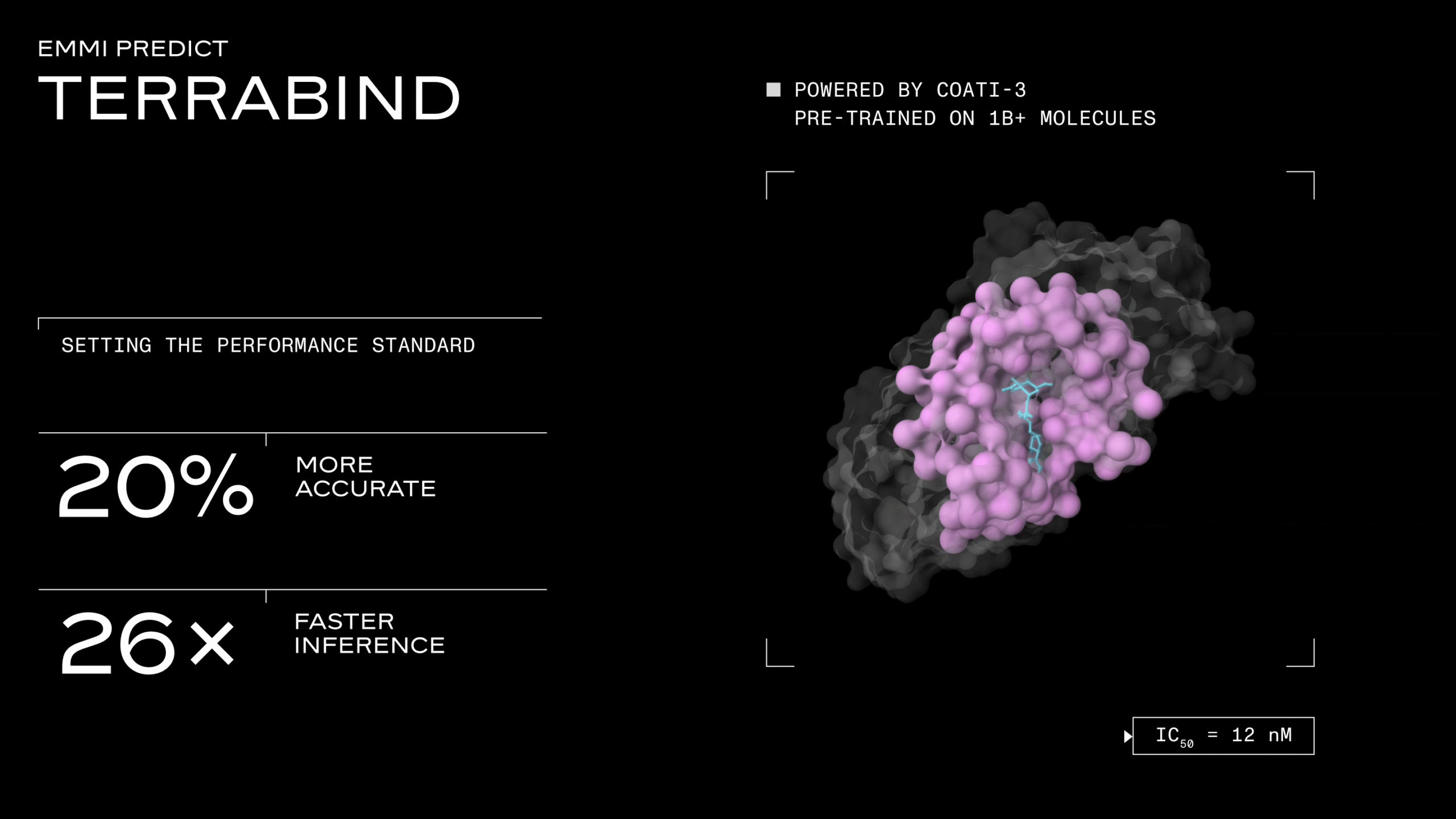
According to Terray, TerraBind achieves 20 percent greater accuracy and 26x faster inference compared with Boltz-2 in internal benchmarks. Source: Terray Therapeutics
What TerraBind actually does differently
The bottleneck, Berlin argues, is baked into the architecture most models share. Nearly every structure-based potency prediction model in the field, he says, including Boltz-2, models from Isomorphic Labs and others, follows the same sequence: encode the molecule and protein, generate a detailed all-atom 3D pose through a diffusion step that shows how the molecule fits against the protein, and then derive the potency prediction from that pose.
“It’s almost like you’re trying to decide the income of people by first looking at pictures of how they dress, instead of directly trying to predict the income,” Berlin said. “We only care how well the molecule works.”
TerraBind’s architectural insight is that the diffusion-based pose generation step, which accounts for roughly 96% of the total compute cost, can be skipped entirely. The model uses Terray’s chemical foundation model, COATI, to encode molecules and proteins into a shared representation space, then feeds that directly into a Pairformer module that resolves structural features and predicts potency without ever generating the all-atom picture. Specifically, TerraBind-Struct works at a coarse-grained level, protein Cβ atoms and ligand heavy atoms only, with no iterative denoising and no all-atom coordinate generation. The result: inference drops from 27.8 seconds per complex on Boltz-2 to 1.04 seconds on TerraBind, measured end-to-end on a single A6000 GPU (196 tokens, 10 samples).
That speed advantage changes what the model can practically do. Terray deploys TerraBind within a two-tiered screening pipeline: every generated molecule is first scored by an ultra-fast sequence-only model (TerraBind-Seq) that is 20,000x cheaper than public alternatives, yielding a subset of promising candidates. That subset then gets the full structure-based treatment from TerraBind-Struct. That’s still 20x cheaper and faster than Boltz-2. The net effect is million-scale screening where the industry standard has been thousands.
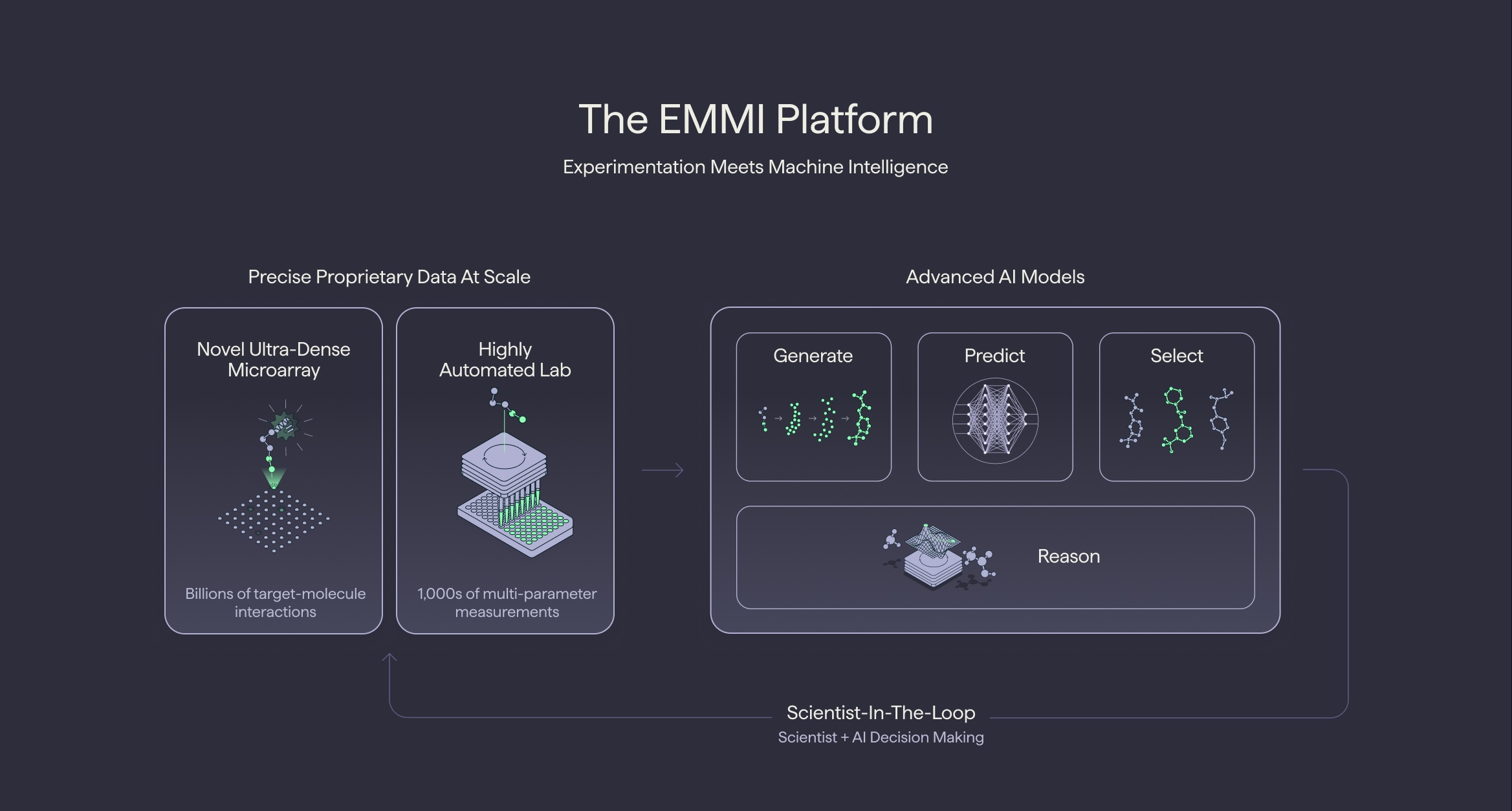
Terray’s EMMI platform integrates proprietary experimental hardware, including an ultra-dense microarray generating billions of target-molecule interactions, with AI models that generate, predict, and select molecules in a scientist-in-the-loop workflow. Source: Terray Therapeutics
Does speed come at a cost?
The obvious concern with stripping out a major architectural component is that you lose accuracy. Terray’s benchmarks suggest the opposite. “You would worry that you’re trading speed and scale for quality, but we don’t,” Berlin said. “The quality is best in class: 20% better than Boltz, roughly on par with what Isomorphic put out, but it does 26 times more and quantifies the uncertainties.”
On two independent held-out test sets, the public CASP16 binding affinity challenge and a proprietary dataset of over 25,000 assay readouts spanning 18 distinct targets, TerraBind demonstrated a 16–20% improvement in Pearson correlation relative to Boltz-2. On the proprietary dataset, TerraBind outperformed Boltz-2 on 15 of 18 targets. Terray attributes the accuracy gains to an unexpected benefit: by removing the diffusion head, the Pairformer module is forced to fully resolve structural features rather than offloading that work to the downstream generative step.
TerraBind produces coarse-grained geometry rather than the all-atom poses that diffusion models generate. Terray argues that this level of structural detail is sufficient for reliable pose prediction and affinity ranking, even if it sacrifices the granular, publication-quality visualizations that diffusion outputs provide.
The stronger accuracy result, 15 of 18 targets, comes from Terray’s proprietary dataset of over 25,000 assay readouts, which is not publicly available for independent verification. The CASP16 result is public. Terray has published its COATI foundation model code on GitHub.
Why uncertainty quantification could change the game
Speed and accuracy benchmarks are one thing. But Berlin argues that the feature most models lack entirely is the one that matters most in practice: knowing how confident the model is about each prediction.
In drug discovery, the standard approach after generating and scoring molecules is to simply pick the top-ranked ones for synthesis and testing, a “greedy” selection. The problem, as Terray explains in its EMMI platform documentation, is that model uncertainty is often correlated: if the top 25 molecules all share a structural motif the model overvalues, a greedy selection can result in a batch where every molecule either wins or fails together. Enforcing structural diversity helps, but doesn’t account for uncertainty that is shared between structurally different molecules.
TerraBind addresses this with TerraBind-Epinet, a variant that uses epistemic neural networks to estimate model uncertainty for every prediction. That uncertainty information feeds into an acquisition function called Expected Maximum (EMAX) that builds what Berlin describes as “hedged baskets” of molecules for synthesis.
“The math will tell you: if this molecule is what I think it is, this other molecule is unlikely to be what I think it is, and vice versa,” Berlin said. “So you can build hedged baskets of molecules where if number one works, number ten won’t, which is fine, you got a winner, but if number two doesn’t, number nine probably will. You get rid of the ‘whole set’ type outcome that’s very common in drug discovery, where you make a bunch of molecules and you don’t move your program far enough along.”
In Terray’s internal benchmarking, this approach yielded a 6x improvement in selection performance over greedy methods, and roughly 3x savings in time and cost in retrospective studies.
What this doesn’t solve yet
Berlin is candid that model performance and drug development outcomes are not the same thing. “Going from model advantage to drug development advantage is actually non-trivial,” he said. “Everybody always skips it: ‘Oh, my model won on this benchmark, problem solved.’ But you have to imbue it in your internal workflows and connect it all the way through.”
Terray’s internal pipeline, focused on immunology, has not yet reached clinical stage, so the platform’s claims remain preclinical. The company has hit milestones in partnerships with Bristol Myers Squibb, Gilead and Calico.
The data moat
The question of whether competitors can replicate TerraBind’s architectural approach is separate from whether they can replicate the results. Berlin expects the architecture will be adopted quickly. “Should everybody have an awakening upon seeing our stuff that our architectural choices are vastly preferred, I expect people will work on it,” he said. “I think it’ll probably sweep through many of the models very quickly.”
The durable advantage, he argues, sits in two places. First is the data: Terray claims to have built the largest global database of small-molecule binding data, now exceeding 14 billion unique target-molecule interactions and growing at roughly 1 billion per quarter. That data comes from the company’s proprietary ultra-dense microarray hardware, which can measure interactions between 32 million molecules and targets of interest in minutes, generating measurements in areas of chemical space where no public datasets exist.
“Almost everybody in the AI space except us has focused their work in areas of known chemical space, because they don’t have proprietary hardware and data at the scale we do,” Berlin said. Terray’s EMMI platform blog puts it more bluntly: “Many current ‘AI drugs’ are strikingly similar to previous patents as the models perform well when tasked with finding a better solution to a previously addressed challenge.”
The second advantage is workflow integration. COATI, the chemical foundation model that powers TerraBind’s speed advantage, has been trained on over one billion molecules and has been in continuous development for years. It underpins not just prediction but the full generate-predict-select cycle that Terray’s scientists use daily. Berlin notes that scientists at Terray are transitioning to interacting with the platform through an AI agent, asking EMMI for a desired outcome and letting it plan the workflow, rather than manually sequencing models.
The long view
Terray has raised over $200 million, with Nvidia and Bedford Ridge co-leading its Series B, and counts Nvidia as both an investor and a technology development partner. The TerraBind announcement is being co-promoted with Nvidia.
Founded in 2019, before both Covid and the ChatGPT-fueled AI wave, Terray has watched the broader industry catch up to the thesis it was already building around. Berlin sees the hype-versus-reality debate as inherent to the timeline of drug development.
“In 15 years, when you look back, it’ll be like, ‘Whoa, the drug discovery process changed, the success rate changed, the time to get through all this changed,’” he said. “But as you go through it, right up against the frontier, you’ll have people arguing all the way through because one drug will fail, two will succeed, and you’ll have the whole cycle again.”
Filed Under: machine learning and AI, Uncategorized