Drug Discovery and Development

  • Home Drug Discovery and Development
  • Drug Discovery
  • Women in Pharma and Biotech
  • Oncology
  • Neurological Disease
  • Infectious Disease
  • Resources
    • Video features
    • Podcast
    • Views
    • Webinars
    • PharmSci360
  • Pharma 50
    • 2026 Pharma 50
    • 2025 Pharma 50
    • 2024 Pharma 50
    • 2023 Pharma 50
    • 2022 Pharma 50
    • 2021 Pharma 50
  • Advertisers
    • Advertise
    • PR Submissions
    • Eblast Submissions
  • SUBSCRIBE

COVID-19 pandemic could be result of incremental bat virus evolution

By Brian Buntz | March 15, 2021

Horseshoe bat

Smithers’ horseshoe bat is a relative of the bat that likely gave rise to the pandemic. Image courtesy of Wikipedia.

When a virus jumps from one host to another, it usually acquires new capabilities to target cells beforehand.

But the SARS-CoV-2 virus seems to have needed little prior adaptation before causing a pandemic, according to a recent study in PLOS Biology.

The genus betacoronavirus to which SARS-CoV-2 belongs is notorious for its threat of jumping from animals to humans. Indeed, the genus is responsible for several outbreaks in the past two decades, including severe acute respiratory syndrome (SARS), Middle East respiratory syndrome (MERS) and, more recently, COVID-19.

The PLOS Biology study concluded that the nearest viral ancestor to SARS-CoV-2 is RmYN02, which evolved in bats. The ancestor virus of SARS-CoV-2 was likely a “relatively generalist virus” that was capable of efficient human-to-human transmission. It is still possible that an intermediate species spread SARS-CoV-2 to humans.

The main difference between the virus behind the earlier SARS outbreak and SARS-CoV-2 is the latter’s increased ability to cleave to angiotensin-converting enzyme 2 (ACE-2), allowing it to infect cells in humans’ upper respiratory tract, albeit with lower disease severity. Paradoxically, however, this capability leads to a more significant disease burden, given the greater case counts linked to SARS-CoV-2 than SARS-CoV, which is now also called SARS-CoV-1.
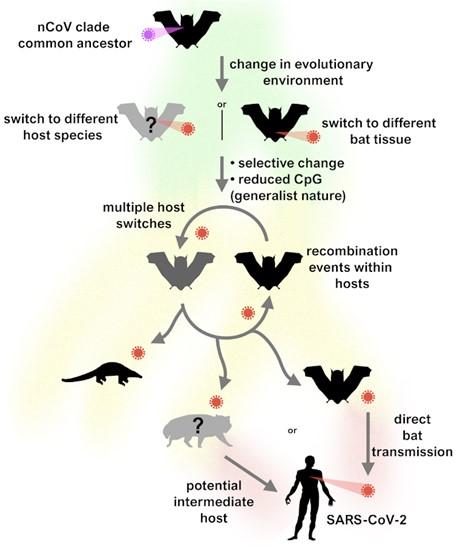
Bat evolution

Schematic of our proposed evolutionary history of the nCoV clade and putative events leading to the emergence of SARS-CoV-2.
Image courtesy of:
MacLean OA, et al. (2021), Natural selection in the evolution of SARS-CoV-2 in bats created a generalist virus and highly capable human pathogen. PLoS Biol 19(3): e3001115. CC-BY

Despite the attention recently given to SARS-CoV-2 variants, the virus has not meaningfully evolved after it began infecting humans roughly a year ago based on the hundreds of thousands of sequenced virus genomes.

“This does not mean no changes have occurred, mutations of no evolutionary significance accumulate and ‘surf’ along the millions of transmission events, like they do in all viruses,” said Dr. Oscar MacLean, who coauthored the PLOS Biology study. While mutations affecting the virus spike improve transmissibility, “‘neutral’ evolutionary processes have dominated,” according to MacLean.


Filed Under: Infectious Disease
Tagged With: bats, coronavirus, covid-19, infectious diseases
 

About The Author

Brian Buntz

As the pharma and biotech editor at WTWH Media, Brian has almost two decades of experience in B2B media, with a focus on healthcare and technology. While he has long maintained a keen interest in AI, more recently Brian has made making data analysis a central focus, and is exploring tools ranging from NLP and clustering to predictive analytics.

Throughout his 18-year tenure, Brian has covered an array of life science topics, including clinical trials, medical devices, and drug discovery and development. Prior to WTWH, he held the title of content director at Informa, where he focused on topics such as connected devices, cybersecurity, AI and Industry 4.0. A dedicated decade at UBM saw Brian providing in-depth coverage of the medical device sector. Engage with Brian on LinkedIn or drop him an email at [email protected].

Related Articles Read More >

Moderna, Merck move toward filing for personalized melanoma therapy as COVID sales lift Q3
Cancer vaccine borrows COVID immune memory to activate T cells against tumors in mice 
AbbVie’s Maviret cured 96% of HCV trial participants. The real world is more complicated.   
FDA greenlights ViiV’s Tivicay PD for HIV-positive newborns in first month of life
“ddd
EXPAND YOUR KNOWLEDGE AND STAY CONNECTED
Get the latest news and trends happening now in the drug discovery and development industry.

MEDTECH 100 INDEX

Medtech 100 logo
Market Summary > Current Price
The MedTech 100 is a financial index calculated using the BIG100 companies covered in Medical Design and Outsourcing.
Drug Discovery and Development
  • MassDevice
  • DeviceTalks
  • Drug Delivery Business News
  • Medtech100 Index
  • Medical Design Sourcing
  • Medical Design & Outsourcing
  • Medical Tubing + Extrusion
  • Pharmaceutical Processing World
  • R&D World
  • Subscribe to our E-Newsletter
  • About Us
  • Contact Us

Copyright © 2026 Arrowfly LLC. All Rights Reserved. The material on this site may not be reproduced, distributed, transmitted, cached or otherwise used, except with the prior written permission of Arrowfly
Privacy Policy | Advertising | About Us

Search Drug Discovery & Development

  • Home Drug Discovery and Development
  • Drug Discovery
  • Women in Pharma and Biotech
  • Oncology
  • Neurological Disease
  • Infectious Disease
  • Resources
    • Video features
    • Podcast
    • Views
    • Webinars
    • PharmSci360
  • Pharma 50
    • 2026 Pharma 50
    • 2025 Pharma 50
    • 2024 Pharma 50
    • 2023 Pharma 50
    • 2022 Pharma 50
    • 2021 Pharma 50
  • Advertisers
    • Advertise
    • PR Submissions
    • Eblast Submissions
  • SUBSCRIBE