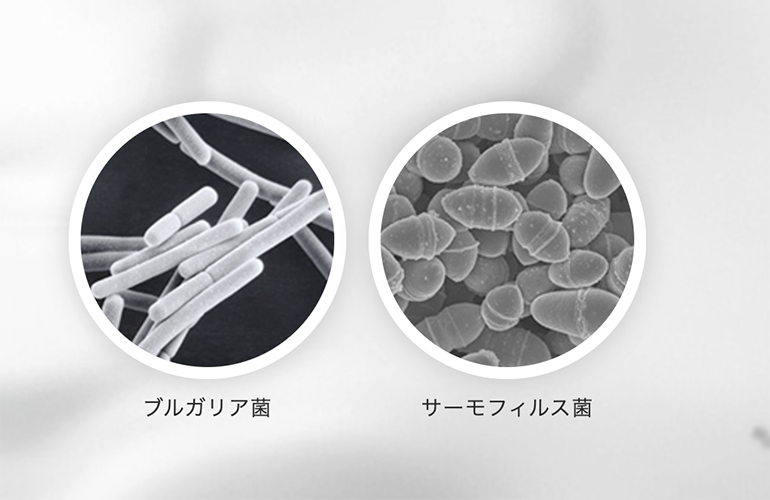
Left: Lactobacillus bulgaricus / Right: Streptococcus thermophilus from the Japanese marketing page for Meiji’s R-1 yogurt line.
Immunotherapy has transformed lung cancer treatment, significantly improving patients’ treatment prospects. But gaps remain. In non-small cell lung cancer, 27 to 46% of patients respond to initial checkpoint inhibitor therapy, and of those who do, the majority develop resistance within four years, according to a study in Cancers 2024. What if a natural polymer produced by a probiotic strain could help tilt those odds?
At AACR 2026 in San Diego, Meiji Holdings presented interim clinical data suggesting that daily consumption of yogurt containing R-1 EPS, an exopolysaccharide produced by the company’s proprietary strain L. bulgaricus OLL1073R-1, was associated with preserved immune-cell populations and other immune changes in NSCLC patients receiving checkpoint inhibitors. According to Meiji’s AACR press materials, the observational study enrolled 91 patients at Saitama Medical University in collaboration with Meiji. The poster reports characteristics for 67 patients and presents several analyses on smaller evaluable subgroups. Separately, an accepted Nature Communications paper from the same Saitama group characterizes the biology of the Th7R biomarker central to the study’s rationale.
The immune cells at the center of the finding
The AACR poster centers on a population of immune cells called Th7R (CXCR3±CCR4-CCR6+ CD4+ T cells), first characterized by the study’s principal investigator, Hiroshi Kagamu, and colleagues in a 2022 Cancer Research paper. In short, Th7R cells appear to be the CD4+ T cell partners that help sustain the CD8+ killer T cells responsible for attacking tumors. Patients with higher Th7R levels before treatment are far more likely to remain disease-free. In resected early-stage patients, preoperative Th7R above a specific threshold predicted markedly better survival (p=0.0002). The foundational work establishing this biomarker carries no Meiji authorship, according to published disclosures.
In earlier work from the Saitama group, peripheral Th7R levels fell after pembrolizumab in patients with shorter progression-free survival, while long responders did not show the same significant decline, suggesting Th7R dynamics may track treatment outcome. Kagamu is listed as an inventor on a patent application related to the Th7R discoveries and has received grant support from Boehringer Ingelheim.
What R-1 EPS appears to do
Earlier mouse work published in Cancer Discovery (2022) by Kawanabe-Matsuda and colleagues offers a plausible mechanism: orally ingested R-1 EPS induces immune cells in the gut that then modulate tumor immunity at distant sites.
In the AACR study, pembrolizumab patients who consumed R-1 EPS yogurt daily showed a preserved Th7R population where a decline would normally be expected (p=0.013), along with a significant increase in a granzyme-positive CD8+ T-cell subset (p=0.0068). Response rates across all three treatment cohorts were numerically higher than both Saitama’s historical institutional controls and selected phase 3 benchmarks, though these are cross-trial, uncontrolled comparisons. The pembrolizumab cohort reported a 58.3% objective response rate versus 44.8% in KEYNOTE-024; the neoadjuvant cohort reported 100% versus 53.6% in CheckMate-816. A progression-free survival analysis favored the R-1 group but did not reach statistical significance.
This is interim, single-arm data using Saitama’s own historical controls rather than a matched comparison population. Key subgroups have single-digit patient counts.
Filed Under: Oncology