By combining nanoparticles with a scorpion venom compound already being investigated for treating brain cancer, University of Washington researchers found they could cut the spread of cancerous cells by 98 percent, compared to 45 percent for the scorpion venom alone.
‘People talk about the treatment being more effective with nanoparticles but they don’t know how much, maybe five percent or 10 percent,’ said Miqin Zhang, professor of materials science and engineering. ‘This was quite a surprise to us.’ She is lead author of the study.
For more than a decade scientists have looked at using chlorotoxin, a small peptide isolated from scorpion venom, to target and treat cancer cells.
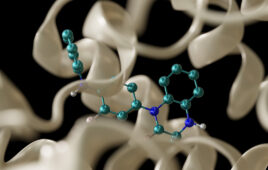
Chlorotoxin binds to a surface protein over-expressed by many types of tumors, including brain cancer. Previous research by Zhang’s group combined chlorotoxin with nanometer-scale particles of iron oxide, which fluoresce at that size, for both magnetic resonance and optical imaging.
Chlorotoxin also disrupts the spread of invasive tumors — specifically, it slows cell invasion, the ability of the cancerous cell to penetrate the protective matrix surrounding the cell and travel to a different area of the body to start a new cancer. The MMP-2 on the cell’s surface, which is the binding site for chlorotoxin, is hyperactive in highly invasive tumors such as brain cancer. Researchers believe MMP-2 helps the cancerous cell break through the protective matrix to invade new regions of the body. But when chlorotoxin binds to MMP-2, both get drawn into the cancerous cell.
Other researchers are currently conducting human trials using chlorotoxin to slow cancer’s spread.
Zhang’s group investigated chlorotoxin action when it is attached to nanoparticles and found the resultant complex doubles the therapy’s effect compared to chlorotoxin alone. Adding nanoparticles often improves a therapy, partly because the combination lasts longer in the body and so has a better chance of reaching the tumor. Combining also boosts the effect because therapeutic molecules clump around each nanoparticle. In the newly published study an average of 10 chlorotoxin molecules were attached to each nanoparticle. Each clump thus offers many therapeutic molecules that can simultaneously latch on to many MMP-2 proteins.
Experiments were performed using mouse brain-cancer cells that were grown in the lab. The imaging results confirm that adding nanoparticles means more of the MMP-2 ends up safely tucked away inside the cell, thus preventing MMP-2 from helping the cancer spread.
Further images showed that the cells containing nanoparticles plus chlorotoxin were unable to elongate, whereas cells containing only nanoparticles or only chlorotoxin could stretch out. This suggests that the nanoparticle-plus-chlorotoxin disabled the machinery on the cell’s surface that allows cells to change shape, yet another step required for a tumor cell to slip through the body.
‘We hypothesized the mechanism and we have all the data to prove our hypothesis,’ Zhang said. Further experiments will involve testing on mice.
So far most cancer research has combined nanoparticles either with chemotherapy that kills cancer cells, or therapy seeking to disrupt the genetic activity of a cancerous cell. This is the first time that nanoparticles have been combined with a therapy that physically stops cancer’s spread.
Slowing the spread of cancer would be especially useful for treating highly invasive tumors such as brain cancer. MMP-2 also shows signs of being overactive in cancers of the breast, colon, skin, lung, prostate, and ovaries, and researchers believe that the technique could slow the spread of these other tumors.
Release Date: April 16, 2009
Source: University of Washington
Filed Under: Genomics/Proteomics