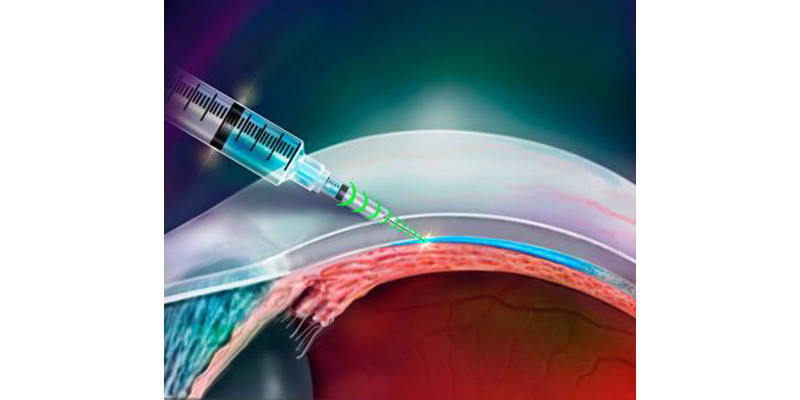
In preclinical testing, resistance-sensing injector allows researchers to more safely and effectively deliver drugs to the body. Credit: Nature Biomedical Engineering
Syringes and hollow needles have been used to deliver medication for more than a century. However, the precise implementation of these devices depends on the operator, and it can be difficult to deliver medication to delicate regions such as the suprachoroidal space at the back of the eye. Investigators from Brigham and Women’s Hospital have developed a highly sensitive intelligent-injector for tissue-targeting (i2T2) that detects changes in resistance in order to properly and safely deliver medication in preclinical testing. Their results are published in Nature Biomedical Engineering.
“Targeting specific tissues using a conventional needle can be difficult and often requires a highly trained individual,” senior corresponding author Jeff Karp, Professor of Medicine at the Brigham, said. “In the past century there has been minimal innovation to the needle itself, and we saw this as an opportunity to develop better, more accurate devices. We sought to achieve improved tissue targeting while keeping the design as simple as possible for ease of use.”
One location that is difficult to target with a standard needle is the suprachoroidal space (SCS), which is located between the sclera and choroid in the back of the eye. The SCS has emerged as an important location for medication delivery and is challenging to target because the needle must stop after transitioning through the sclera, which is less than one millimeter thick (about half the thickness of a U.S. quarter), to avoid damaging the retina. Additional common tissue targets include the epidural space around the spinal cord (used for epidural anesthesia to ease pain during labor), the peritoneal space in the abdomen, and subcutaneous tissue between the skin and muscles.
The i2T2 device was fabricated using a standard hypodermic needle and parts from commercially available syringes. Body tissues have different densities, and the intelligent injector harnesses differences in pressure to enable needle movement into a target tissue. The driving force, maximal forces and frictional force of the injector were tested using a universal testing machine. The feedback of the injector is instantaneous, which allows for better tissue targeting and minimal overshoot (injecting past the target tissue) into an undesired location.
The i2T2 was tested on tissue from three animal models to examine delivery accuracy in the suprachoroidal, epidural and peritoneal spaces as well as subcutaneously. Using both extracted tissue and an animal model, the researchers found that the i2T2 prevented overshoot injuries and precisely delivered medication to the desired location without any additional training or specialized technique.
In preclinical models, the researchers reported high coverage of contrast agent in the posterior section of the eye, indicating that the payload had been injected into the correct location. The researchers also showed the injector could deliver stem cells to the back of the eye that could be useful for regenerative therapies.
“The stem cells injected into the SCS survived, indicating that the force of injection and the transit through the SCS were gentle on the cells,” said Kisuk Yang, a co-author and postdoctoral fellow in Karp’s laboratory. “This should open the door to regenerative therapies for patients suffering from conditions of the eye and beyond.”
“This intelligent injector is a simple solution that could be rapidly advanced to patients to help increase target tissue precision and decrease overshoot injuries. We have completely transformed needles with a small modification that achieves better tissue targeting,” said first author Girish Chitnis, a former postdoctoral fellow in Karp’s laboratory. “This is a platform technology, so the uses could be very widespread.”
“The i2T2 will help facilitate injections in difficult-to-target locations in the body,” said Miguel González-Andrades, MD, ophthalmologist co-author of the manuscript and collaborator with Karp’s lab. “The next step toward human use is to demonstrate the utility and safety of the technology in relevant pre-clinical disease models.”
Filed Under: Drug Discovery