 The pharmaceutical industry heads into 2026 carrying strong M&A momentum, a surging Chinese deal landscape and continued buzz around obesity drugs and new modalities.
Deals involving Chinese pharma and biotech firms reached $92.2 billion in potential value through November 2025. That’s nearly double the $51.9 billion recorded in 2024, according to Mark Lansdell, Director, Asset and Portfolio Strategy Practice Lead at Evaluate
“I expect this trend of rising deal value to continue into 2026, fueled by factors such as impending patent cliffs faced by western pharma, the ease and speed with which Chinese companies can generate clinical data, and China’s growing dominance of certain key modalities and mechanistic approaches in high-value TAs such as oncology,” Lansdell said over email.
M&A projected at $223 billion in 2025
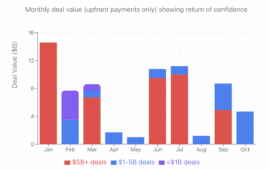
The broader M&A market surged in 2025, with more frequent deals exceeding $5 billion, and some topping $10 billion from players like J&J and Novartis, along with a flow of smaller moves that increased in the second half of 2025, said Ben Folwell, Director, BD&L Lead at Evaluate. Total deal value is projected to reach $223 billion for 2025.
“As we head into 2026, I expect M&A to hold strong, at least throughout the first half of the year,” Folwell said, noting that companies facing significant portfolio risk from patent expirations, including Merck, made acquisitions in 2025 to replace flagship drugs, while others moved into obesity and cardiometabolic spaces.
Oral GLP-1s and combination therapies emerging
Obesity therapeutics will remain a top performer in 2026, driven by oral formulations and combination drugs, said Madeline Verbeke, supervisor and clinical advisor at MMIT.
“Oral GLP-1 therapies for obesity are anticipated to enter the market in late 2025, with additional drug approvals expected throughout 2026,” Verbeke said. “As competitors work to match Novo’s early lead, these treatments should capture meaningful market share, particularly among patients who prefer alternatives to injectables.”
Verbeke also expects existing FDA-approved drugs to find new indications for obesity-related conditions, including chronic heart failure.
She pointed to combination therapies as an emerging focus. Early data is promising, showing they can help manage side effects and cut down on dosing frequency.
Also worth keeping an eye on are combination therapies addressing side effects and dosing frequency, she added.
Modalities to watch: ADCs, radionuclides and PD-1xVEGF
Several therapeutic modalities built momentum in 2025 and are worth keeping an eye on watching in 2026, said Ethan Smith, therapy area director at Norstella.
PD-1xVEGF drugs saw significant progress with global data in thoracic and breast cancers, with some emerging as frontrunners to potentially challenge Keytruda. ADCs “exploded” in 2025, with readouts that could move established players such as Enhertu into much earlier disease stages in breast cancer. And targeted radionuclide therapies gained traction in prostate cancer and neuroendocrine tumors, with next-generation alpha-emitters expected to drive “fundamental paradigm shifts” in 2027 and beyond.
Filed Under: M&A trends