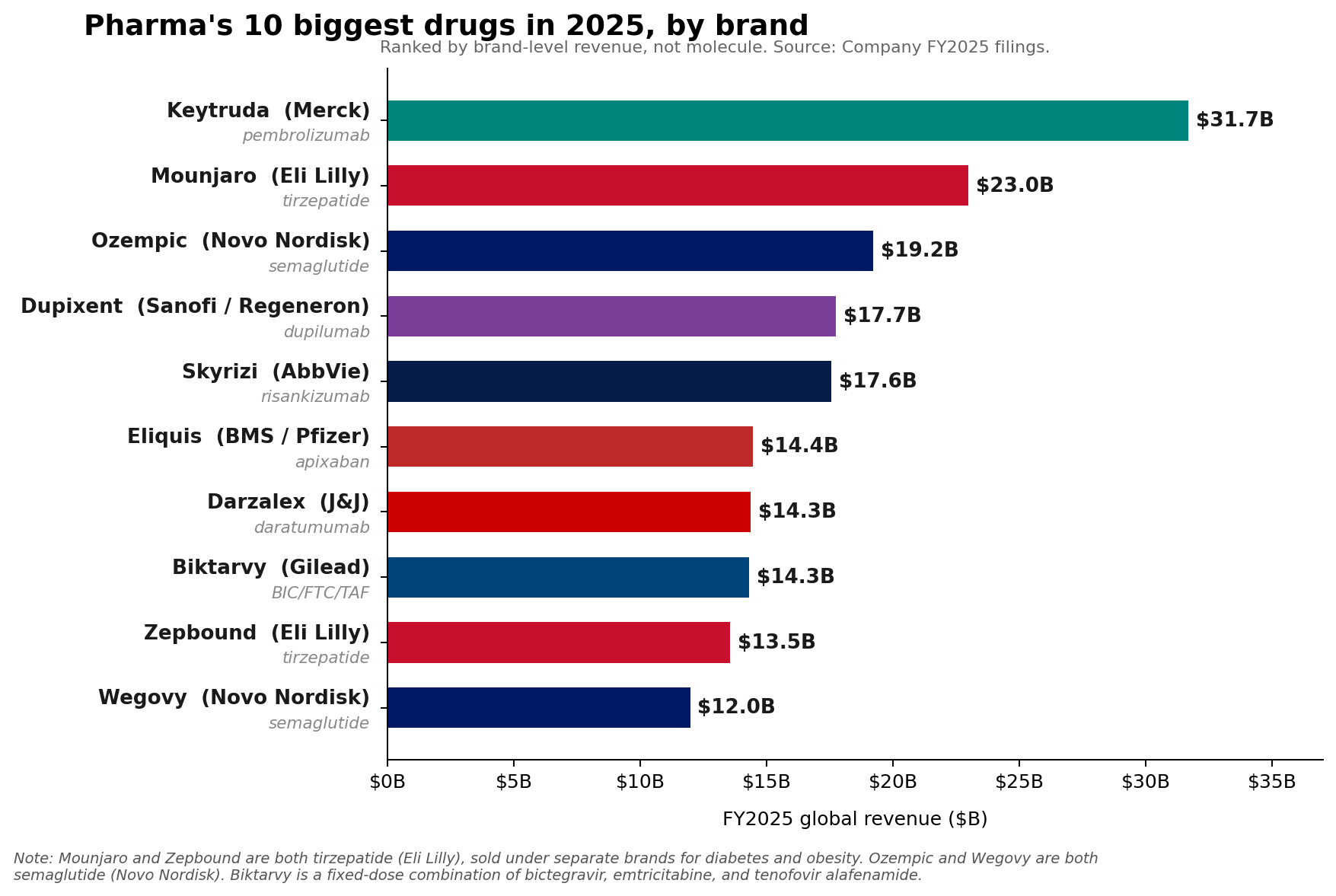
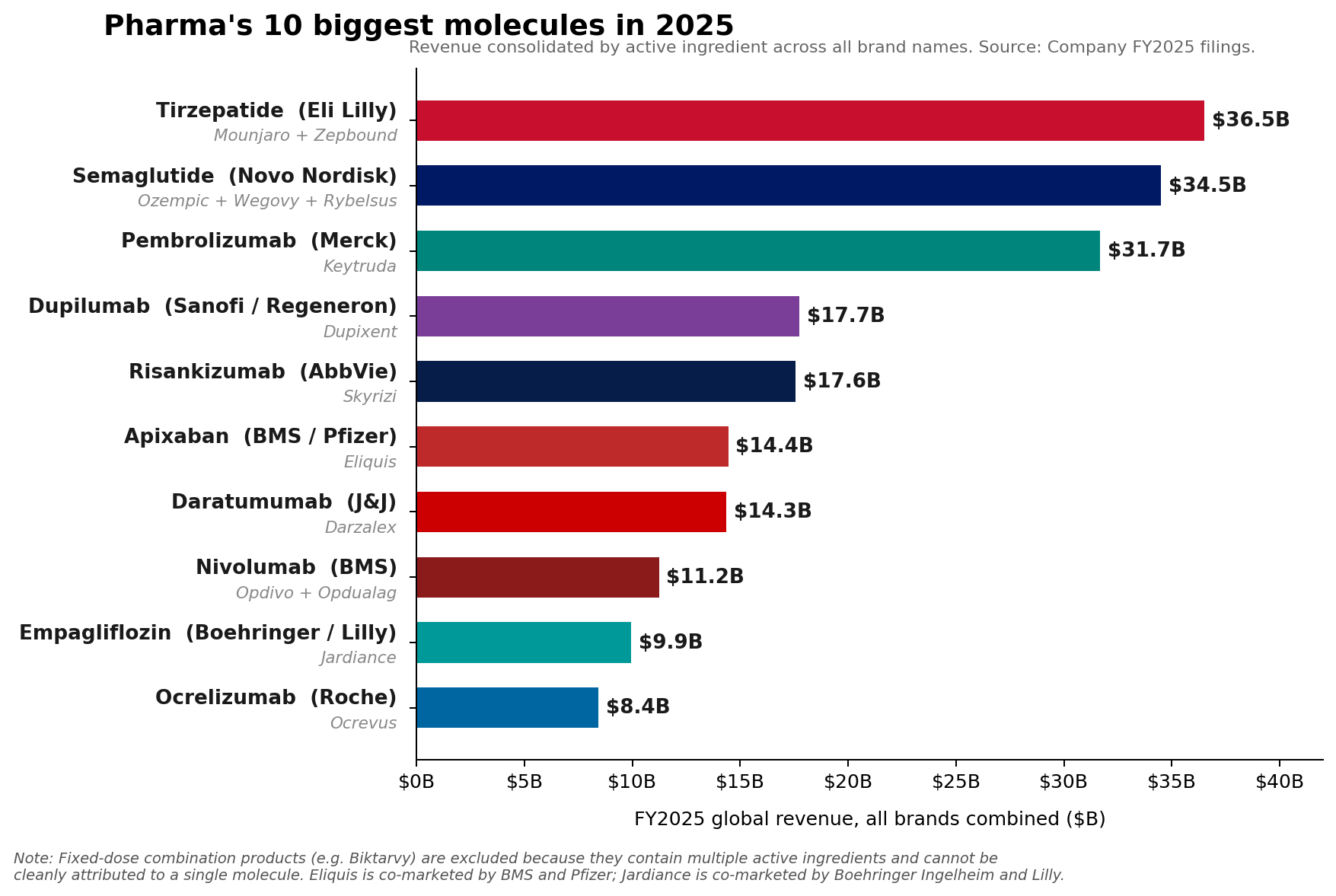
 Merck’s Keytruda (pembrolizumab) remained pharma’s No. 1 brand in FY2025 with $31.7 billion in sales. But it is no longer the industry’s top-selling medicine at the molecule level. Lilly’s tirzepatide franchise, spanning Mounjaro ($22.965 billion) and Zepbound ($13.542 billion), reached roughly $36.5 billion in 2025 revenue, while Novo Nordisk’s semaglutide franchise, counting Ozempic, Wegovy and Rybelsus together, reached roughly $34.5 billion.
Merck is still showing muscle. Keytruda grew 7% in 2025, and the company is still extending the franchise with new indications and lifecycle moves such as subcutaneous Keytruda QLEX. The bigger question is what happens as Keytruda’s loss of exclusivity nears in the coming years. CEO Rob Davis has framed that coming drop-off as “more of a hill than a cliff.” Still, Merck’s FY2026 revenue guidance of $65.5 billion to $67.0 billion came in below Wall Street expectations. Meanwhile, the obesity market is only getting more competitive, with Lilly’s oral GLP-1 orforglipron winning FDA approval on April 1, 2026 and commercially available as of April 9.
Some of the biggest gainers were already scaled specialty brands with room to keep climbing. AbbVie’s Skyrizi reached $17.562 billion in 2025 sales and Rinvoq reached $8.304 billion, Sanofi’s Dupixent rose to €15.714 billion, and Novartis’ Kisqali climbed 58% to $4.783 billion. Johnson & Johnson, meanwhile, said its 2025 Innovative Medicine growth was driven primarily by products including Darzalex and Tremfya. Citeline’s 2026 R&D review reinforces that commercial picture: immunologicals were one of the few large therapeutic buckets that still expanded, rising 20.6% even as the overall pipeline count dipped. In other words, the leaderboard below Keytruda is not turning into a pure GLP-1 monoculture. It is getting crowded with large, durable franchises in immunology and oncology that are still compounding.
Orforglipron is a wildcard
Foundayo (orforglipron), a once-daily oral small-molecule GLP-1 receptor agonist that Lilly licensed from Chugai in 2018, could remake the leaderboard in 2026. But analysts disagree on its potential.
Lilly guided to $80 billion to $83 billion in 2026 revenue after a 2025 driven by Mounjaro and Zepbound, and it got a major new catalyst when the FDA approved Foundayo, the orforglipron obesity pill, on April 1, 2026. Because that approval landed after Q1 ended, it will matter much more for the rest of 2026 than for reported Q1 numbers. While orforglipron is a huge strategic story for 2026, Mounjaro and Zepbound are still more likely to drive the biggest absolute revenue gains this year.
Mounjaro entered 2026 off a $22.965 billion base and Zepbound off $13.542 billion in 2025 sales, while Foundayo was approved only on April 1, after Q1 had already ended. Lilly said prescriptions would be accepted immediately, with shipping beginning April 6, which makes orforglipron the biggest new strategic variable in obesity, but not necessarily the biggest 2026 dollar-growth engine. Citeline’s 2026 Pharma R&D Annual Review helps explain why the launch matters anyway: the anti-obesity pipeline jumped 30.7% to 588 active compounds, what report author Ian Lloyd calls “a gut-busting 30.7%” expansion against a backdrop of overall pipeline contraction. Orforglipron is entering a market that is expanding fast, but it is still entering behind two Lilly products that already sit at blockbuster scale.
On oral semaglutide, the important 2026 commercial event is not old Rybelsus, which Novo says declined 2% at CER in 2025, but the newer Wegovy pill, which Novo says launched in January 2026 and is already reflected in its 2026 outlook. Novo also says it expects to roll out Wegovy more broadly in 2026 and introduce the 7.2 mg dose in a number of countries, and it just launched Wegovy HD in the U.S. this week. But the key reality check is that Novo’s own 2026 guide is still for adjusted sales growth of negative 5% to negative 13% at CER, reflecting pricing pressure, competition, and U.S. access dynamics. So the best framing is: oral sema matters strategically and could widen the funnel, but it does not yet look like the product that will dominate 2026 revenue growth.
AbbVie’s immunology engine tells a similar story of scaled franchises still compounding. AbbVie exited 2025 with Skyrizi at $17.562 billion and Rinvoq at $8.304 billion, and it guided to 2026 adjusted EPS of $14.37 to $14.57. Skyrizi and Rinvoq together generated $25.866 billion in 2025, which works out to roughly 42% of AbbVie’s total $61.160 billion in net revenue for the year. That means AbbVie already has a two-drug immunology engine that, by itself, is approaching the scale of the industry’s largest single brands.
Filed Under: Pharma 50