
Drug Discovery and Development

  • Home Drug Discovery and Development
  • Drug Discovery
  • Women in Pharma and Biotech
  • Oncology
  • Neurological Disease
  • Infectious Disease
  • Resources
    • Video features
    • Podcast
    • Voices
    • Views
    • Webinars
  • Pharma 50
    • 2025 Pharma 50
    • 2024 Pharma 50
    • 2023 Pharma 50
    • 2022 Pharma 50
    • 2021 Pharma 50
  • Advertise
  • SUBSCRIBE

Pfizer-AstraZeneca COVID-19 vaccine combinations are effective, study suggests

By Brian Buntz | June 29, 2021

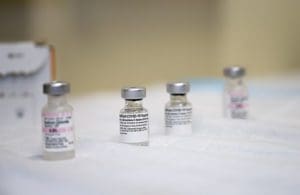
Pfizer-BioNTech vaccine

Doses of the COVID-19 vaccine at Walter Reed National Military Medical Center, Bethesda, Md. DoD photo by Lisa Ferdinando.

British researchers report that using distinct COVID-19 vaccine types for the first and second doses appears to be effective, according to a preprint study in The Lancet.

As global health authorities seek to vaccinate as many people as possible, a potential hurdle is the need to use identical vaccines for the prime and boost stages. Using a so-called heterologous prime-boost vaccination would enable more rapid vaccination, but data about the efficacy of such a strategy have been scarce.

In the recent study, researchers randomized 830 adults 50 and older into eight groups to receive the varying combinations of the AstraZeneca and BioNTech-Pfizer vaccines.

To get a sense of the efficacy of the various combinations, the researchers used a geometric mean ratio (GMR) and geometric mean concentration (GMC) of serum SARS-CoV-2 anti-spike immunoglobulin G levels.

The study concluded that the immunity 28 days after administering the second dose was non-inferior when using an AstraZeneca vaccine for the first dose and a BioNTech-Pfizer shot for the second.

Trial recipients who received two doses of the Pfizer-BioNTech vaccine had antibody levels approximately 10 times higher than those who received two doses of the AstraZeneca vaccine. Those who received first the Pfizer and then the AstraZeneca vaccines had antibody levels about five times higher than those who received two doses of the latter vaccine. Meanwhile, those who received the AstraZeneca vaccine as a prime and a Pfizer boost had immune responses roughly comparable to those who received two doses of the Pfizer-BioNTech vaccine.

For recipients receiving a Pfizer-BioNTech vaccine for the first shot and an AstraZeneca shot for the second, the combination did not fare as well. The researchers concluded that they “failed to show non-inferiority of the heterologous schedule.”

Although the latter combination did not meet their non-inferiority criteria, combining the two vaccine types fared better than using the AstraZeneca vaccine for both the prime and boost.

Ultimately, according to Dr. Matthew Snape, a professor in pediatrics and vaccinology at Oxford University, any combination of the two vaccines is likely to offer strong efficacy.

One caveat is that mixing vaccine doses leads to more side effects, including headaches, chills and body aches, than using two identical vaccine doses.

The researchers are also gathering data on whether the AstraZeneca vaccine is more effective if the second dose is administered up to 12 weeks after the first dose. It is also likely that a third dose of the same vaccine will offer greater efficacy.


Filed Under: Infectious Disease
Tagged With: AstraZeneca, AstraZeneca plc, BioNTech, coronavirus, covid-19, COVID-19 vaccine, COVID-19 vaccine trial, COVID-19 vaccines, Oxford, Pfizer
 

About The Author

Brian Buntz

As the pharma and biotech editor at WTWH Media, Brian has almost two decades of experience in B2B media, with a focus on healthcare and technology. While he has long maintained a keen interest in AI, more recently Brian has made making data analysis a central focus, and is exploring tools ranging from NLP and clustering to predictive analytics.

Throughout his 18-year tenure, Brian has covered an array of life science topics, including clinical trials, medical devices, and drug discovery and development. Prior to WTWH, he held the title of content director at Informa, where he focused on topics such as connected devices, cybersecurity, AI and Industry 4.0. A dedicated decade at UBM saw Brian providing in-depth coverage of the medical device sector. Engage with Brian on LinkedIn or drop him an email at [email protected].

Related Articles Read More >

Vaccines, autism and America: A stress test for public health standards
RSV at IDWeek 2025: Competitive expansion of preventive and therapeutic modalities
Top 25 drugs by sales: 2025 H1
Bipartisan support for vaccines could be a balm for beleaguered vaccine companies
“ddd
EXPAND YOUR KNOWLEDGE AND STAY CONNECTED
Get the latest news and trends happening now in the drug discovery and development industry.

MEDTECH 100 INDEX

Medtech 100 logo
Market Summary > Current Price
The MedTech 100 is a financial index calculated using the BIG100 companies covered in Medical Design and Outsourcing.
Drug Discovery and Development
  • MassDevice
  • DeviceTalks
  • Medtech100 Index
  • Medical Design Sourcing
  • Medical Design & Outsourcing
  • Medical Tubing + Extrusion
  • Subscribe to our E-Newsletter
  • Contact Us
  • About Us
  • R&D World
  • Drug Delivery Business News
  • Pharmaceutical Processing World

Copyright © 2026 WTWH Media LLC. All Rights Reserved. The material on this site may not be reproduced, distributed, transmitted, cached or otherwise used, except with the prior written permission of WTWH Media
Privacy Policy | Advertising | About Us

Search Drug Discovery & Development

  • Home Drug Discovery and Development
  • Drug Discovery
  • Women in Pharma and Biotech
  • Oncology
  • Neurological Disease
  • Infectious Disease
  • Resources
    • Video features
    • Podcast
    • Voices
    • Views
    • Webinars
  • Pharma 50
    • 2025 Pharma 50
    • 2024 Pharma 50
    • 2023 Pharma 50
    • 2022 Pharma 50
    • 2021 Pharma 50
  • Advertise
  • SUBSCRIBE