You said:Oral SERD giredestrant cuts recurrence risk 30% in early HR positive breast cancer

(Adobe Stock)
Giredestrant, an experimental oral selective estrogen receptor degrader, reduced the risk of invasive disease recurrence or death by 30% compared with standard hormone therapy in a phase 3 trial of more than 4,100 patients with early-stage, hormone receptor-positive, HER2-negative breast cancer.
The lidERA trial results, presented Wednesday at the San Antonio Breast Cancer Symposium by Genentech and Roche, mark the first time an oral SERD has demonstrated a statistically significant disease-free survival benefit in the adjuvant setting, a potential inflection point after more than two decades of tamoxifen and aromatase inhibitors as the default post-surgical treatment.
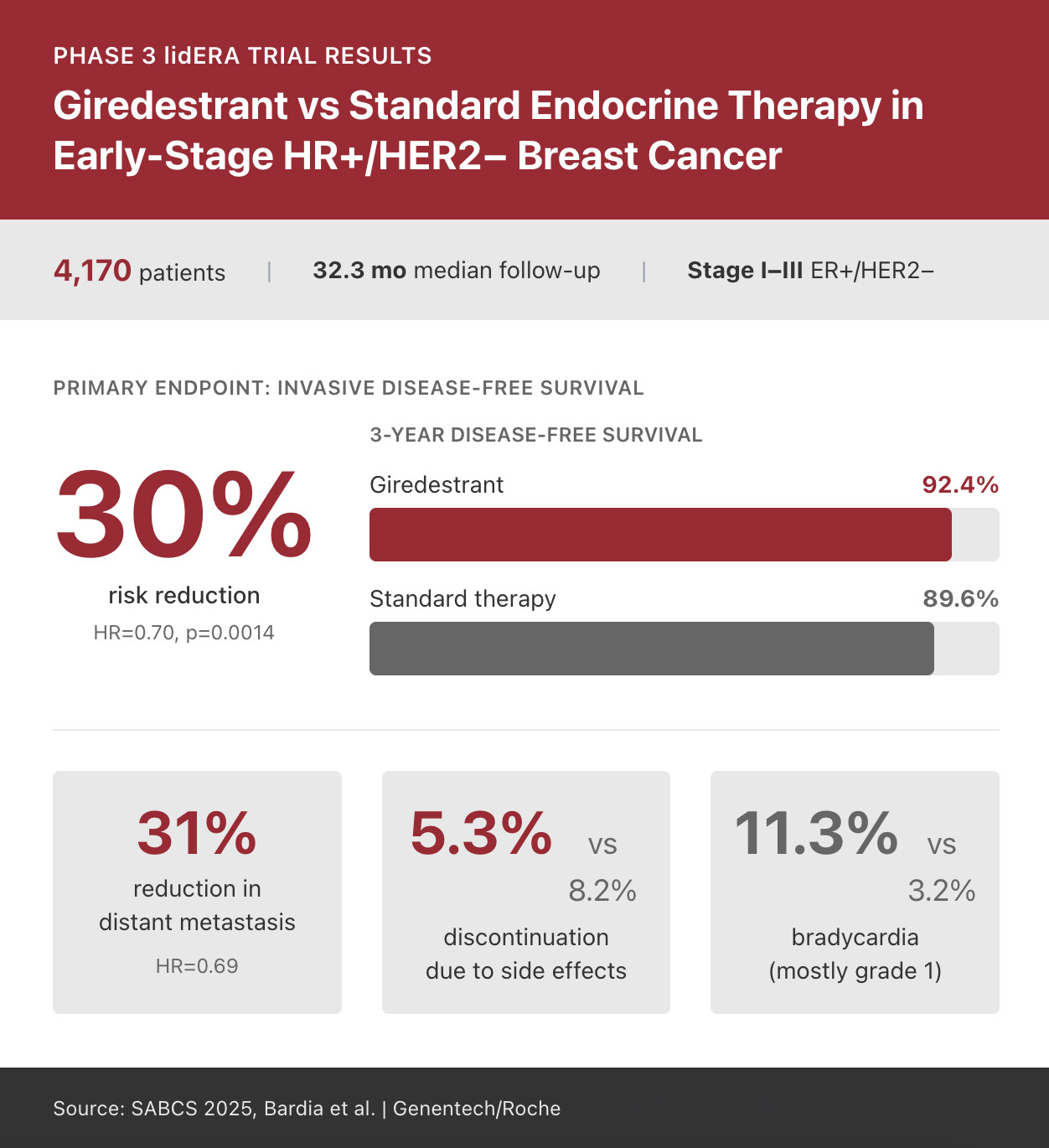
At three years, 92.4% of patients taking giredestrant once daily were alive and free of invasive disease, versus 89.6% on physician’s choice of standard endocrine therapy. The drug also cut distant metastasis risk by 31%.
Giredestrant is designed to more completely block and degrade the estrogen receptor, a driver of growth in HR positive tumors. It is the first oral SERD to demonstrate a statistically significant and clinically meaningful invasive disease free survival benefit in the adjuvant setting in a phase 3 trial, according to the company.
Screenshot
The lidERA trial enrolled more than 4,100 patients with medium or high risk stage I to III estrogen receptor positive, HER2 negative early breast cancer across global sites. Participants were randomized to receive once daily oral giredestrant at 30 mg or physician’s choice of standard endocrine therapy, typically third generation aromatase inhibitors or tamoxifen, for up to five years after surgery. Cancer Network+1
At a median follow up of 32.3 months, patients in the giredestrant arm were 30% less likely to experience invasive disease recurrence or death than those receiving standard endocrine therapy. At three years, 92.4% of patients in the giredestrant group were alive and disease free compared with 89.6% in the control arm.
The drug also improved distant disease free survival. The SABCS presentation reported a 31% reduction in distant metastases for patients on giredestrant versus standard therapy, suggesting a potential impact on the risk of life limiting metastatic relapse. That signal is consistent with topline descriptions of the trial’s secondary endpoints.
Safety and tolerability profiles were similar between study arms, with familiar endocrine related adverse events such as arthralgia, hot flashes and headaches reported at comparable rates. Fewer patients stopped therapy because of side effects in the giredestrant arm, 5.3% versus 8.2% with standard therapy, according to the SABCS release. Bradycardia, a known class effect of oral SERDs, was higher with giredestrant at 11.3% versus 3.2% with standard therapy, but most cases were grade 1, asymptomatic, and did not require treatment interruption.
Giredestrant in combination with everolimus has already delivered a positive phase 3 readout in the metastatic setting in the evERA trial, and multiple ongoing studies are exploring combinations with CDK4/6 inhibitors and HER2 targeted agents in advanced disease.
JPMorgan analysts have estimated that an adjuvant indication could generate around $5 billion in annual revenue if giredestrant secures a broad label. For drug discovery and development teams, lidERA provides one of the clearest signals so far that next generation oral SERDs can move beyond metastatic rescue therapy and begin to reshape frontline endocrine standards in early breast cancer.
Filed Under: Oncology
Tagged With: adjuvant endocrine therapy, aromatase inhibitors, distant metastasis reduction, Genentech, giredestrant, hormone receptor positive breast cancer, HR-positive HER2-negative early breast cancer, invasive disease-free survival, lidERA trial, oral SERD, phase 3 clinical trial, recurrence risk reduction, Roche, San Antonio Breast Cancer Symposium (SABCS), selective estrogen receptor degrader, tamoxifen