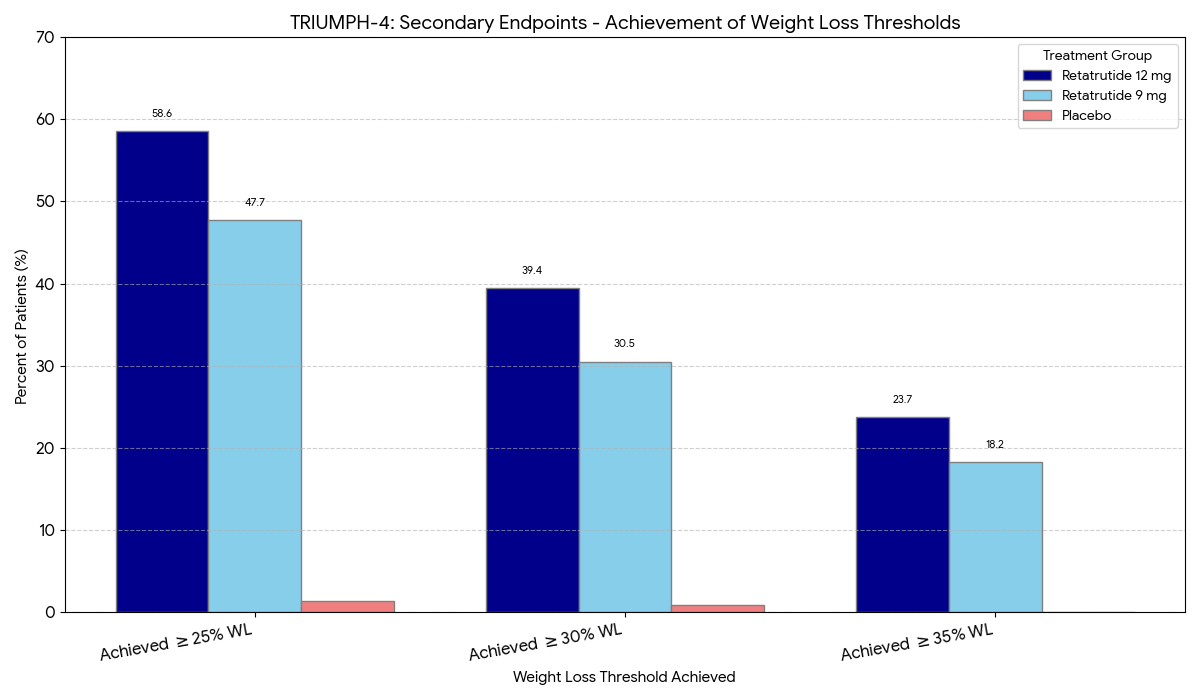
Lilly announced results from its Phase 3 TRIUMPH-4 trial of retatrutide, a first-in-class GIP, GLP-1 and glucagon triple hormone receptor agonist, on Thursday. In the efficacy-estimand analysis, participants taking the highest dose (12 mg) lost an average of 28.7% of their body weight at 68 weeks, about 71.2 pounds from a baseline of 248.5 pounds. In the same arm, 23.7% of patients achieved at least 35% weight loss.
Retatrutide also reduced pain in patients with knee osteoarthritis, with Western Ontario and McMaster Universities Osteoarthritis Index (WOMAC) pain scores dropping by as much as 4.5 points, a 75.8% reduction with the 9 mg dose, compared with a 2.4 point (40.3%) reduction for placebo.
Comparatively, tirzepatide, the active ingredient in Zepbound and Mounjaro, demonstrated an average weight loss of 22.9% at 176 weeks with the 15 mg dose in the SURMOUNT-1 Phase 3 study in adults with pre-diabetes and obesity or overweight. Novo Nordisk’s semaglutide, the GLP-1 analog used in Ozempic and Wegovy, showed an average weight loss of 10.6% at 68 weeks with the 2.4 mg dose in adults with type 2 diabetes and obesity or overweight in the STEP 2 Phase 3 trial.
However, some investors worry that retatrutide may work almost too well. Lilly said that some patients who dropped out of the trial left because they felt they were losing too much weight.
“Discontinuation rates due to adverse events were 12.2% and 18.2% with retatrutide 9 mg and 12 mg, respectively, compared to 4.0% with placebo. These rates were highly correlated with baseline BMI and included discontinuations for perceived excessive weight loss,” Lilly said in a press release.
Discontinuation rates for tirzepatide in the 72 week SURMOUNT-1 trial were 4.3%, 7.1% and 6.2% for the three doses and 2.6% for the placebo group. The highest dose of retatrutide had almost three times the adverse-event discontinuation rate of the highest dose of tirzepatide.
TD Cowen analyst Steve Scala has flagged the high rate of discontinuation as a concern and suggested it could make outcomes of future trials harder to predict.
Additionally, 43.2% of patients on the high dose reported nausea and 33.1% reported diarrhea, compared with 10.7% and 13.4% in the placebo group. Scala wrote that the rate of vomiting was roughly twice that seen in an earlier Zepbound trial.
Other analysts have cautioned against putting too much stock in the rate of dropouts, arguing that clinical trial designs do not fully reflect how the drug may be used in practice, including more flexible dosing and patient selection.
Filed Under: clinical trials, Drug Discovery, Endocrinology, Gastroenterology, Uncategorized