 Treating obesity may directly improve psoriatic arthritis outcomes, according to Phase 3b data released Wednesday by Eli Lilly. In the TOGETHER-PsA trial, patients receiving both Zepbound (tirzepatide) and Taltz (ixekizumab) showed a 64% relative improvement in arthritis disease activity compared to those on Taltz alone. The findings suggest obesity treatment directly improves psoriatic arthritis disease activity.
In that finding, the study appears to be among the first controlled Phase 3–level studies to show that pharmacologic treatment of obesity improves psoriatic arthritis disease activity. Obesity has long been associated with worse outcomes in psoriatic arthritis, including reduced response to biologic therapies and higher disease activity. Evidence has been limited, however, that treating obesity could improve psoriatic arthritis. Prior studies largely relied on observational data, lifestyle interventions or post hoc analyses. That reality left open the question of whether weight loss directly alters inflammatory disease pathways. “This is the first controlled pharmacologic study to demonstrate that treatment of obesity improved PsA disease measures, and we are particularly impressed with the findings showing significant improvement in PsA disease activity with Zepbound used alongside Taltz, an already rapid-acting and durable PsA treatment,” said Mark Genovese, senior vice president of immunology development at Lilly, in a press release.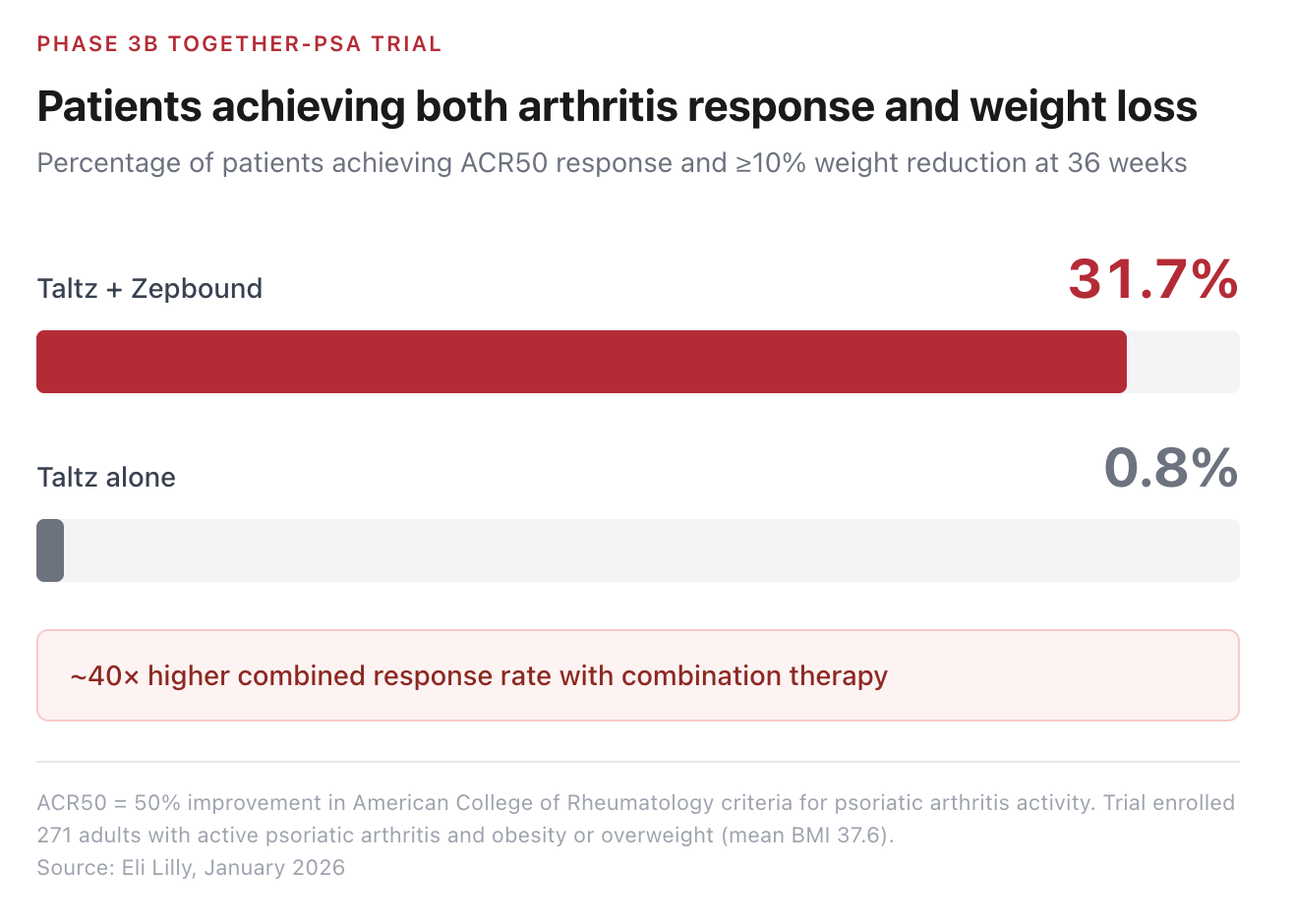
In the 36-week trial, 31.7% of patients receiving Taltz plus Zepbound achieved both a 50% improvement in psoriatic arthritis activity (ACR50) and at least 10% weight reduction, compared to 0.8% on Taltz monotherapy. Looking at arthritis response alone, 33.5% of patients on the combination achieved ACR50 versus 20.4% on Taltz alone. The study enrolled 271 adults with active psoriatic arthritis and a mean BMI of 37.6; more than 60% had previously tried one or more advanced therapies
The results come as GLP-1 drugs continue to show effects beyond weight loss. Lilly’s tirzepatide, marketed as Zepbound for obesity and Mounjaro for diabetes, has demonstrated benefits in obstructive sleep apnea (OSA) and heart failure. The FDA approved Zepbound in December 2024 for adults with moderate-to-severe OSA and obesity. For heart failure, however, while Phase 3 SUMMIT trial data showed significant benefits, Lilly withdrew its U.S. application for heart failure with preserved ejection fraction (HFpEF) in May 2025 after the FDA requested an additional confirmatory clinical trial.
The TOGETHER-PsA data adds inflammatory disease to that expanding list, and positions Lilly to potentially capture a patient population that spans both its immunology and cardiometabolic franchises.
Novo Nordisk has also expanded indications for its blockbuster semaglutide beyond diabetes and weight loss. The FDA approved Ozempic in January 2025 to reduce kidney disease progression and cardiovascular death in adults with type 2 diabetes and chronic kidney disease, and granted accelerated approval in August for treatment of MASH, a serious liver condition. But the drug class has limits. In November, Novo Nordisk reported that the pill version of semaglutide failed to slow Alzheimer’s progression in two Phase 3 trials, as Scientific American reported. The EVOKE trials enrolled nearly 4,000 patients, the largest, longest GLP-1 trials ever conducted in a neurodegenerative disease, Science noted, and showed no cognitive benefit despite improvements in some biomarkers. Novo Nordisk has ended its Alzheimer’s semaglutide program.
Filed Under: clinical trials, Drug Discovery, Metabolic disease/endicrinology, Rheumatology