
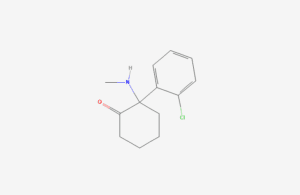
[Image courtesy of PubChem]
A single ketamine infusion can cost $400 or more in the U.S. Ketamine can also cause significant transient increases in blood pressure.
Furthermore, higher doses of the drug can lead to pronounced states of disassociation, which can induce anxiety in some individuals. Doctors generally recommend that patients receiving ketamine avoid driving or operating machinery for some time following a treatment session.
Whether ketamine’s dissociative side effects are necessary for its antidepressant effects remains unclear.
Dissociating from dissociative side effects
“The dissociative side effects have had a negative impact on the uptake of this [ketamine-based] treatment approach,” said Dr. Hans Eriksson, chief clinical development officer at HMNC Brain Health.

Dr. Hans Eriksson [Image courtesy of HMNC Brain Health]
“Our thinking here is to question whether it is possible to disentangle the dissociative side effects from the antidepressant properties,” Eriksson said.
Working with partner Develco Pharma, HMNC dosed the first patient in a second Phase 2 TRD study testing the use of KET01 in TRD patients. The study will enroll 117 TRD patients at roughly 38 clinical sites.
Eriksson suspects there may be some potential therapeutic benefit in the “trip” resulting from classic psychedelics such as LSD or psilocybin. “When it comes to ketamine, I’m less convinced, partially because of what we already now have seen in our development programs,” Eriksson said.
In IV-based ketamine infusions, the volume of the drug quickly peaks in the bloodstream and then drops rapidly, as ketamine has a short half-life. “We are working with an oral prolonged-release formulation that peaks at about six or seven hours,” Eriksson said.
HMNC believes the gradual buildup of the ketamine concentration is associated with better durability than if a bolus dose of the drug were administered intravenously. “If you take ketamine orally, you have a large first-pass effect in the liver,” Eriksson said. “The liver is quite good at metabolizing ketamine to downstream metabolites that are also active, but the quite dissociative ketamine gets quickly metabolized.”
When it is broken down in the body, ketamine produces various metabolites, including (2R,6R)-hydroxynorketamine. One study found that the molecule appeared to have antidepressant effects in animals.
Initial data are promising on ketamine for depression
Eriksson acknowledged that minimizing dissociation could theoretically translate to less of an antidepressant effect. “The proof, of course, will be in the pudding,” he said.
Early data from a Phase 2 proof-of-concept investigator-led study indicate that KET01 may fare well compared to traditional antidepressants.
HMNC previously initiated a study involving TRD patients with its formulation at the University of Zurich, Switzerland and two other smaller satellite sites. While planning to include about 200 patients in the study, COVID-19 hit, negatively affecting recruitment. The company later decided to terminate the study. “The study was underpowered — only a third of the original sample size,” Eriksson said. “But the study still gave us quite important information.”
The study divided participants into three arms. Two arms received either 60 mg or 120 mg of twice-daily ketamine, while the remaining group received a placebo.
The highest dose of 120 milligrams twice daily separated from the placebo arm after two weeks of treatment. “The magnitude of the effect was five points on the Montgomery–Åsberg Depression Rating Scale (MADRS),” Eriksson said. “To most clinicians, that’s a reasonably good clinical effect.”
While the data from the study are limited, Eriksson believes that KET01 could compare favorably to other antidepressants. “As you might guess, we didn’t reach statistical significance in this small study,” he noted. “It’s not conclusive evidence, but there is a strong trend in favor of antidepressant efficacy.”
Data were clearer that KET01 has minimal dissociative effects. Using the Clinician-Administered Dissociative States Scale (CADSS) of the 15-day treatment period, the study found that KET01 recipients overall had a mean dissociation score similar to that of placebo. “The scores between placebo and active treatment were almost identical,” Eriksson said. “There were virtually no reports of dissociation and no signs of blood pressure increase.”
Recipients who received 160 mg per day split into two 80-mg doses had lower CADSS scores than placebo recipients. “We’re talking about small sample sizes, but importantly, we did not see any excess dissociation beyond placebo,” Eriksson noted.
Next steps in exploring ketamine for depression
HMNC and Develco Pharma are now running a larger Phase 2 trial in Germany, the Czech Republic and Poland. Focused on treatment-resistant depression, the study will investigate using KET01 as adjunctive therapy with ongoing antidepressant treatment over three weeks.
While therapeutic ketamine use for depression is usually confined to inpatient settings, the Phase 2 study is an outpatient study. “Only the first dose is given under the supervision of the investigator at the site,” Eriksson said. “The remaining doses are taken at home.”
Eriksson is optimistic that KET01 could offer an effective therapy with minimal side effects. “There is probably a need for a more active initial induction phase where you give the medicine more frequently,” Eriksson said. After roughly a week, KET01 recipients might switch to taking a tablet weekly for six months. “We are talking about a total of 30–35 tablets. So we are aiming for a relatively small overall exposure.”
HMNC is aware that ketamine is a scheduled compound with some potential for abuse. “We believe our formulation doesn’t give a dissociative high when you take it as prescribed,” Eriksson said. “But we plan to undertake an abuse liability study to understand the propensity for abuse.”
The company also plans on exploring technical methods to reduce the abuse potential of KET01. “We are really taking these issues seriously and do as much proactively as we can both to understand the potential for abuse and also to try to implement methods that will decrease the potential for abuse,” Eriksson concluded.
Filed Under: Psychiatric/psychotropic drugs





Tell Us What You Think!
You must be logged in to post a comment.