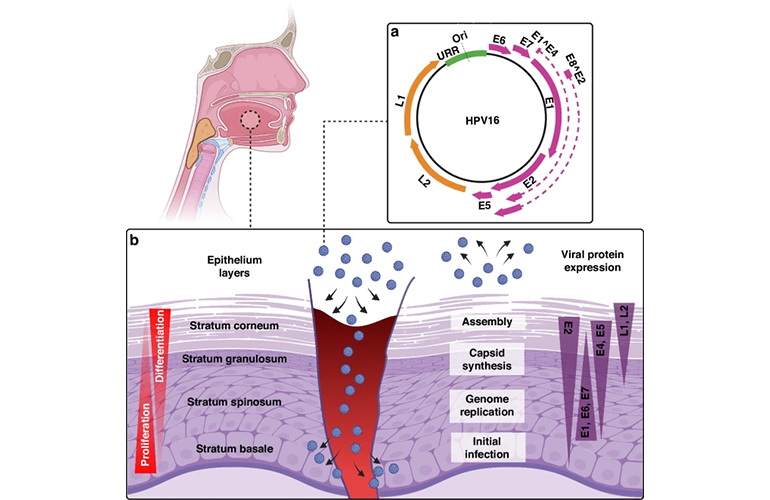
Inside HPV16: the viral blueprint and the path it takes through a host cell. Credit: Hossein Tabatabaeian, via Wikimedia Commons, from British Journal of Cancer (2024), CC BY 4.0.
A nasal HPV vaccine has been shown to shrink cervical cancer tumors in mice, researchers reported in Science Translational Medicine last month. The vaccine targets HPV16 E7, a protein made by the human papillomavirus (HPV) that targets a tumor suppressor and causes uncontrolled cell growth. Unlike most vaccines, which are preventative, this medicine could be a treatment for HPV patients who have precancerous lesions growing in their cervix.
Approximately 660,000 new cases of cervical cancer are diagnosed worldwide per year, with roughly 95% caused by HPV, according to the WHO. While HPV vaccines prevent over 90% of cancers caused by HPV, they can’t treat the existing disease.
Treatments for HPV in the cervix include a loop electrosurgical excision procedure (LEEP), during which a wire loop is used to remove abnormal cells; cryosurgery, which freezes the cells; or laser surgical removal.
Patients who develop cervical cancer, which is often caused by HPV, must rely on treatments such as surgery, radiation and chemotherapy. Therapeutic vaccines, which direct the immune system to attack cancer cells, offer a potential new treatment. Many groups are working on therapeutic vaccines for HPV, most as an injected shot.
Rika Nakahashi-Ouchida’s team at Chiba University in Japan developed an HPV therapeutic vaccine in the form of a nanogel that can be administered as a nasal spray. The gel carries a harmless version of the HPV16 E7 protein, which triggers an immune response.
In mice with cervical tumors, the vaccine prompted an immune response to the tumor tissue in the cervix, and the tumors shrank. In other experiments in macaque monkeys, the treatment caused the cancer protein-targeting immune cells to travel to the cervical tissue.
The results are promising, but there is still work to be done. For example, applying this approach to a similar treatment for other HPV strains. The paper concludes that, “this nasal therapeutic vaccine effectively controlled cervical cancer and will contribute to preclinical evidence for clinical testing in the near future.”
Filed Under: Oncology