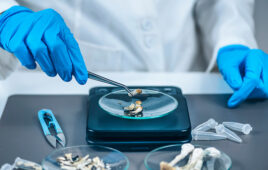
Researchers at the University of São Paulo’s Ribeirão Preto School of Pharmaceutical Sciences (FCFRP-USP) in Brazil have found a molecule in the venom of Brotheas amazonicus, a species of scorpion native to the Amazon, which appears to attack breast cancer cells in a way similar to a widely used chemotherapy medication. Their findings were presented during FAPESP Week France.
The researchers found a molecule called BamazScplp1 in the venom of the scorpion that appears to have anti-tumor potential. Tests showed that the peptide’s effect on breast cancer cells was comparable to that of paclitaxel, a common chemotherapy treatment. The molecule triggers necrosis, an uncontrolled form of cell death.
Finding medicines through bioprospecting
“Through bioprospecting, we were able to identify a molecule in the species of this Amazonian scorpion that is similar to that found in the venoms of other scorpions, and acts against breast cancer cells,” said Eliane Candiani Arantes, a professor at FCFRP-USP and the coordinator of the project. Bioprospecting is the evaluation of natural compounds for their potential as therapeutic agents.
It isn’t a new practice. The U.S. National Cancer Institute (NCI) screened over 35,000 plants and animals for anticancer compounds between 1956 and 1976, according to Padma Nambisan in her book An Introduction to Ethical, Safety and Intellectual Property Rights Issues in Biotechnology.
Bioprospecting is the foundation of many drugs used today. According to an article by David J. Newman, “in the area of cancer, over the time frame from 1946 to 1980, of the 75 small molecules [approved], 40, or 53.3%, are natural or naturally derived.” He also reported that 33.5% of the small molecules approved from 1981 to 2019 were natural.
Compounds from rattlesnake and yeast to make sealant
The Center for the Study of Venoms and Venomous Animals (CEVAP) at São Paulo State University (UNESP) has long been studying the potential of venoms for various uses, including pharmacological. One of its projects produced a patented fibrin sealant made from snake venom enzymes and fibrinogen from buffalo, cattle or sheep. The sealant forms a fibrin structure similar to the body’s natural clotting and tissue repair mechanisms and has been investigated for use in nerve repair, bone healing and restoring movement. It is currently in Phase 3 trials.
Recently, researchers cloned and expressed another rattlesnake serine protease known as colinein-1. Now, they aim to produce the protease through heterologous expression – in a gene from an organism that doesn’t have it naturally – in a species of yeast called Pichia pastoris.
With the same yeast, the team also plans to produce a growth factor called CdtVEGF, originally found in a species of snake native to South America, Crotalus durissus terrificus.
“This growth factor favors the formation of new vessels. If we combine it with colinein-1, we can create an improved fibrin sealant compared to the one being developed at CEVAP, with the possibility of expanding the industrial scale, since it can be obtained through heterologous expression,” Arantes said.
Filed Under: Oncology