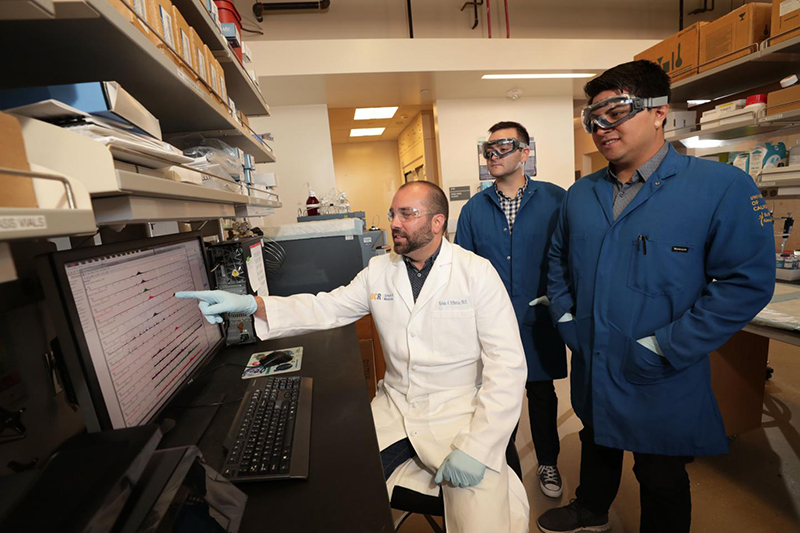
From L to R: Nicholas DiPatrizio, Pedro Perez, and Donovan Argueta. Credit: UCR/Stan Lim.
Signals between our gut and brain control how and when we eat food. But how the molecular mechanisms involved in this signaling are affected when we eat a high-energy diet and how they contribute to obesity are not well understood.
Using a mouse model, a research team led by a biomedical scientist at the University of California, Riverside, has found that overactive endocannabinoid signaling in the gut drives overeating in diet-induced obesity by blocking gut-brain satiation signaling.
Endocannabinoids are cannabis-like molecules made naturally by the body to regulate several processes: immune, behavioral, and neuronal. As with cannabis, endocannabinoids can enhance feeding behavior.
The researchers detected high activity of endocannabinoids at cannabinoid CB1 receptors in the gut of mice that were fed a high-fat and sugar—or Western—diet for 60 days. This overactivity, they found, prevented the food-induced secretion of the satiation peptide cholecystokinin, a short chain of amino acids whose function is to inhibit eating. This resulted in the mice overeating. Cannabinoid CB1 receptors and cholecystokinin are present in all mammals, including humans.
Study results appear in the journal Frontiers in Physiology, an open-access journal.
“If drugs could be developed to target these cannabinoid receptors so that the release of satiation peptides is not inhibited during excessive eating, we would be a step closer to addressing the prevalence of obesity that affects millions of people in the country and around the world,” said Nicholas V. DiPatrizio, an assistant professor of biomedical sciences in the UCR School of Medicine who led the research team.
DiPatrizio explained that previous research by his group on a rat model showed that oral exposure to dietary fats stimulates production of the body’s endocannabinoids in the gut, which is critical for the further intake of high-fat foods. Other researchers, he said, have found that levels of endocannabinoids in humans increased in blood just prior to and after eating a palatable high-energy food, and are elevated in obese humans.
“Research in humans has shown that eating associated with a palatable diet led to an increase in endocannabinoids—but whether or not endocannabinoids control the release of satiation peptides is yet to be determined,” said Donovan A. Argueta, a doctoral student in DiPatrizio’s lab and the first author of the research paper.
Previous attempts at targeting the cannabinoid CB1 receptors with drugs such as Rimonabant—a CB1 receptor blocker—failed due to psychiatric side effects. However, the DiPatrizio lab’s current study suggests it is possible to target only the cannabinoid receptors in the gut for therapeutic benefits in obesity, greatly reducing the negative side effects.
The research team plans to work on getting a deeper understanding of how CB1 receptor activity is linked to cholecystokinin.
“We would also like to get a better understanding of how specific components of the Western diet—fat and sucrose—lead to the dysregulation of the endocannabinoid system and gut-brain signaling,” DiPatrizio said. “We also plan to study how endocannabinoids control the release of other molecules in the intestine that influence metabolism.”
Filed Under: Drug Discovery